Hacker News new | ask | show | jobs
by jerojero 43 days ago
I think if I wanted a cheap laptop I'd probably get the macbook neo, and if i wanted a non-gaming expensive one i'd get a macbook pro.

I really don't see the market fit for this, I guess the android integration. But my god, I'd die of cringe if someone asked me about my laptop and I had to say "googlebook". Believe it or not, these things matter a lot, particularly if you're trying to target a young audience.

25 comments

Chromebook users.

I loved my Pixelbook, fantastic piece of hardware. When that ended, I went with an Acer Chromebook. Works fine, just not the same.

I would go for a Mac Air or Neo, but only if I could install ChromeOS.

I will most likely get a Googlebook, and would be more likely to do so if it was not named Googlebook and did not have Gemini built in.

> I would go for a Mac Air or Neo, but only if I could install ChromeOS.

To each their own, but this is absolute insanity.

I used DOS,then Windows, then Mac for a total of almost 40 years. I think using Windows and OSX are insanity, but to each their own.

I now have a machine that boots almost instantly and just works without maintenance, upgrades, or compatibility issues. I can throw it in the river, and for $300 get a machine that will be up and running in about one minute. I can use multiple machines (small/cheap to bring on a trip, laptop for casual working, larger machine for more serious work, even at the same time. I have full access to everything from my iPhone, or access to some computer anywhere. I use remote VSCode via Crostini to do development work (terminal, vi, Codex, Claude Code) on a bunch of beelink boxes and Hetzner servers.

I cannot run installed software and I am dependent on Google for email, files, photos. For the latter, I have backups of my email and files (photos are not as easy).

Life is simpler this way.

Do you not want to be able to develop while being offline?
No reason that you can't. ChromeOS has supported Linux containers for over a decade.
also - I do not like developing on my personal machine. I got into this habit a long time ago - I would always use a remote Linux box, and now with LLM's I ride them bareback (or maybe they ride me). If I trash a machine (which has not happened yet), I just rebuild it or find another box.
I am retired, and don't need to - I have a couple of beelink's (just need my home wireless running) and a couple of VPS if I really want to do things away from home, which I don't

I cannot remember the last time I wanted internet access but could not find it. Cell coverage is pretty good and reliable these days.

You totally can, I got Linux+VSCode+Docker running on my new Chromebook in less than 15 minutes, without doing any funny stuff.

But for optimal DX it can still be preferable to VSCode tunnel into your big powerful dev box that has everything configured just right.

With AI dependence, unless you are a holdout, offline development isn't really a thing anymore. Perhaps to do some code reviews, but actually producing new code?
That is sad.
Nothing changed. You can still code the old way. All those 100x productivity gains are probably closer to 10% productivity gains after you account for all the added debugging and steering.
I feel like we are of a similar age. This is great advice. My small company is growing and i'm thinking this is the path so I don't need an IT helpdesk.

Do you still use vi or were you meaning vi(*) and actually use something else? I've been on vim for a while but happy to go back to vi

actually both. vim for "real" work, but also vi when I am moving though different machines that have minimal tooling (production or production support machines, which may not have vim installed). I have been retired for some time, so I am programming for fun, and have recently gotten into it a lot more with Codex/Claude. Before I retired I also used more visual editors with debuggers since we were on Macs in addition to vi/m. I have found that I don't need those fancy editors with the LLM's as I am just editing markup/config files and browsing code.

While I think Chromebooks are great, I would consider that if your company grows, not everyone is comfortable with vi/m, and a Mac does give you some nice options for higher end dev systems.

I'd love to read more about your setup. I'm doing about half of what you have.
It is very simple:

I have multiple Chromebooks and an extra monitor, and use Google for files, email, photos. I can grab my cheap Chromebook and throw it into my backpack, don't bother with a case. I have learned to live without using installed apps.

I have a couple of beelink boxes at home that I stash in the corner of a room, connected to my home wireless. I use Crostini to remote into these boxes to do any development. I treat these boxes the same way I treat my Chromebook - disposable. I have scripts that will reconstitute my dev environment from GitHub and my backups.

If I trash a chromebook, I grab or buy a new one. I can do pretty much anything (except dev work) from my phone if needed. If I trash a dev server, I use another one. I also have some virtual machines at Hetzner. I keep my backups there, as well as any apps I want public.

My only concern is my Google dependence. That is the trade-off for being 100% cloud based and treating my devices as disposable.

you can do the same with mac os and also have a great user experience; perhaps not the cheap replacement but doesn't feel right optimizing for replacement given that my devices last around 5 years anyway
You can use Google services on a Macbook and have installed apps.
Not for $300, you don't.

I take more risks with my Chromebooks than I do with a MacBook, such as mountain-biking with it or leaning it in a car when visiting sketchy neighborhoods. Chromebooks offer a good-enough on-the-go, full-Unix experience, with an all-day battery. Sure, M-series Macs have higher performance and >20h batteries, but those nice-to-haves re well in excess of what most users need, most of the time.

I think Google is alluding to the fact that they'll continue Chromebooks but they aren't promising anything right now, or even clarifying much outside of the specific reveals.

They've won the netbook market and they'll have existing contracts and education market to always account for. With messaging that the ChromeOS experience will change and may have some things removed to refocus it I think the assumption is that it continues within it's specific use currently.

I don't get how life is simpler.

We are way out of context window, occupied by OS chores.

Life was simpler when we were dumber, but now, no. Stop lying.

ChromeOS is a very competent, fast, and easy-to-use operating system. For my family, it's basically perfect. It's virtually unbreakable and anyone can pick it up quickly.

Windows is a hot mess and frankly I wouldn't recommend it to anyone outside of gamers. For the technically competent, there's nothing to gain on Windows, and it will just get in the way. For the those less technically inclined, Windows means complexity and viruses. Also most Windows laptops suck major ass.

MacOS is better, especially if you have an iPhone. But even MacOS is a bit too complex for the less technically inclined. If you have an android phone, then a chromebook is 100% the way to go for those people. Also, chromebooks get crazy software support these days, on par with macbooks.

> ChromeOS is a very competent, fast, and easy-to-use operating system.

It also locks you into the cloud services of an advertising company that loves harvesting your data to help find new ways to sell you things.

I see this too often. But, realistically users do not care about the harvesting as it is unseen and behind the scenes. Most people just want get stuff done in a competent, fast and easy-to-use operating system.

>It also locks you into the cloud services of an advertising company

this is pretty much any company these days. microsoft is guilty of the same.

Users absolutely care, what a terrible comment. Users have ZERO choice. Tech companies are not regulated, tech companies abuse their monopolies at their users detriment, and tech companies do not have consumer councils to help mitigate these issues.

What it actually appears to be is we have a market where undemocratic business leaders are deciding the direction of technology in a country that only seems to benefit them and not the population.

What a terrible mindset to have and I sincerely hope you never have any capacity to yield power in your life.

Until your google account gets locked for some unknown reason and you there is 0 support and recourse. And now you can't even log into your own computer.
>But, realistically users do not care about the harvesting as it is unseen and behind the scenes.

Like them I think I am also surprised not because that isn't the case, but because it's wild to see that take on HN, which skews way more towards privacy/owning your compute.

They don’t care because they don’t understand, or don’t want to. It’s a scary thing to confront the fact that you are psychologically and demographically profiled so that people can manipulate you to extract as much of your money and attention as possible.
So is Apple. Went to the Apple store recently. To buy something they told me scan a QR code. The code popped up

"Get Start and Personalize Your Apple Store Visit" and a big button "Share Now"

Under the button in small text was a link to "customize" which said they were going to harvest your contact info, your carrier account, your phone model and applecare info, the list of all devices you own, the list of all your subscriptions, your purchase history, your reservation history.

They said all of it was for ads (to make more customized recommendations)

So much for "Apple = Privacy"

> I see this too often. But, realistically users do not care about the harvesting as it is unseen and behind the scenes.

And when it's brought up where people do know, there's always these attempts at gatekeeping by speaking for the average user like a priest would speak for God.

The person who asked that cares, and didn't ask "the average, realistic user", because you can't ask an abstract concept questions.

So does Windows. macOS locks you into a company that hoovers up your data but pinky promises not to sell it and will fight tooth and nail to have prevent others from doing the exact same thing on their operating system.

If you care about privacy, Linux and BSDs are the only options, but actually good out-of-the-box Linux laptops are few and far between.

Except for Chromebooks, of course.

Big difference is that you can use macOS without a user account. Can't do that with Windows without some hidden terminal magic.
There’s a pretty big difference as Apple can’t access the data stored in iDrive. Only you can locally.

Big difference from google and microsoft where everything you type and do is being tracked and fed into ads.

That’s no better than Windows (without a lot of effort and a constant game of cat and mouse only achievable by technical users). At least Google’s cloud services tend to actually be good, if you made peace with the tracking and privacy concerns.
Apparently you can create a local account on a chrome device [1], although I can't vouch for the process; otherwise cloud auth is tied to Google, yes. You could use a guest account for everything, if your really want; but then you lose out on persistence.

But as long as you accept that everything you do is in a browser; which is reality for the vast majority of computer users, there's no real lock-in. You can just as easily use the browser version of Microsoft Office as the browser version of Google Docs.

You're certainly locked into Google for the browser and for updates, unless you do a lot of work. But it's been a while since it was common to get commercial OS updates from a 3rd party.

[1] https://www.xda-developers.com/how-use-chromebook-without-go...

Yes, this is true, and I myself am degoogled. Mostly, except YouTube, but I am off Gmail and stuff these days.

But, we need to pick our battles. For most people the reality is they have a Google account anyway, and they will log into and sync on any device. So, it makes no difference.

Does it matter?

Your friend using Android or iOS may have typed your exact address, phone, signal id, gps, etc on her Google/apple account. And now?

If you fly to use you are giving more info.

Are you running your own bank? Pepper are you? What happens when you join job (tons of papers?)

wild that we're talking about which OS locks you up more w.r.t an apple product.
Counterpoint. I use Windows and MacOS daily and they are both awful (and occasionally wonderful) for different reasons. Windows on a laptop sucks simply because I can't close the lid and put it in my bag without it catching fire, but apart from that I don't care too much either way.

I use Linux CLI all the time but every time I've tried to use a Linux desktop as a daily driver, it's stopped working one day for reasons that are beyond my ability to care enough to figure out.

I used to think so too, but when my extremely-non-techy mother's Chromebook died, she was able to switch from chrome OS to Ubuntu with minimal fuss. Chrome OS has some specific features, but if you just need a web browser Ubuntu works fine.
You say this only because she hasn’t been ransomwared yet, which is impossible on ChromeOS.
It's also very rare on Linux. On Linux, 99% of software comes from trusted repositories. The odds of randomware existing in the Ubuntu repos is low.

It's not the wild wild West like Windows. There are structural reasons why Linux desktops are less susceptible to malware, as well as the obvious marketshare issue.

It's also a non-issue if you use Ubuntu like chrome OS. She doesn't have any data stored locally.

More generally, this feels roughly equivalent to saying "it's better to live in a tent than a house, because a house will crush you when an earthquake happens."

I support a lot of old folk on laptops that are less technically inclined. All they want is Windows because familiarity, despite Microsoft making things unfamiliar every release.
MacOS is too complex? What web site even is this?
Sorry, I mean for some users who can barely use computers as it is, so mostly the elderly. For us obviously it's not too complex. But for some, it is, and it's also largely overkill because some groups don't want to run software anyway. They just need a file browser and web browser.
It's the only OS for my 93 year old mother. I can manage it remotely, too, and she can't mess it up.
My mother (80+) runs Fedora, and I believe she is incapable of messing it up, even if she did have the root password. Doubleclicking random exe files off the internet is almost uniquely a Windows problem. I dunno about Macs - its users are usually technically illiterate, but Apple has done a pretty good job of locking users out of their own machines.
> Doubleclicking random exe files off the internet is almost uniquely a Windows problem.

Tell that to my partner's grandfather, who managed to find and install malware chrome extensions on his chromebox.

Gosh I can’t believe how lucky I am. I’m not technically illiterate and I haven’t been locked out of my machine.
I work for organizations that spend thousands per year on MDM to turn macOS running on Macbook Airs into effectively ChromeOS.

For certain use cases, a computer that can do nothing whatsoever except run the absolute latest version of production Chrome is better than any other device.

Please refrain from making claims like "absolute insanity" without backing it with some sort of commentary on the claim. It really isn't worthy of HN.

see guidelines https://news.ycombinator.com/newsguidelines.html

A computer filled with great hardware that gets its hands held behind its back by shit software sounds like the soup de jeure for apple.
The HP Dragonfly Chromebook is pretty good. The Asus models are also very nice. The Acers are hit or miss; quality is iffy on those and there's a zillion models so it's impossible to find a specific one.

I wish Framework would keep supporting ChromeOS but alas. You could put ChromeOS Flex on one - it doesn't have Android apps, which is fine for me, and it does support the Linux environment, which is excellent.

Why would you want ChromeOS and not Linux?
With ChromeOS you get both.

I have used Linux for 20 years, but only for development, and I will only develop on Linux.

For everything else (email, files, photos), I want a browser. Used to be Mac/Osx, but got tired of being managed by it.

Just my preference. You can do everything on Linux, just never felt comfortable with it.

Sure, but I'd never want that browser to be Chrome. Extensions, especially ad blocking ones, are important.
I agree I would rather have something other than chrome, but I need to trade that off with my desire for the benefits of a simpler system.

If Apple came out with a SafariBook equivalent, I would consider it. Might even do both if I could auto sync between them.

The Neo is the closest and the good thing is it has an actual OS to install apps onto. I'm not sure if via the Linux containers Firefox can be installed on ChromeOS.
You want a browser for files?
b/c you don't have to think about the operating system and updates. I posted about my experience here: https://news.ycombinator.com/item?id=48051902

...basically, I have "nerd cred" and run linux on my desktop, but for my laptop I wanted: disposable (no leaky hard drive), zero maintenance (no kernel modules for sound drivers), battery-portable.

90% of the time I'm wanting `vim` + `git` + `ssh`, and 20% of the time i'm wanting to run some random stuff locally. Chromebook is basically zero friction and 1/10th the price (and 1/10th the capabilities) of a "very nice mac laptop", plus you can pop into a very capable linux VM (w/ passthrough GUI support) without a lot of ceremony.

Windows laptops are out of the question, and pure linux laptops (until only very recently) were of marginal support and low battery capabilities (especially "close it and stuff it in a backpack for 3 days").

> Windows laptops are out of the question, and pure linux laptops (until only very recently) were of marginal support and low battery capabilities (especially "close it and stuff it in a backpack for 3 days").

Dell has sold laptops with first-party Linux support for nearly fifteen years, to say nothing of other smaller OEMS.

As for the battery issues during sleep: that actually has to do with a combination of the BIOS settings + downstream ramifications of secure boot (and how the old-fashioned "hibernate" used to work). Unfortunately, that isn't specific to Linux. My MBP has the same problem, and so do the same laptops running Windows.

> (no kernel modules for sound drivers)

What century did you write this in?

https://github.com/pop-os/pop/issues/3961

"""last week: Pop!_OS 22.04: kernel 6.17.9-76061709 — module BTF validation cascade boots system to emergency mode #3961

Thanks for taking a look,

Quick update — I'd already recovered before seeing this comment. The path that worked: boot Pop_OS-oldkern, run sudo apt install --reinstall linux-image-6.17.9-76061709-generic linux-modules-6.17.9-76061709-generic && sudo kernelstub, reboot. 6.17.9 came up clean. The reinstall's postinst hooks ran update-initramfs automatically; /boot/initrd.img-6.17.{4,9}-* are both freshly dated 2026-05-06 (~11:44 / 11:46), and kernelstub copied them to the EFI partition. Verified: journalctl -k -b 0 | grep -iE 'btf|failed to validate' | wc -l → 0. """

In the year 2026, on my Linux laptop (T14, Linux 6.18.26) I ran the following:

  lsmod | cut -f 1 -d ' ' | grep snd | wc -l
And it responded: 53. Fifty three kernel modules are dedicated to sound. I, of course, never had to install any of them by hand, or take any other direct care.
Those modules are all in tree. The distro chose to build them as modules. You could have built them into the kernel. I don't think that counts. When I hear about manually futzing with "kernel modules for sound card" I think you're running out of tree modules in 1997.
ChromeOS is linux. It's a Linux distro that works correctly out of the box, setting it apart quite strongly from all other Linux distros.
Then why do people install Linux in Chrome books?
Chromebooks make a pretty nice, Linux friendly machine. They're usually cost optimized given the market they address, but that's fine if it fits your needs. Sometimes they have "weird" hardware, keyboard/mouse controllers and stuff at least wasn't always "pc standard", audio controllers seem to be commonly outside mainstream as well.

It's nice to run Linux on a machine that was built to run Linux. No silly windows key, no fighting with firmware that was built for windows first. I have a Chromebox that was a great mini desktop and the pricing was nice. My first Chromebook ran FreeBSD pretty well once it was no longer needed for ChromeOS, etc.

You have to shop carefully, you want something that's easy to put a MrChromebox firmware on and doesn't have any known issues with the OS you want to run. It's been a while since I purchased a ChromeOS device and the current state is different than it was then; I'm not sure how easy it is to find reasonable options now, but there were plenty of good options in the past. You also want to be sure that it has enough ram and storage for you needs or that those are expandable, but I think soldering ram and storage is pretty common across the range.

The number of people who have "installed linux" other than ChromeOS on a Chromebook is probably in the low single digits, while the ChromeOS installed user base is in the hundreds of millions. For any given thing someone is going to try to put linux on that thing, but it is not a common use case for Chromebooks that we need to discuss.
I was genuinely asking. In “my circles” a Chromebook is a cheap laptop that one can install Linux on. As in, “oh, I just picked up this used Lenovo Chromebook and installed Ubuntu on it”.
FWIW I'm one of those people. I have an old rotting pixelbook that I installed Linux on back-in-the-day thanks to Mr. Chromebox. It was a huge improvement over chromeos but I'd never buy a chromebook to install Linux on it again because there was too many small annoyances like needing to fix the keymap every time I did a clean install (the caps lock key was bound to super and I vaguely recall some craziness around the higher function keys), and sound didn't work.
Crostini is kind of a joke, but I use it to remote into real Linux boxes. For me, best of both worlds.
"Works" is kind of generous. Try connecting a printer for example.
Having very recently (and unsuccessfully) tried to connect a printer to "real" Linux, that's not really a relevant point against ChromeOS.

In the end, after hours of frustration, my solution was to print the document from my (amusingly, Google Pixel Android) phone.

This is actually the perfect detail to discuss. ChromeOS printing is literally just CUPS, so it has the same functionality as any other Linux distro. If you have a modern IPP printer on a normal home Wi-Fi, you can expect it to just work. This covers most people's needs.

Where ChromeOS shines is that it has never been affected by severe and numerous CUPS security vulnerabilities like CVEs 2024-47175 through 2024-47177, which were unauthenticated remote vulnerabilities, while Ubuntu and Fedora (and all other major distros) were affected. Why? ChromeOS sandboxes the hell out of these kinds of subsystems. CUPS runs in a PID namespace, network namespace, mount namespace, on a read-only filesystem, with seccomp filters. It cannot use the network, ever. It can only communicate over a pipe with a network proxy. The proxy is only active if and when a user tries to print. The proxy is also in a seccomp jail that prevents it from doing anything except enumerated network traffic and the pipe. The proxy is written in a safer language than CUPS itself, and protects CUPS from malformed, malicious inputs by validating both PPDs and print requests.

That sounds like some nice engineering.
We tried Chromebooks for our kids, and the instant I could buy Neos I did. It might just be that we're fully bought into the Apple ecosystem, but I had a hell of a time trying to get stuff like parental controls figured out on ChromeOS.
You don't need parental controls at all. Google will make sure they see exactly what they need to see...

/s

You can install ChromeOS on a Mac: https://chromeos.google/products/chromeos-flex/

It's a great stopgap OS for older hardware.

> I would go for a Mac Air or Neo, but only if I could install ChromeOS.

Similarly, but I would extend that to mac mini/studio, but I would like Linux on it. I like hardware, but I hate the OS there.

As a linux desktop user, I would buy it only if I can wipe ChromeOS out of it.
> I would go for a Mac Air or Neo, but only if I could install ChromeOS.

Is this satire?

I think it's a successor to the Chromebook. In the vast majority of modern K-12 public schools, the school district owns the hardware, not the students.
Everything on this page suggests it's not for education.

Emphasis on AI and connecting to your phone. How many Iceland trips do students make?

Well Chromebooks are primarily EDU products yet still marketed and sold direct to consumers.

Presumably school districts are just going to see different marketing.

Now that I look closer at the Googlebook, I think you are right.
The target is definitely not the K12 education market. It looks more like a premium device which most Chromebooks are not.
On second thought, I think it's not for K12 after all.
I recently heard from couple of Technology Directors at schools that they are looking to procure Macbook Neos replacing their Chromebooks. This might be a strategy to defend their Chromebook market in schools.
Why would an organization want to move from a centrally managed fleet to an unmanaged fleet?
You can still centrally manage Macs? Look at every tech company.
Yeah, but can schools do what even tech companies struggle with/cobble together here?
Macs are very popular in schools today for teachers and staff. Switching to Macbook Neos for students would actually simplify their support burden. I'm not sure they'd be cost justified though.

Source: My wife works IT for our school district.

What do you think schools do currently?
Pretty sure when they talked about "very high build quality" and such they're saying this is not a replacement to the cheap chromebooks (which I think the macbook neo is eating anyway) but a higher price point.
Yes, you are probably right.
I don't think these are Chromebook successors. This is supposed to be a premium line according to the "Android Show" video. But I suspect future Chromebooks will use this OS eventually.
Unless they're cheap, it's not going to sell well for K-12.

I used to work for an ed-tech company that was specifically focused on software for chromebooks and in talking with customers the biggest selling point of chromebooks for schools what their price. The school issued devices get absolutely beat to shit and they just expect a certain number to be decommissioned at the end of the year. Most schools are looking to buy the cheapest thing that does the job and the small group that have the money to actually buy premium devices are going to gravitate toward Apple products.

If Google is selling these for less then $500 then maybe there's a place for them, but like we saw it with the Pixelbook, there just isn't really demand for an $1000 chromebook

Is the value of the Chromebook in education that it is 1) cheap or 2) doesn't do anything except have a browser?

If it is both, then all the Neo needs to do is have a browser only mode and goodbye Chromebook market.

A Chromebook is far cheaper than a neo. It could be less then a third the price, and that makes a big difference when you're buying a thousand of them.
Gembook or Geminote would've been cooler. But no one asked me unfortunately.
Google MegaPixel!
Googlebook Pixel? Or PixelBook running GooglebookOS?
GooBook? Sounds obvious to me. Or just Bookgle. Lap Goog. aiPad. OogleNote. Infinite possibilities.
You might be surprised how good cloud gaming has gotten. I play AAA games at max settings on my MacBook Pro through GeForce Now, and with fiber internet it's nearly indistinguishable from native.
The problem with cloud gaming is that there's too many ways for it to go wrong and only one way for it to go right.

It's hard to explain to normal people that if you have a stable internet connection and live relatively near to a data center and you buy a dongle and a cat6 cable to avoid any Wi-Fi interference and you enjoy playing certain genres of games but not other genres of games, then you can get a good gaming experience.

You have to be a technical person to understand the failure modes and most people aren't technical, get frustrated, and just say that it sucks. Cloud gaming is not a mass market product.

I know people in general hated it, but I found Stadia to be quite good. I'm not too upset because Google paid me back full purchase price, but it's almost a shame that they managed to mess up cloud gaming that badly.
I don't know, I saw quite a few positive comments on Stadia, both as a service and the general approach. Most of the negativity was about it being a Google product and not wanting to get invested in a platform they would inevitably kill. Then of course there was the reaction when it was inevitably killed.
It seems pretty inconsistent. I tried GeForce Now on my gigabit internet and it was super laggy with a lot of audio glitching. Maybe I just didn't have a datacenter near by.
The main problem now is publishers have to opt their games in to be playable. Until that's solved cloud gaming is a non-starter for me given my current library.
You have my attention. I assume this would also work well on a worse laptop (since the processing is done in the cloud)?
Yes, it's just streaming a video to you. The main limit is your connection speed if you're not near a datacenter as you're limited by ping, so controls can be laggy. You can try it out for free though, which will give you an idea of how good your link is.
I use boosteroid, which is just steam on cloud. ~4k @ 120Hz for $12/month. No HDR though (they recently removed it). Such a stupid good deal compared to the price of a gaming PC, that I can't really complain. So many data centers with GPU sitting around...
Not just sitting around, available for rent at hourly rates that will add up to a lot more than $12/month if you actually use them! I'm surprised they can offer this service at $12/month with presumably unlimited usage.
I'm a happy Apple ecosystem user. However, there are many more Windows and Android users worldwide.

I think that the appeal of this product is that the Wintel monopoly of years ago is dying. If the Googlebook is well executed (as the Apple M1 line was), it can be an option for Android users who wish to move away from Windows but are not knowledgeable enough to use Linux. I think the only problem here is Google's track record of abandoning product ideas. A new product like this requires multiple iterations to get it right, but if Google abandons it as soon as the results are not what was expected, it will not have the time to mature in areas like gaming or app support.

Does this thing run Android? There don't seem to be any details in this post.
FYI: aluminium-os.com is an independent information platform. We are not officially connected with Google, Alphabet Inc., or any related organisations.
At this point, if you want a laptop, get a mac and be done with it.

Until other manufacturer step up their game, there will be years and years.

Apple was given a free run by Intel's fab issues. I'm hoping Panther Lake laptops together with Dell's CAMM2 will make Linux on amd64 highly competitive with Linux on the M-series, so maybe months and months - not years and years.
It's not just about the CPU and battery life. They sold MacBook well even when they where thermal throttling, had poor battery life and poor performance.

MacBook right now just combine everything, other laptop they might get a good CPU but the screen and the keyboard are trash, other you will have a great trackpad but that's all, nothing else.

I thought Microsoft had the market cornered on terrible product naming but "Googlebook" is extremely awful.

My suggestion, if they really want to go this route, is to shorten it to "gBook".

I am old enough to remember that iPad was supposed to be a product-line-dooming bad name.
Everyone was expecting "iSlate", which would have been far better according to popular opinion at the time.
I was expecting the Apple Palette
And just a few years before then... Wii.
The first thing that came to mind is "What about all that gobbledygook in your Google-dee-book?"
I'm imagining poultry running around clucking: "gBook! gBook! gBAWK!"
It's sad that the M5 Apple chips don't support Linux better. I'm in the market for a laptop, and I'd buy a MBP in a heartbeat if I could wipe it and put Debian on it.

My 2013 MBP was going strong with Debian until the battery started puffing up last year, and I finally had to recycle it.

I get it, I know I'm not their market, but it still pains me because it was a great laptop.

What is more sad is that no one in the Linux world has taken the bull by the horn like those three former Apple engineers who got a license from Arm to design Arm chips why hasn’t anyone taken the leap in the Linux world to make that happen for Linux OS? In short, that isn’t Apples job it’s been 35 years for someone in Linux land to step up to the plate.
I don't know what you're trying to say with "making that happen for Linux" and "that isn't Apple's job". I didn't imply anybody needed to do anything. The point I was making is that I like Apple's hardware but won't buy it if I have to run their garbage software.

When (if) somebody gets Linux working on them then I'll buy another MBP. In the meantime my money goes to Lenovo.

You're not the target audience. My parents, in-laws and the schools are the target audience.

A reasonably large chunk of the world use a computer for "googling" information and sending/receiving emails. For them, opening "the internet" means clicking the Google logo (Chrome).

This device could be perfect for them.

>but my god, I'd die of cringe if someone asked me about my laptop and I had to say "googlebook"

i'd hate for my computing choice to lack fashion forward qualities -- I wouldn't want to be embarrassed at Gate A-13 with my new Apple perched on my lap proudly while waiting for the next question from my adoring fans.

I hope they appreciate the new color!

real talk : my favorite excuse for using an Apple product throughout my life is the tried and true "my company stuck me with it and I hate this piece of shit.", so I find it kinda fascinating that they're such cult objects -- and to be fair I am sure i'd say exactly the same thing if I was ever stuck in a company stupid enough to try to make me be productive on a fancy chromebook, too.

> I think if I wanted a cheap laptop I'd probably get the macbook neo

I would recommend the same. I absolutely love my Neo. It's such a nice machine for the price.

MacBook neo is not expensive but it's not cheap.
Just the build quality on MacBooks compared to your random PC laptop piece of plastic that falls apart within a few years would make me very picky. I have a random “corporate” Lenovo and everything physical in it is way way worse than in my work MacBook
It's $600. In this market that's practically free.
Which machines on the market beats it at the price?
Google Pixelbook from years ago was $999 IIRC. I wouldn't be surprised if Googlebook is more expensive than Neo.
I wanted to like the Pixelbook, but it had a lot of limitations, ChromeOS being the major one. I recall that people were able to run Linux on them, but no idea what that experience was like.
Got a cheap Acer Win11 machine for like $500 last year. I don’t think they even know what the low-end market is like, it is all about getting the most RAM/storage while everything else is reasonable and cheap enough. In which it is really hard to make a profit there because the price is the most important thing
The Neo is amazing as an "AI thin client" the Googlebook seems to be trying to be.

> I'd die of cringe if someone asked me about my laptop and I had to say "googlebook"

A "GBook"? "Goog"? "Gook"? "Glook"? "Boogle"?

So, I'm not usually one to point these out but one of those words is considered pretty offensive by some and I am assuming that was not your intention.
The spelling maybe, but not if pronounced as "book"
Is this reply even real?
There's people who hate Apple and won't buy a Mac no matter what. They're a sustainable market segment to compete for. Google isn't competing with Apple for customers, but with Acer, Asus, HP, etc
>I really don't see the market fit for this,

Why pay $500-700 for Mac Book Neo for the same low processing power experience that you can get on a Googlebook for half the price? Especially considering you can install linux on it natively.

Other then that, Gemini is the biggest advantage. Google can offer Gemini for free because its TPUs are orders of magnitude more efficient than Nvidia stuff. Even free tier Gemini is really good considering it can integrate with a bunch of your stuff like google docs, and the lower last gen models have pretty generous usage limits.

Overall, if you are in Android ecosystem, you don't really even need a cheap laptop anymore, considering things like Samsung Dex exist.

> Why pay $500-700 for Mac Book Neo for the same low processing power experience that you can get on a Googlebook for half the price?

What makes you think a googlebook will be half the price of a macbook neo?

Also, a used M1 macbook air is $300 on swappa/ebay and will be even better than the neo anyway. It's still more performant than every other non-Apple ARM based laptop/chromebook on the market and will have far superior build quality.

Kompanio Ultra Chromebooks are faster and have a touch screen for use as a tablet or developing mobile-friendly apps. No point in a MacBook Air.
What the cost of these Kompanio Ultra 910 based chromebooks? like > $800?
$700 MSRP.
> Kompanio Ultra Chromebooks are faster

Lol. There is zero chance the low end mobile phone SoC shipped in those is remotely as fast as a six year old M1. Even flagship SoCs from qualcomm and samsung still do not exceed it's performance yet.

> Lol. There is zero chance the low end mobile phone SoC shipped in those is remotely as fast as a six year old M1.

Go look up some benchmarks, the Kompanio Ultra 910 is very comparable in speed to the Apple M1.

It's not really a "low end mobile phone SoC" - it's a Chromebook-specific chip with Cortex-X925 and Cortex-X4 cores.

Cortex-C1-based SoCs are faster but only available in phones to date, which gives them less thermal room.

Anecdotally, I own both an M1 and a Kompanio Ultra 910 device, and they feel subjectively very similar from a performance standpoint.

You're right. It's faster. It's an M2 class chip.
> Why pay $500-700 for Mac Book Neo for the same low processing power

I pre-ordered a Neo on a whim to use as a couch laptop alongside my work laptop and gaming computer. It's so fast. It blows everything out of the water when it comes to interactivity.

Plus the whole build quality, screen, touchpad and speakers are all so much better than the work Latitude. Linux support is lacking, but it's still a full usable Unix.

> Google can offer Gemini for free because its TPUs are orders of magnitude more efficient than Nvidia stuff. Even free tier Gemini is really good considering it can integrate with a bunch of your stuff like google docs, and the lower last gen models have pretty generous usage limits

Good point, that could work. Buy this and you get so many years of Gemini for free and such. "Why pay Anthropic $200/month for Claude when you can buy this and get Gemini for free for a few years". OpenAI and Anthropic are not going to make their own devices most likely either to compete.

Having seen how people managed to run Cyberpunk 2077 on the Neo with okayish frame rates I don't think there's a single ARM laptop out there that could deliver that performance on Linux. Maybe I'm wrong though.
Surface Pro 11 is slighly more than Neo and runs cyberpunk.
iirc getting Linux to work on Surfaces is messy though?
These things are $250?! Where did you find that info?
> I think if I wanted a cheap laptop I'd probably get the macbook neo

8GB of RAM for MacOS is a concern. ChromeOS is probably more RAM efficient..

> ChromeOS is probably more RAM efficient

Based on? Chrome tabs taking up gigs of RAM would make me think ChromeOS isn't going to be very light on memory.

You can control chrome tabs, e.g. autosuspend, close them, etc, you can't control MacOS RAM footprint.
Googlebook is cringe? It's just the name of the company, calm down.

They used to have something called the pixelbook, which is the most generic name you can possible have. Neither of these names are unarguably better than the other.

If this ends up being great for developing android apps, and running them on the desktop, plus having 15+ hour battery life, it could be interesting. Knowing google, it probably won't though.

Crossover has allowed me to 100% Spider-Man Remastered on a base M5 MacBook Pro. Gaming is not out of reach.
Why anyone would view a non-upgradeable phone slapped into a laptop case with minimal computing capability for the price would ever consider a Neo is beyond me. At that point, get a damn tablet. It’s literally the same thing but, like, designed with intent rather than a bunch of scrap pieces.

Seriously, what’s the draw? The 8 gigs of ram? The 200 gigs of storage? The major lack of ports?

Have you ever touched a Neo? It does not feel like scrap pieces. That is the magic.

A phone has great battery life and standby power management. What’s the problem with running a different OS on it if it works just fine?

Different stuff for different folks I guess. At work all files are on the cloud, I have a NAS and a computer I can remote into for development. A Neo is just perfect to make all of that mobile.

As for tablets, I’d only recommend one if you need a stylus for drawing or a smaller form factor. I think that is the market where the Neo is competing, that is where you have a point.

I have, yeah. It's an absolutely shit experience. Terrible materials, terrible internals, terrible experience. Have YOU touched one? They couldn't even be assed to make the logo shiny because it's such a departure from Apple quality lol. If you're going to astroturf for Apple, at least make it somewhat believable. Nobody would have these opinions if they weren't dented from birth or hired by Apple.

Neo definitely isn't competing in the professional art region. Absolutely nobody wants an underpowered laptop to make their art experience miserable. They'll either buy a purpose-built ipad or they'll get a wacom tablet. What a crazy strange opinion to have when you clearly do NOT do any art on computers!

Yes, I own one. I touch it every day :)

It has good build quality. It has been a great experience _for me_. Sorry, I don’t care if the logo is shiny or not.

I said I’d recommend a tablet for people that need a stylus, meaning to do art, I don’t think a Neo is good for that, but for other users, I stand on my opinion that the Neo can in many cases be a better deal than a tablet.

The only reasons people logically buy an apple are twofold: first, you know it’ll still work mostly fine in a decade. Second, it gets you further into the walled garden. That’s really only nice if you’ve got a computer that will last long enough that the garden isn’t painful. That’s the only reason they can command such a high price. This will be a piece of shit in 4 years TOPS, while commanding 80% of the price. And again, Apple has made them impossible to upgrade or repair, shortening the lifespan even further.

Bro stop with the copium

In local prices, a MacBook Neo is $800 for a 13" display, 8GB RAM, 256GB storage.

A 13" iPad Air with 8GB RAM, 256GB storage and a Magic Keyboard is $1648.

The iPad has a notably more capable CPU, for over double the price.

An Android tablet isn't a capable replacement for a MacBook/iPad. (And I don't know that you can get even get any 13" Android tablet with a reasonable keyboard case for a discount over a MacBook Neo.)

I kinda don't care about whatever stupid market you've got in your strange country. The ipad air is $500.
You get 90% of the MacBook experience for half the price. Most users only need this 90%.
You get 40% of the macbook experience for half the price buddy. Absolutely nobody buys macbooks thinking they'll be worthless in 3 years like they do with other laptops. This is Apple stepping down to a garbage tier, and ignoring the roots that made them popular.

lol, 90% for half the price. What insane cope.

What, you mean you don’t want to sound like a turkey when describing your computer to others?
supposedly macbook pro's M-series are quite adept for gamers these days.
They’re surprisingly powerful for all three games that are available on the platform.

Jokes aside, there are some games with competent Mac ports and if you only have an M-series Mac, you can find some titles that play nice. But most of the stuff that you’d play on a PlayStation or on Windows is simply not available.

But the gaming software market is very heavily biased towards delivering for Windows on Intel. That said, I’m not a gamer so what do I know?
Linux gaming is getting a definite boost from Windows 11 being a shitshow.

And pracically _nobody_ does native Linux games, they're all just running Windows games through Proton, and faster. So fast actually that Proton is Microsoft's performance target :D

I encounter a few native Linux games from time to time on Steam, mostly indies and other smaller games. There was a time there was a medium-sized push for this, Steam was pushing it, lots of Humble and GOG stuff came out with Linux versions...

But yeah, Proton is so good now that I don't think there's much impetus to port. Test on Deck/Steam Machine/Proton, sure, but not so much port. Steam Play also handles runtime container stuff for native Linux games so that can be pretty good and stable itself, but I've definitely had situations where switching over to the Windows version via Proton is a better result than the native Linux one.

The processing power is there but the actual game support is not, which is the more important part. There are some games that support it but at least 3/4th of my Steam library won't run on a macbook.

Even games which used to run on mac mostly stopped after 32bit support was killed.

I'd like to meet the person that supposed this to you, and ask them what games they play.
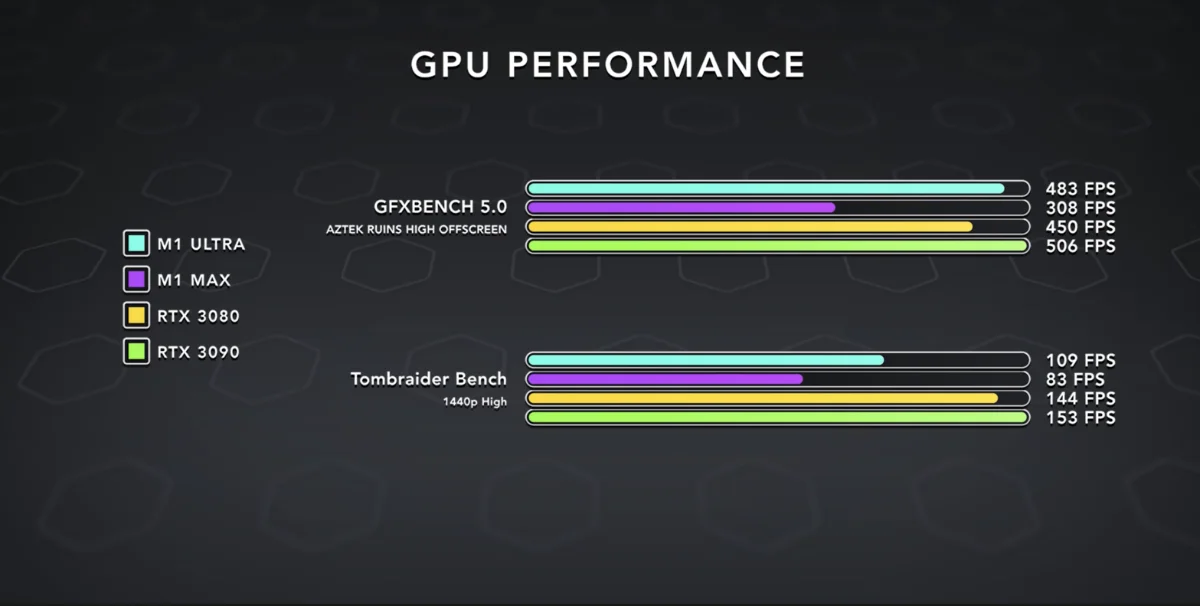
The M1 Ultra got 70% of the frames of an RTX 3090 on Tomb Raider[0], so I suppose they're right. Performance-per-watt monsters.

And Apple GPUs have only gotten better.

[0]https://techjourneyman.com/img/blog/m1-ultra-vs-rtx-3090-ben...

That wasn't really my question. The M1 Ultra is a 5nm chip up against the 8nm RTX 3090 - for >$2000 and 220W+ you'd kinda hope the M1 Ultra outperforms the 8nm stuff.

My question is, what games are people playing on Mac? Tomb Raider is one of ~6 AAA titles that was ported to Mac in the last decade. All the other big-ticket games - GTA V, Arc Raiders, Elden Ring - are all hamstrung by Apple's terrible translation software and don't run much better with Crossover either.

Apple Silicon, strictly speaking, is the least adept hardware that you can own for gaming. If you are a gamer, almost every single other GPU on the market would perform better for your needs.

I have an RTX 5090 and am an avid gamer. When I travel I use my M1 MacBook Air and play indie games like Slay the Spire, Hades 2, Balatro, and Hollow Knight Silksong. Not cutting edge but definitely cutting edge fun. Those games run with no difficulties.

Slay the Spire 2 is in early access and has some major issues running but I suspect that’s some issues in the game engine because it’s not framerate but some sort of hitching that makes button presses not register.

YapYap which is an intentionally retro ugly 3D style runs barely in a playable state on the M1, but it got me through in a pinch when my kid wanted us to both play.

If I want to play AAA I fall back to my desktop, you can stream using Moonlight or Parsec but unless both sides are wired it isn’t great.

All of those games are simple enough to run in cheap phones, so not really a very informative data point, is it?
I play some native games on a M4 Max using Steam, with good performance.

Baldurs Gate 3, Cyberpunk 2077, Crimson Desert, No mans sky, Darkest Dungeon 1,2, Warhammer Rogue Trader, and a few other CRPGs. Crossover Mac is also an option for Windows games.

If you’re a hardcore gamer, the Mac isn’t going to cut it but it’s a lot better now than it used to be.

You really had to squeeze those numbers through those filters to get that diction out, didn't you? :P

My 16" M1 Max is kinda crap at running games - I'd put it somewhere around cheaper laptops with 3050 series GPUs.

Googlebook sounds funny now, but so did iPad when it was announced.
The Googlebook name won't stick around for that long. It'll be like the Nexus and Pixel C, around for 1-3 revisions, canned, then brought back a few years later.
They should bring back the Nexus line. It's more fitting nowadays.
I still remember the Maxipad jokes.
I would rather buy this shit than anything Apple.

Of course, there are more than 2 options for laptops. Thankfully those two shit companies didn't get to round up that market yet.

There's an entire world outside of Silicon Valley and the Apple ecosystem. Apple has a ~9% PC market share. Who is buying the other 91% if there is no demand?
I can tell you they're not going to be buying "googlebooks" plus, Apple has never until this year offered an actual low-price machine.

Of course their market size is going to be smaller when you're leaving out the sub $1000 dollar market.