Hacker News new | ask | show | jobs
by aldrich 33 days ago
> Not once has a European ever given the US credit for the Marshall Plan.

How can you honestly say that though. A blatant overgeneralization of a large group of people, but this has been a recurring theme on HN lately.

So I would agree that people spouting anti-US sentiment have been conveniently downplaying, leaving out, or haven't been educating themselves on, this important part of US-European history, but what's new.

In the meantime, streets have been named after Marshall, plaques and statues have been erected (including recent times) at least in the more Western parts of continential Europe where much of the Marshall Plan funds ended up, and its extreme importance is quite an ingrained part of WW2 school history education. Just as one example, Arnhem was largely rebuilt using these funds and has historically paid homage and still does today with such tributes and memorials.

1 comments

>How can you honestly say that though. A blatant overgeneralization of a large group of people, but this has been a recurring theme on HN lately.

Perhaps there is a miscommunication. What I meant to say is, I have not seen it mentioned a single time over many hours of arguing on HN about the US/Europe relationship. It's not an 'overgeneralization', simply an observation.

>In the meantime, streets have been named after Marshall, plaques and statues have been erected (including recent times) at least in the more Western parts of continential Europe where much of the Marshall Plan funds ended up, and its extreme importance is quite an ingrained part of WW2 school history education. Just as one example, Arnhem was largely rebuilt using these funds and has historically paid homage and still does today with such tributes and memorials.

That is nice to hear. But it doesn't seem to stop US-bashing from being the continent's trendiest hobby. I never saw a European say to another: "Hey now, they did do the Marshall Plan for us. Maybe the Yanks aren't always bad."

The problem is that US establishment politicians have traditionally sold US foreign policy to voters as "a responsibility to uphold freedom and democracy" and so forth. Then Americans hear directly from the supposed beneficiaries of this "responsibility", and the sentiment is overwhelmingly negative. The American voter feels betrayed, and wants out of the arrangement. It contributes to (1) anti-establishment sentiment, and (2) isolationist sentiment.

The condescending attitude of Europeans ("NATO is mainly to benefit US interests, you American fool", without being very specific about those interests aside from vague handwaving towards the Middle East, where most of us want less involvement anyhow) is not helping matters.

The relationship is complex. Remember the Marshall Plan was needed partly because massive amounts of European infrastructure and industry which had occurred in some cases long before the USA even joined the war. The USA had the benefit of being resource rich, but also geographically isolated which meant that the continental USA never suffered from severe bombing raids or threats of invasion. (Many European towns and cities ended up being levelled.) It fought the war on entirely different terms to Europeans. Even today this geographic factor plays out. Europe deals with the refugee crises caused by Middle Eastern wars far more than the USA does, and Russia could invade EU countries by land far more easily than the USA.

Europe has benefitted from the USA in some ways, but the USA doesn't always have to bear the consequences.

>Remember the Marshall Plan was needed partly because massive amounts of European infrastructure and industry which had occurred in some cases long before the USA even joined the war.

How does that change things? You could just as easily argue that Poland's economy was ruined by the USSR, therefore EU help is "complex".

Europe was an unfortunate spot, due to a war which started in Europe, and the US helped Europe defend against tyranny and rebuild. If the US hadn't helped Europe rebuild and defend itself, perhaps the USSR would've expanded all the way to the Atlantic.

Europeans have an annoying habit of taking US help for granted, and complaining about us endlessly. I'm tired of it. We should've taken the Swiss approach and allowed Europe to suffer the full consequences of European folly. That's what we do about poverty in Africa and South America. We don't regard that as our problem. Europe should not be our problem either.

Lord knows Europe wouldn't help the US rebuild if we suffered a devastating war. There was no European Marshall Plan after the US Civil War.

I never see Europeans complain about Swiss neutrality. The US should take the Swiss approach.

Poland's economic woes were caused by Germany. It was not able to regrow its economy due to its Cold War government.

"Europe was an unfortunate spot, due to a war which started in Europe"

That is arguable. Some Asians say the war started in the Far East with Japanese attacks on China and the USSR which occurred before 1939, let alone 1941.

"I never see Europeans complain about Swiss neutrality. The US should take the Swiss approach."

Switzerland is not a militaristic power, but an economic one. It is not expansionist. It is currently the host country of the World Economic Forum though, and the WEF's legacy is controversial to say the least.

"Lord knows Europe wouldn't help the US rebuild if we suffered a devastating war. There was no European Marshall Plan after the US Civil War."

The US Civil War had nothing like the scale of WW2. The tank battle at Kursk alone dwarves the US Civil War. Large parts of the USA were unaffected by the civil war and both sides had the same language and a similar culture.

"That's what we do about poverty in Africa and South America. We don't regard that as our problem. Europe should not be our problem either."

North America and Europe have interfered heavily in both Africa and South America. Not just militarily but economically, propping up and training various dictators. The USA just bailed out Millei in Argentina and intervened in Venezuela.

Europe is a lot friendlier to the USA than most parts of the world and is a major part of its trade. Elsewhere it becomes more complicated.

>Poland's economic woes were caused by Germany. It was not able to regrow its economy due to its Cold War government.

So the notion that Poland should be grateful to Europe is rather farcical.

>That is arguable. Some Asians say the war started in the Far East with Japanese attacks on China and the USSR which occurred before 1939, let alone 1941.

The European war started in Europe.

>Switzerland is not a militaristic power, but an economic one. It is not expansionist.

Exactly, I'm saying the US should take that route. Our military posture should be armed neutrality like Switzerland rather than propping up European regimes.

>The US Civil War had nothing like the scale of WW2.

On a population-adjusted basis they were similar. Wikipedia states:

"Based on 1860 census figures, 8 percent of all white men aged 13–43 died in the war, including 6 percent in the North and 18 percent in the South."

https://en.wikipedia.org/wiki/American_Civil_War#Casualties

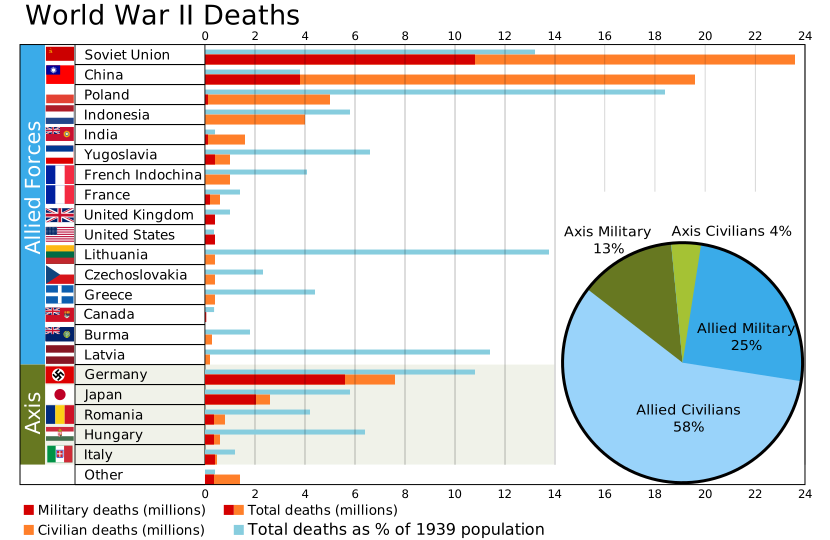
You can see WW2 figures for "total deaths as % of 1939 population" here: https://upload.wikimedia.org/wikipedia/commons/d/d1/World_Wa...

>The tank battle at Kursk alone dwarves the US Civil War.

Based on a quick glance at Wikipedia this appears to be false.

But the population-adjusted figures are the ones that matter. The US Civil War was about as devastating to the US as it existed in the 1860s as WW2 was to Europe as it existed in the 1940s. Europe did not do much to help with rebuilding.

>Large parts of the USA were unaffected by the civil war

Sure--and Sweden, Spain, Portugal, etc. were not heavily affected in Europe.

>both sides had the same language and a similar culture.

Not relevant for my point.

>North America and Europe have interfered heavily in both Africa and South America. Not just militarily but economically, propping up and training various dictators. The USA just bailed out Millei in Argentina and intervened in Venezuela.

>Europe is a lot friendlier to the USA than most parts of the world and is a major part of its trade. Elsewhere it becomes more complicated.

When it comes to authoritarians, I notice the US always does the wrong thing. If we cooperate with authoritarians, we are "propping them up". If we help resist them, we are "destabilizing". If we sit by and do nothing, we are "complicit". Whatever the US does, there is always a term you can use to explain why the US is the villain, without having to learn any details of the situation. It's a sealed system of knowledge akin to a religion.

In any case, it sounds like you're with me that the US should be more isolationist then. I don't know why you're trying to argue with me, when you agree with my conclusion. Between "propping up", "destabilizing", and "complicit", I say "complicit" is the best answer. That's why I advocate complicity towards Europe. European problems should stay European. We shouldn't be "propping up" repressive European regimes: https://eternallyradicalidea.com/p/the-situation-for-free-sp...

"the notion that Poland should be grateful to Europe is rather farcical."

Poland has always been in Europe, and so was Germany. The USSR was partly in Europe as well. Maybe you mean the European Union? In which case, it may be a temporary fix, because as Poland becomes wealthier, the cheapness of labour no longer applies.

"The European war started in Europe."

It was never purely a European conflict. Several major

"Sure--and Sweden, Spain, Portugal, etc. were not heavily affected in Europe."

Spain stayed out of the main conflict because it had just been in a war in which the USSR, Germany and Italy were all involved. Gernika/Guernica was famously bombed from the air by the Germans. Franco may not have even won without external help. Like Japanese aggression before 1939, it can be argued that the Spanish Civil War was the beginnings of WW2.

Portugal's shipping was at heavy risk, especially to and from the Azores and Madeira. Macau ended up under informal occupation by Japan, with "advisors" installed there. Portugal was in no position to take on Japan.

Sweden was in no position to negotiate and traded with Germany, Finland and Nazi-occupied Denmark & Norway. It was effectively a satellite state.

"Based on a quick glance at Wikipedia this appears to be false."

You shouldn't have to look at Wikipedia. Kursk was the biggest tank battle in history with thousands of units taking part. That should be common knowledge. It dwarves anything in the US civil war.

"When it comes to authoritarians, I notice the US always does the wrong thing. If we cooperate with authoritarians, we are "propping them up". If we help resist them, we are "destabilizing". If we sit by and do nothing, we are "complicit". Whatever the US does, there is always a term you can use to explain why the US is the villain, without having to learn any details of the situation. It's a sealed system of knowledge akin to a religion."

It was put succinctly by one American, if I can mind rightly... Someone was told that some dictator was a bastard, and the reply was "But he's our bastard." Something like that. Al Haig made similar statements. Kissinger asked about East Timor said something like, "that was an island, you should see what I can do with continents". Again quoting from memory.

I think the "our bastard" mentality applies to Saudi Arabia and the Ukraine, which is an utterly corrupt country but in which there have been concerted attempts to orientate it away from Russia, even to the point of adopting the western date of Christmas. (I wouldn't be entirely surprised if Zelensky tries to advocate for the Roman alphabet in future as well.)

The USA has helped create some positive changes across the world, but often does so with an iron fist and an end to help itself. This is my main worry with Cuba... It may throw off its Communist dictatorship, but just end up a corrupt US satellite as it was under Batista.