|
|
|
|
|
|
by ryandrake
67 days ago
|
|
|
I remember having convincing a few coworkers that the number of distinct floating point values between 0.0 and 1.0 is the same as the number of values between 1.0 and infinity. They must not be teaching this properly anymore. Are there no longer courses that explain the basics of floating point representation? I was arguing that we could squeeze a tiny bit more precision out of our angle types by storing angles in radians (range: -π to π) instead of degrees (range: -180 to 180) because when storing as degrees, we were wasting a ton of floating point precision on angles between -1° and 1°. |
|
|
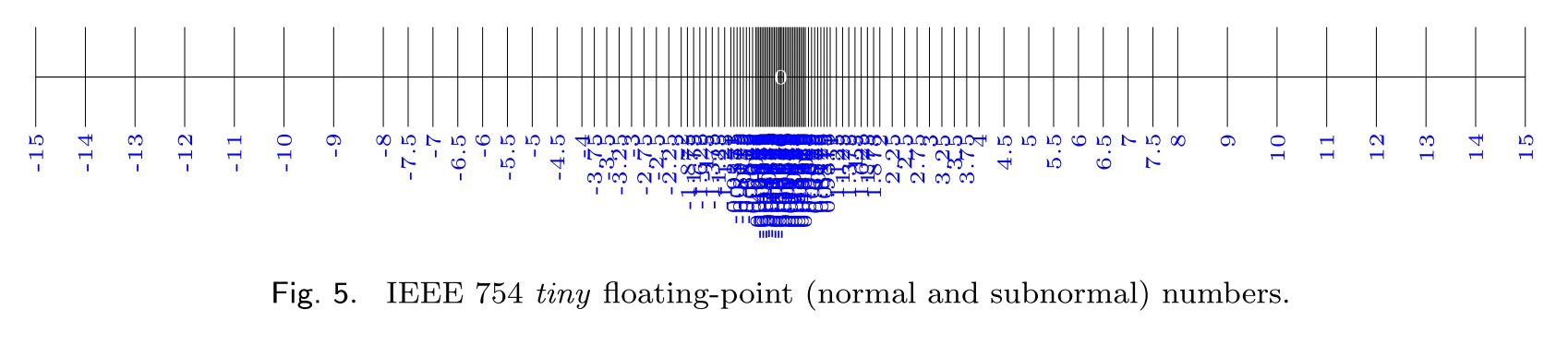
In those old FP formats, the product of the smallest normalized and non-null FP number with the biggest normalized and non-infinite FP number was approximately equal to 1.
However in the IEEE standard for FP arithmetic, it was decided that overflows are more dangerous than underflows, so the range of numbers greater than 1 has been increased by diminishing the range of numbers smaller than 1.
With IEEE FP numbers, the product of the smallest and biggest non-null non-infinite numbers is no longer approximately 1, but it is approximately 4.
So there are more numbers greater than 1 than smaller than 1. For IEEE FP numbers, there are approximately as many numbers smaller than 2 as there are numbers greater than 2.
An extra complication appears when the underflow exception is masked. Then there is an additional set of numbers smaller than 1, the denormalized numbers. Those are not many enough to compensate the additional numbers bigger than 1, but with those the mid point is no longer at 2, but somewhere between 1 and 2, close to 1.5.