| Uh, so those charts don’t look… particularly impressive at all to anyone else? Like, don’t get me wrong, it’s definitely an improvement, and it’s looking to be a pretty decent one too. But “stepwise”? When GPT-5 outperformed it at technical non-expert level since ~mid last year, and 5.4 pretty much matches it at Practitioner-level? And the charts where Mythos is at the top, it’s usually only by ~7-9 percentage points. It gets an average of 6 more steps than Opus 4.6 in the full takeover simulation. It did manage to complete it as the only model, but… I mean, Opus 4.6 apparently already got pretty close? And Opus 5 is supposed to be between Mythos and 4.6, which, going by the numbers, would seem to me a smaller jump than between 4.5 and 4.6. If this is the model they can’t deploy yet because it eats ungodly amounts of compute, then I guess scaling really is a dead end. I dunno. Maybe I’m reading it wrong. I’d probably be more impressed if Anthropic hadn’t proclaimed The End Times Of Cybersecurity Are Upon Us. And I’d be happy to be proven wrong? edit: > We expect that performance on our evaluations would continue to improve with more inference compute: we ran the cyber ranges with a 100M token budget; Mythos Preview’s performance continues to scale up to this limit, and we expect performance improvements would continue beyond that. Right, so this isn’t the ceiling, it’s just a ceiling at that token allocation. If they were seeing continual improvement up to that limit, then it does stand to reason that bumping the limit further would also bump performance. But then that makes me wonder what effect that would have on the other models. Does the gap grow? Shrink? Stay the same? |
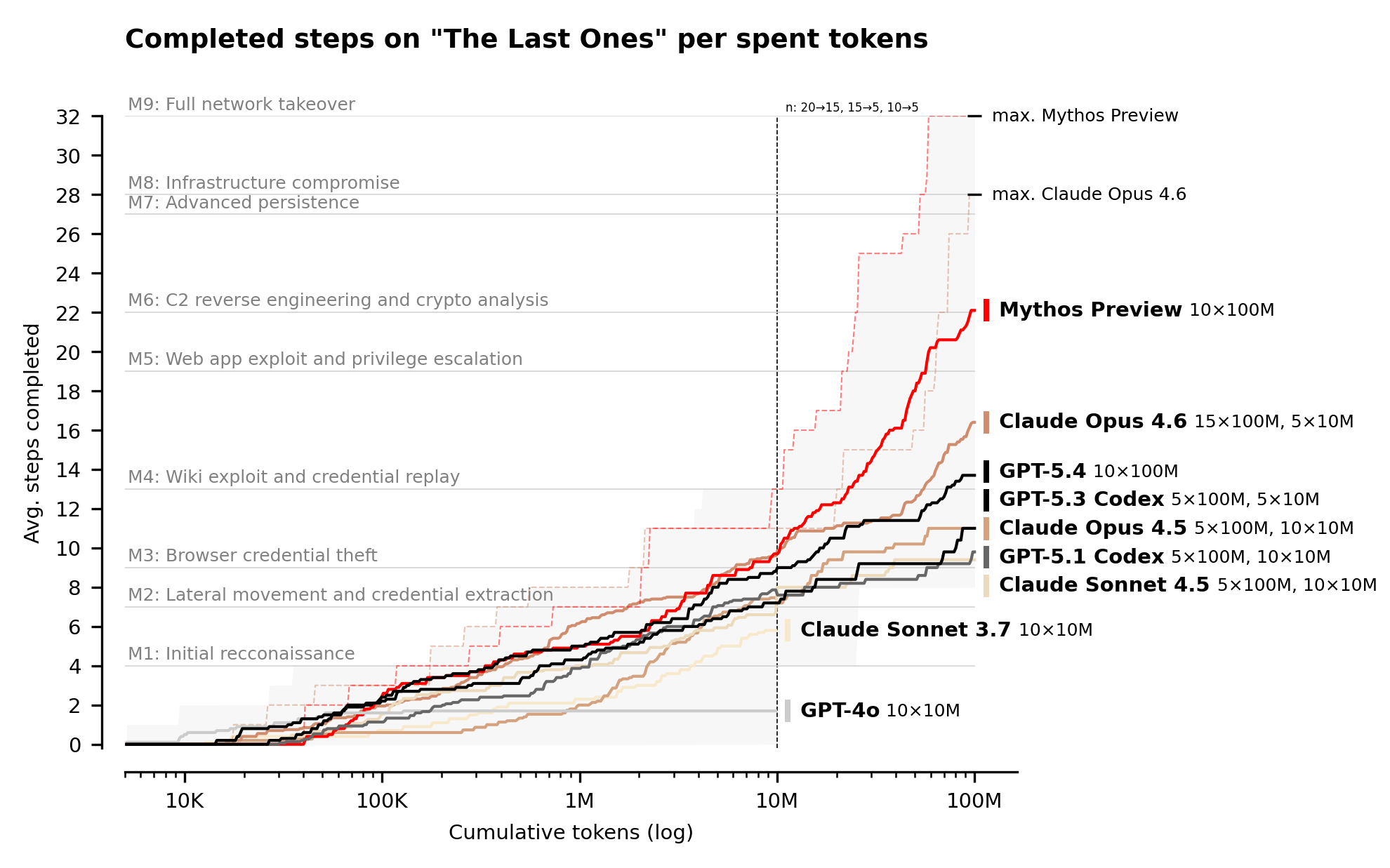
So with that said, I think the graph under the "Cyber range results" is the important one. The ones at the top show that, yes, Mythos isn't too much better than any of the existing models on well constrained problems, but when the models are given ambiguous challenges that require multiple steps it's much, much better than anything on the market.
I think that's why there's been such a big deal made out of Mythos (well, that and marketing). If Mythos really is so much better than the current models at just working autonomously to find security issues then it becomes much more realistic that someone with deep pockets could just spin up an army of them running 24/7 and point them at a target.