| See https://bas.westerbaan.name/notes/2026/04/02/factoring.html and https://scottaaronson.blog/?p=9665#comment-2029013 which are linked to in the first section of the article. > Sure, papers about an abacus and a dog are funny and can make you look smart and contrarian on forums. But that’s not the job, and those arguments betray a lack of expertise. As Scott Aaronson said: > Once you understand quantum fault-tolerance, asking “so when are you going to factor 35 with Shor’s algorithm?” becomes sort of like asking the Manhattan Project physicists in 1943, “so when are you going to produce at least a small nuclear explosion?” To summarize, the hard part of scalable quantum computation is error correction. Without it, you can't factorize essentially anything. Once you get any practical error correction, the distance between 32-bit RSA and 2048-bit RSA is small. Similarly to how the hard part is to cause a self-sustaining fissile chain reaction, and once you do making the bomb bigger is not the hard part. This is what the experts know, and why they tell us of the timelines they do. We'd do better not to dismiss them by being smug about our layperson's understanding of their progress curve. |
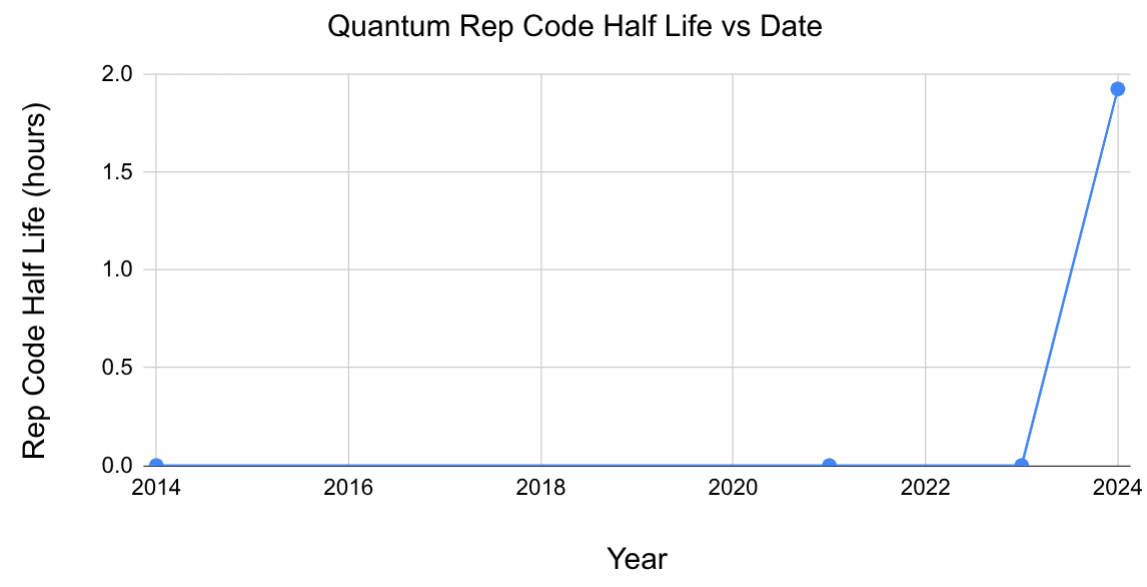
The actual challenge is we still don’t know if we can build QC circuits that factorize faster than classical both because the amount of qubits has gone from ridiculously impossible to probably still impossible AND because we still don’t know how to build circuits that have enough qbits to break classical algorithms larger or faster than classical computers, which if you’re paying attention to the breathless reporting would give you a very skewed perception of where we’re at.
It’s also easy to deride your critics as just being contrarian on forums, but the same complaint happens to distract from the actual lack of real forward progress towards building a QC. We’ve made progress on all kinds of different things except for actually building a QC that can scale to actually solve non trivial problems . It’s the same critique as with fusion energy with the sole difference being that we actually understand how to build a fusion reactor, just not one that’s commercially viable yet, and fusion energy would be far more beneficial than a QC at least today.
There’s also the added challenge that crypto computers only have one real application currently which is as a weapon to break crypto. Other use cases are generally hand waved as “possible” but unclear they actually are (ie you can’t just take any NP problem and make it faster even if you had a compute and even traveling salesman is not known to be faster and even if it is it’s likely still not economical on a QC).
Speaking of experts, Bas is a cryptography expert with a specialty in QC algorithms, not an expert in building QC computers. Scott Aronson is also well respected but he also isn’t building QC machines, he’s a computer scientist who understands the computational theory, but that doesn’t make him better as a prognosticator if the entire field is off on a fool’s errand. It just means he’s better able to parse and explain the actual news coming from the field in context.