Hacker News new | ask | show | jobs
by KronisLV 72 days ago
That's an insane amount.

That makes me feel even more strongly about throwing proprietary and predatory codecs in the trash and opting to use AV1 et al wherever possible, it's better anyways and surely close to a decade after coming out, we'd expect devices to support it well enough.

6 comments

> it's better anyways and surely close to a decade after coming out, we'd expect devices to support it well enough.

A lot of people, myself included, are still using quite old hardware. The GPU in my daily driver is ~10 years old at this point. Between crypto, COVID, and this AI craze raising GPU costs by insane amounts, it hasn't made sense to replace it with something newer. I know I'm not alone on that...

For legacy devices, VP8/VP9 is a good option. Intel Added VP8 hardware decoding to Broadwell which was 12 years ago. Nvidia had hardware VP9 decoding 10 years ago on the Geforce 10 series. AMD had hardware VP9 decode support 9 years ago on the Radeon 400 series.
If my 10 year old card can't encode in hardware, it's a nonstarter.
I still happily use my 2012 27" iMac for all my work. So I'm with the parent comment.
I work in AI and I'm surrounded by RTX-4090 and H100 servers but for much of the day to day AI training I use my RTX-970 in the desktop on my desk for convenience and it works just fine for most cases.

Literally 2 meters from my desk is a 2x RTX-4090 server and many times I just use my 8 year old GPU anyway so you don't need it.

For a long time I thought my RTX-2060 was just not capable and the other day I did a ffmpeg GPU transcode and was surprised by how well it did. So now I am thinking about putting on some of Google's new Gemma edge models (probably the smallest will work with my 6GB VRAM + 2 GB) setup. I am not a 100% sure what that 2GB is but I think it is borrowing from the system in some manner.
Video encoding uses dedicated silicon, it's not using the card's compute.
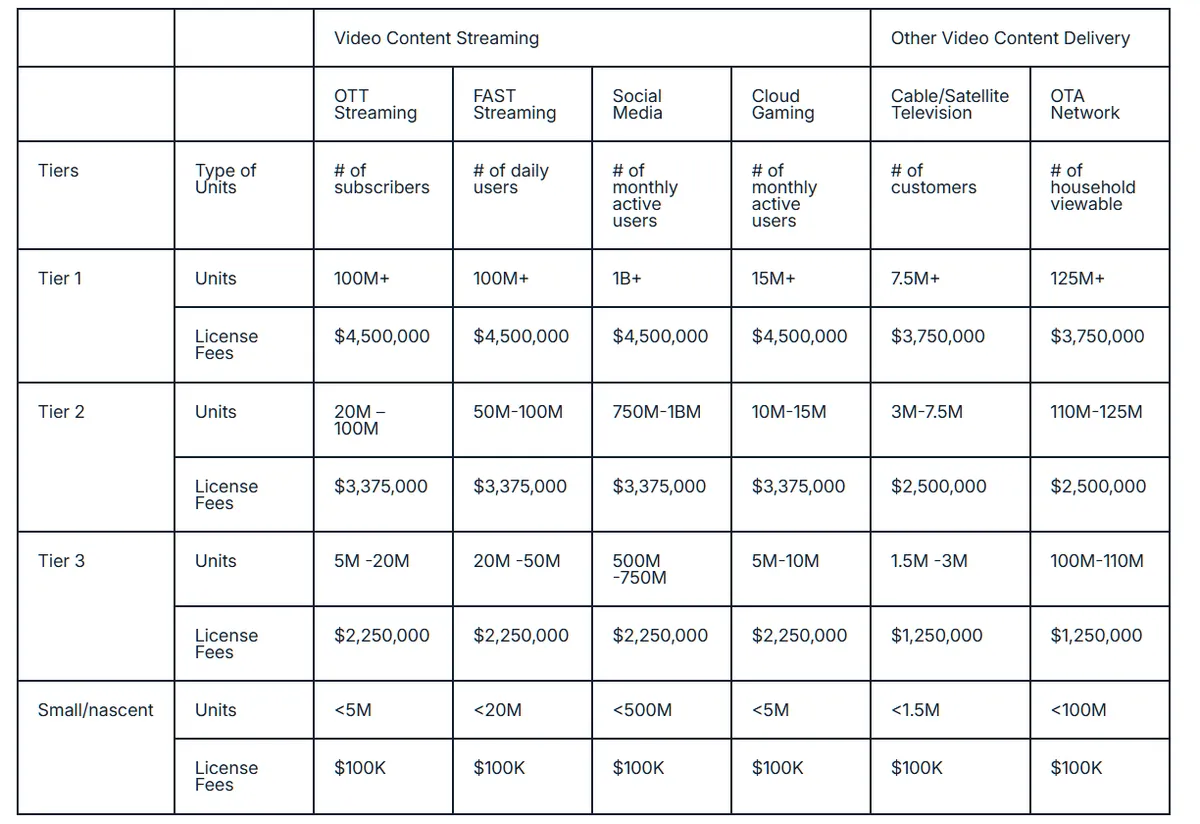
Insane in absolute terms, but not per user. Take look at the actual fee schedule [1]. The most costly is the license for cable TV, which costs 50¢ per year per subscriber. The least costly is social media, which goes up to whopping 4.5¢ per MAU per user.

I very much understand how the licensing alliance likely was bothered by the fact that they are leaving money on the table, when TikTok's revenue per user is $50 a year, and a cable subscription is easily $800 per year, with the high-end reaching $2000. The big players aren't going to notice much. For the small players, nothing changed.

[1]: https://cdn.mos.cms.futurecdn.net/3wzYaofEETCfXdQmREx9BK-120...

I think the dumb part is that it's not like decoding or encoding video becomes harder when there's more users. The effort to write code for encoding for a small service of 1000 users and a large service of 10 million users is the exact same. We really don't need middlemen extracting everything they can, which will drive up costs.
Is it insane at all? The biggest fees are charged to the biggest providers. With short form video now the dominant form of addictive social media content, it doesn’t seem insane at all that large media companies ought to compensate inventors/owners of patented video technology. A company with 100 million or more subscribers is not a company I feel a lot of empathy for if they’re trying to avoid paying licensing fees.
It goes to $2.5m for 5 million users/subscribers and tops out at $4.5m for 100 million subscribers. It’s not staggered evenly at all IMO. So I worry mainly for the small players. This shouldn’t have any meaningful effect on any big player.
But for small players nothing apparently changed, they keep paying the $100k as usual.
5 million users isn’t a lot unless we’re talking paid subscribers. Their license likely does not make a distinction. For a (free/ad supported) service like a niche YT clone, this could be fatal.
The problem is that open codecs can still be encumbered by patents and the holders will sue. VP9 and AV1 have their own patent pool for that very reason. Google may have open sourced its codecs but if they don’t indemnify users people who think they’re safe might be in for a bad time.
100%. Just because AOM/Google says that wont charge a royalty doesn't mean AV1 isn't covered by patents owned by others. Since everyone and their brother saw how they can milk the patent system for money, they got patents that cover all "next-gen" video technologies (AV1, HEVC, VCC) a long time ago and will sue anyone that uses them. Ironically, since there are so many patent holders, each of which want a larger piece of the "licensing pie", it's making the new video technologies impossible to license. You may license HEVC or AV1 from one patent pool, but the other two and hundreds of other individual patent holders could also sue you. This is why many brands like Synology, Dell and HP have just started to simply remove these codecs from their products. I wouldn't treat any video codec as "patent free" until AT LEAST 20 years after the spec was release (AV1 = March 2038). This kind of infighting will guarantee that HEVC or AV1 will never become a ubiquitous standard for at least 20 years the way AVC/h.264 did.

I, for one, am happy about this. Nothing makes me happier than to see patent trolls eat themselves alive. Also, being an open source advocate, I appreciate when propriety technologies that are "good enough" can finally be used by open source applications. Unless you are pushing a ton of video, or working with high resolution (4K, 8K)/ high bit-rate videos, AVC/h.264 is perfectly fine.

There's sadly loads of older Apple and Android devices out there holding back AV1 adoption for years to come. Hardware AV1 decoding only just arrived in the Apple M3+ and A17 Pro onwards, and software decoding has its own big trade offs regardless of the OS.
The big problem is that Apple disables AV1 support in Safari on devices that do not have hardware decoders, even if those devices are powerful enough to decode in software. I can understand it for a phone, but it seems unreasonable for an M2 Ultra Mac Studio.
AV1 might not be as patent-free as we had hoped: https://arstechnica.com/gadgets/2026/03/av1s-open-royalty-fr...
It's more another example of 'you can sue for anything on a whim'.
What's the likelihood Dolby succeeds?
AV1 may also have patent issues - AV1’s open, royalty-free promise in question as Dolby sues Snapchat over codec - https://arstechnica.com/gadgets/2026/03/av1s-open-royalty-fr...