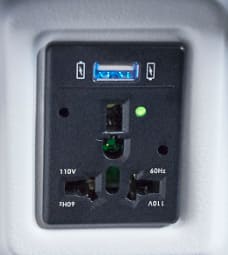
Easier if you have a vast domestic flight market (US, China, etc), but not really practical if you're flying across borders, which is the base case in Europe, much of Asia, etc.
With traditional outlets you also inherit the whole legacy mess of competing standards for power mains. You don't want to feed 240V to a NEMA 1-15 outlet and melt someone's device mid-flight.
I do wonder if in some far future we'll just replace wall outlets with USBs for ordinary appliances, reserving traditional outlets for major power draws like stovetops, HVAC, industrial equipment etc. Maybe planes are the vanguard of this future?
They exist but are insanely unsafe. It would be ten kinds of illegal to install a socket like that in your home under any code I've ever seen.
It's already difficult enough to prevent people from making contact with the live parts when you're dealing with a plug and socket actually designed for each other. There's no hope in hell when you have ten extra holes.
Because it's completely impossible to prevent people from being able to touch a live contact in a socket that must accept many different types of plug. Safe sockets firmly grip the plug they are designed for. This socket cannot, since it must be willing to accept anything you stick in.
Without being able to grip any individual plug's prongs, any actual plug plugged into the socket will always hang from it. This exposes the top of the live contacts, now flowing with mains (!!) power.
Look at the image above. Note the sheer size of those bottom holes, and remember that the socket can't firmly grip anything (compare the narrow US/Japanese holes, the diagonal Australian/Chinese holes, the circular European holes, the outer British holes - all overlapping but in different places). You are basically guaranteed to get exposed contacts.
This is just bizarrely dangerous on a transcontinental flight where you might be asleep, covered in blankets, etc. Given that this kind of socket would be illegal to install in your own home under most electrical codes, I have no idea why it's fine on a plane.
(And that's without getting into how this provides a completely incorrect voltage to most of the plugs, or how it encourages folks to try to shove non-compliant plugs into all that spare room, or the existence of plugs like Argentina's, that will fit but will be electrified on the wrong prong, etc etc)
So how do most European airlines have just that on their intercontinental flights?
I don't think I've flown intercontinental without universal power sockets (accepts EU & US plugs, sometimes others, voltage info hard to find) in the past 10 years.
In some cases it's sadly still a premium cabin thing. I refuse to fly economy at this point, premium eco tends to be good enough to get power sockets.
What are you going to plug into a power outlet on an airplane that isn't dual voltage? A kettle or a toaster? I assume they have a way of preventing people from using those.
Almost all the international flights I've flown have had power outlets, always between 220V and 110V countries (heck, only Japan is 110V besides the US as far as I know).
I it works for China because they use (as an option at least) similar outlets to the USA (just ungrounded, pop).
Central/South America has a lot of 100-130 V too, I believe, but I don't have direct personal experience.
I find the standard voltages pretty interesting. The 230 V standard, for example, is mostly a lie. In reality, Britain and former British colonies tend to run on 240 V, and continental Europe/Asia/Africa tends to run on 220 V. The 230 V standard includes wide enough tolerances so that no one needed to actually change anything. I've never actually seen 230 V, the supposed standard, in real life.
> I've never actually seen 230 V, the supposed standard, in real life.
I've just measured the voltage in a socket my home (Germany) and the multimeter says 231 V. (And it's nighttime, so no solar generation from houses in the neighbourhood potentially distorting the local grid.)
I think 'assuming that the airline has a way of preventing' people from plugging in dangerous items is doing a loooooot of heavy lifting in your argument.
How, exactly? The airlines have absolutely no way to know what shoddy electrical device you bought god-knows-where you're plugging into mains power in their airtight travel-coffin, packed with hundreds of people, hurtling across some ocean.
> Almost all the international flights I've flown have had power outlets
Seems deeply unusual to me, but I won't dispute your experiences. I've flown internationally fairly often, and in my experience power outlets are rather uncommon (at least in the eastern hemisphere, flights to/from the Americas may differ, I haven't flown around there for many years).
Every flight I've been on had outlets that just let you plug in almost any plug. They have 115 VAC nominally supplied to them, although most chargers work just fine down to 90 VAC. Unless you're trying to run your cement mixer I don't think the peak voltage matters much.
Europe has a lowest common denominator plug, there are universal outlets (jack of all trades, master of none) that you already often find in airports, and each airline has a home country anyway.
Yeah, no. In EU+CH alone, you've got Schuko, French, reversed French (Czech), British (Ireland, Malta, Cyprus), and more rarely Italian, Danish and Swiss plugs. And those are just the current national standards as of 2026, ignoring anything non-standard or historic or foreign.
You can't just slap some ungrounded 240V Frankenstein multi-socket on the back of a plane seat and call it a day. Hell, you can't even do that in your own house in most developed countries.
That's before you even get to passengers plugging in their own $2 socket converters off eBay, half-inserted and loosely hanging off your already-lethal socket. And then these passengers wrap themselves in a synthetic blanket and go to sleep. What could go wrong.
We're not talking about some CRUD web app here, where being held together by sticky tape and prayer is fine and expected. This would actually kill people. Not exactly easy to deal with a smouldering corpse in the middle seat at 30,000 feet.