Hacker News new | ask | show | jobs
by thoughtlede 135 days ago
I think we can simplify the answer to this question for most audience and say "the air is blue".

If they say, the air appears to be clear when I stare at something other than sky, the answer is you need more of air to be able to see its blue-ness, in much the same way that a small amount of murky water in your palm appears clear, but a lot of it does not.

If they ask, why don't I see that blue-ness at dawn or dusk, the answer is that the light source is at a different angle. The color of most objects changes when the light source is at a flat angle. And sun lights hits at a flat angle at dawn and dusk.

If they ask, what exactly is the inside phenomenon to see the sky color to be blue, then explanations like this blog are relevant.

If they ask, what exactly is a color, the answer is that it is a fiction made up by our brain.

6 comments

As confusion elsewhere on this page illustrates, one also needs to clarify absorption. "It's just blue" sky and "it's just blue" stained-glass have quite different behavior. Both side scatter some blue, but while one mostly transmits the rest, the other mostly absorbs the rest, for very different experiences peering through it.

So perhaps "clear with a blue tint"?

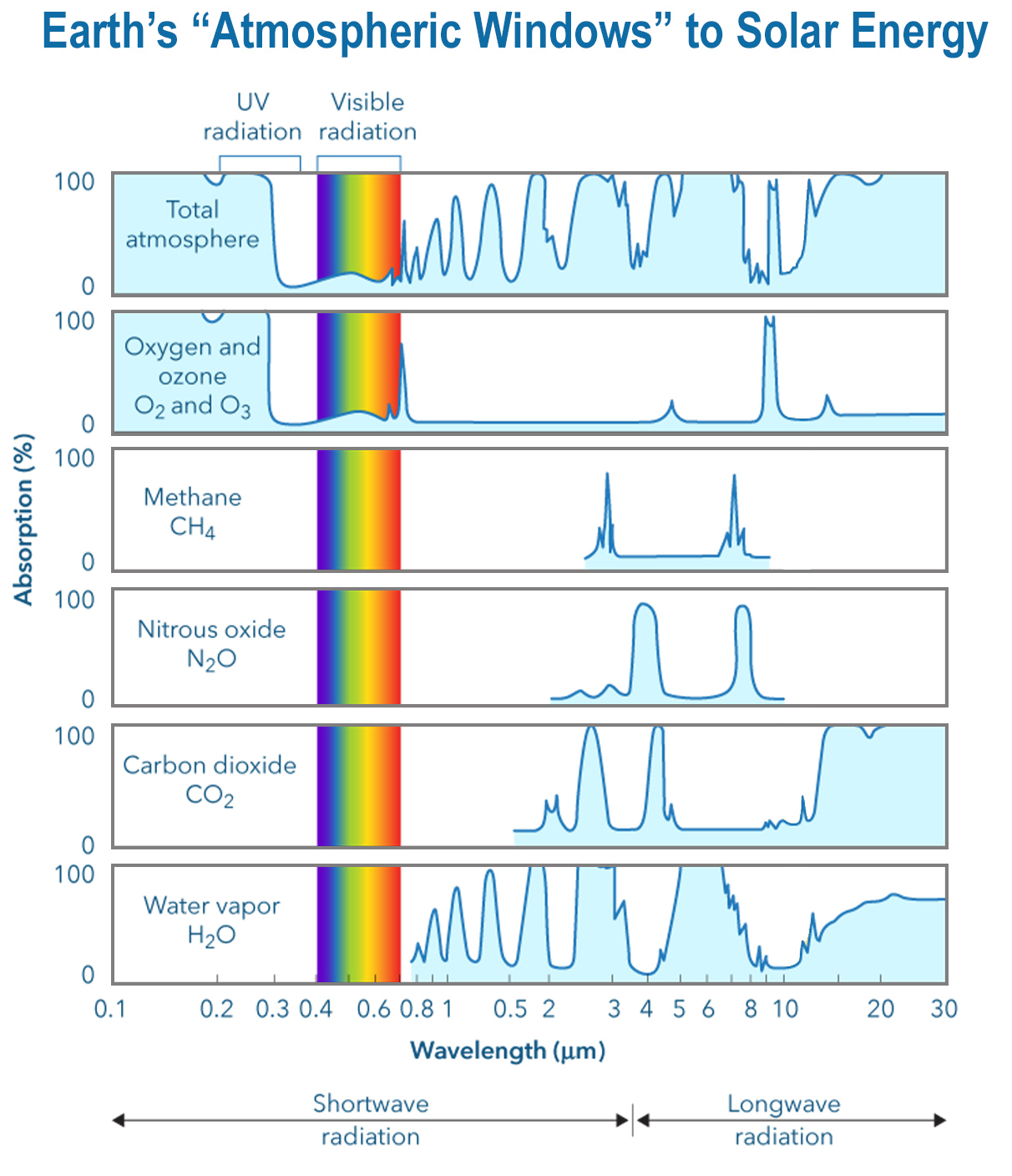
The air is most definitely not blue. It is a shade of orange. https://pace.oceansciences.org/images/EarthAbsorptionEMSpect...
"Air is blue" works surprisingly well as a first approximation, in the same way "the ocean is blue" works until someone asks why
I think the color of the ocean is an even more interesting subject than the color of the sky. There is even more interesting physics involved.
And biology. The amount of plankton in the water can tint the color noticeably .
Yes, to all the the scattering, the sky has, you have water and other material relevant for absorption in the path. In the end even the colour of the ground might matter. In the past some people said, that the sea is blue, because it's a reflection of the blue sky, but that covers only a part of the problem.
Yes, I came here to say this. The whole topic drives me crazy. Air is just blue. Everything is a color because of some physics reason. Some birds have blue wings due to microscopic structures and how light interacts with them, rather than pigment.

If you took a large column of air into space and shined white light through it, it would be blue.

No, it would look red. The weird thing about air is that it's not reflection or absorption that gives the color, but scattering, and that means the color is strongly dependent on what direction you are looking at it from in a way that most transparent mediums aren't.
Ok, so the air would be red from one angle, blue from another. In each case, that is what color the air “really” is, in the same sense that a butterfly’s wings are blue (but not from every angle)
Except that one is transmissive and the other reflective. They're not the same kind of thing. TBH I feel like a demo like this is the only way to get an intuitive feel for it: https://www.youtube.com/watch?v=-Xx7sPPTu3Y .

(I agree that just going on about Rayleigh scattering is probably overly obtuse: at least not without explaining that scattering is part of how color is formed in the first place. But it's also not just a case of 'well air is blue like apple juice is orange')

Isn't it the water that is blue? Water is mostly clear, but it is very very slightly blue.
Liquid oxygen has the same color.