Germany squandered so much money on nonsense, when they could have simply driven the few kilometers over to Eindhoven and bought an ASML machine for "Silicon Saxony".
Sure, it would have taken years and years and serious commitment by the government and private sector to make that a successful move. But instead of putting in the hard work with a clear vision for the future, we mostly spend our time whining and wailing. It's a shame.
High-end chips should be more of a EU concerted effort rather than every country for itself.
The problem is that unlike Airbus, which (highly inefficiently) can be made in multiple countries, you can't really spread out parts of a fab that way. The most you can do is fab machines + chips + chip packaging. Netherlands already has fab machines and in packaging there isn't a high margin.
That leaves chips, and you can be sure that whoever gets the fabs, the other EU countries will throw a shit fit and demand counter investments to compensate. And on top of that there is also regional animosity. So even if it makes logical sense to pop the fab down in the middle of the blue banana, it won't make political sense because France and all of South and East EU will be angry about "the rich getting richer".
>High-end chips should be more of a EU concerted effort rather than every country for itself.
And how are we gonna do that exactly? EU runs on national interests of those footing the bill, mainly France and Germany as the largest net contributors.
When you're relying on national subsidies to build and run a factory and adjacent infrastructure in a country, you're tied to national interests and demands of those countries footing the bill for all that infrastructure.
So the likes of France and Germany aren't gonna give billions in subsidies from their taxpayers' money to semiconductor companies so that they can incorporate in Netherlands to dodge taxes and then create jobs in low-cost Poland and Romania instead of at home, even though that's already been happening to an extent in other industries over the last 20+ years.
It's the same with arms purchases now. France blocked Ukraine from using its money to buy British made weapons that are already available, since it expects that money to go back into the French economy, not to the economy of a competitor, even if the much needed weapons will arrive much later.
Yeah I know, UK isn't EU anymore, but the point still stands, as EU nations are still economically competitors to each other and they're not gonna spend their tax money to fund competing economies even in the EU block.
> And how are we gonna do that exactly? EU runs on national interests of those footing the bill, mainly France and Germany as the largest net contributors.
The top net contributors are countries like Denmark, Sweden, The Netherlands, etc., I'm not sure where you get the idea that France and Germany are.
I will say you point out another big problem with the EU: its budget is tiny compared to the member states themselves. I do think as time goes on and millenials get in real positions of power, the idea of a more unified EU will get much broader support. So more of an EU army, much more of a single market, etc., but this will be a 25-50y timescale. I would have said it might have taken much longer, but the US and China bullying single EU countries has really displayed how exposed the current situation is.
> It's the same with arms purchases now. France blocked Ukraine from using its money to buy British made weapons that are already available, since it expects that money to go back into the French economy, not to the economy of a competitor, even if the much needed weapons will arrive much later.
> Yeah I know, UK isn't EU anymore, but the point still stands, as EU nations are still economically competitors to each other and they're not gonna spend their tax money to fund competing economies even in the EU block.
No, that is just reasonable. Theoretically I am all for open trade in the name of efficiency, but in the coming multi-polar world, there is real advantage to having more onshored production. This also really makes me want to integrate Ukraine into the EU. Their troops are very battle-hardened at this point, and would bring ample experience to EU armies. Especially in the field of drone warfare.
> and millenials get in real positions of power, the idea of a more unified EU will get much broader support. So more of an EU army
Wow, how convenient that millenials who age out of military conscription , become more pro-military conscription.
Also, check the stats, majority of EU youth don't want to fight to even protect their own country, let alone other EU countries. For example Only 16% of Germans would "definitely" take up arms to defend Germany if attacked. Let that sink in.
Because why would they? What's to fight for when you can't afford to own a house and people aren't starting families anymore? Go fight and die to protect your landlord's, Blackrock's and Vanguard's wealth? N'ah bro, I'm packing my bags and fleeing across the border any way I can.
So no, the "EU army" fantasy is not happening no matter the propaganda, unless you put a gun to their head.
> I would have said it might have taken much longer, but the US and China bullying single EU countries has really displayed how exposed the current situation is.
You didn't have to wait for US and Chian to bully, you just had to watch the EU's share of global GDP completely slide into oblivion over the last 20 years compared to US and CHian to figure that when you're economically weak you become more exploitable. More EU military will not change that balance unless the EU military can somehow surpass US and CHina combined to dictate world politics and trade in their favor, which let's be real, is not happening.
You're nuts dude. All the stuff you say is cherrypicked, taken out of context or just a straight up lie, just so you can paint the world in your strange perspective.
> Wow, how convenient that millenials who age out of military conscription , become more pro-military conscription.
The youngest millenials are still ±30 now, they would still be eligible for conscription until 45.
> Also, check the stats, majority of EU youth don't want to fight to even protect their own country, let alone other EU countries. For example Only 16% of Germans would "definitely" take up arms to defend Germany if attacked.
First of all, you decided to be cute and pick the country that is the most reluctant about war, due to having an uneasy past. Like Japan. But let's roll with it. That poll says 16% "definitely", but also an additional 22% "probably". 59% would "probably not" fight. But of those who would not fight, 72% are women who would be unlikely to be in conscripted combat roles, so the real percentage of refusals would more likely be 17% (59% - 42%). And there's also the factor that a people gets incensed when their homeland is actually attacked, so the actual willingness is likely to be higher under pressure.
> Go fight and die to protect your landlord's, Blackrock's and Vanguard's wealth?
You're so unknowledgeable you confused BlackRock with Blackstone. Anyway, all three of those own minimal percentages of EU (or US, for that matter) housing stock.
Landlords are another matter, a huge amount of stock is in the hand of small 1-5 domicile owners. They are mostly boomers.
You are right to be irate at how millenials, gen z and gen alpha are getting the shaft right now. But that has nothing to do with war or the EU's economic situation, and everything with policy choices of the past 30-40 years that coddle boomers (housing stock, pensions, healthcare) at the cost of everyone else.
> N'ah bro, I'm packing my bags and fleeing across the border any way I can.
Good riddance, no one in the EU wants to host a seditious clown.
> So no, the "EU army" fantasy is not happening
The train of progress steams ahead unbothered. A couple of decades ago the EU or the euro "fantasy wasn't happening". And the current population is more pro-EU than ever, and the like has only been trending up since the EU's inception.
> you just had to watch the EU's share of global GDP completely slide into oblivion over the last 20 years
The EU actually had the biggest economy from 2008-2015, although that was more an artifact of exchange prices. The last decade has indeed been mismanaged but we have certainly not "slid into oblivion".
The US has had an economically amazing decade, and China was always going to become number 2 considering the population it has. And then on top of that, lots of countries in SEA, South America and some in Africa have grown to be a much larger slice of the global economic pie. And that's good! A rising tide raises all ships.
In general, the economic center of gravity was always slowly going to shift to Asia, and thus the Pacific seaboard.
> More EU military will not change that balance unless the EU military can somehow surpass US and CHina combined
The US military doesn't surpass the combined militaries of China and the EU either.. nor has it used its hegemon power to "dictate world politics", even if it has meddled in other's affairs sometimes. The main mission of the US military is (was?) security for itself and global stability & free shipping lanes to allow as much trade for the US as possible.
The solution is to make the EU more like an actual unified economic and monitary union- with a central fiscal authority, unified public debt, all member states joining the Eurozone, unified tax system, etc.
Since when is the quality of arguments and the understanding of economics and politics tied to the age of your account? Is this how arguments are won here? Age discrimination goes against HN rules. Your opinion on global events is not automatically more correct than others just because you've been on HN 10 years longer than others.
>posting doubious takes like this
Universally recognized and factually proven facts = dubious to you?
What (counter-)arguments do you actually bring to this discussion, other than throwing ageism and baseless accusations at people as your strategy to discredit their opinions you dislike?
The EU is exactly the image of a central government and worse of it all, its bureaucrats are not elected by anyone so you get bullshit like the zombie Chat control coming back every 2 months. The most dysfunctional system of all.
So in your opinion, the solution is that individual national serenity should be abolished and the EU should have the liberty, nay, the authority to fleece its highest payers into the system, like France and Germany, and then redistribute their money to whoever and whatever it sees fit, for the
"greater good" of the union, with no accountability or obligation to provide them equal benefits in return?
How is this not communist tyranny with extra steps?
How do you expect those people footing most of the bill to give up their status quo and voluntarily sign up for something like this? Oh wait, I remember, that's why they're pushing chat control and digital-ID on us.
> How do you expect those people footing most of the bill to give up their status quo and voluntarily sign up for something like this?
If you do not see how someone like US or China can play 27 individual countries and divide Europe by propping one nation and discrediting another, for example recent Trump admin meddling with Poland, or Musk fiddling with German and Spanish government, then it's going to be difficult having this discussion with you.
Another aspect... Spain stopped being a dictatorship 51 years ago, half of the continent was under Soviet influence until something like 35 years ago, communist for that matter. The continent has been consolidated over the last half a century. Painting EU as the root of all evil is not a way forward.
> So in your opinion, the solution is that individual national serenity should be abolished and the EU should have the liberty, nay, the authority to fleece its highest payers into the system, like France and Germany, and then redistribute their money to whoever and whatever it sees fit, for the "greater good" of the union, with no accountability or obligation to provide them equal benefits in return?
There indeed won't be equal benefits, but instead France, Germany etc are going to benefit a lot more in this kind of situation than without the integration. We've already seen the massive benefits of the single market integration for example for the German economy and industry. It'd be strange to think that further erosion of barriers and better integration wouldn't bring further benefits to the economies involved.
> How is this not communist tyranny with extra steps?
Um, by the fact that the EU wouldn't be taking over the means of production when it'd be integrating? Like come on, this is just silly, to call a block dedicated to free market principles and social capitalism "communist tyranny".
I swear, this kind of economic illiteracy is going to be the end of us all.
> How do you expect those people footing most of the bill to give up their status quo and voluntarily sign up for something like this? Oh wait, I remember, that's why they're pushing chat control and digital-ID on us.
The EU isn't pushing for the Chat Control and whatever, it's only certain member countries like Denmark doing that. They should absolutely be reprimanded for that, but nevertheless the difference is important.
Also, the people "footing most of the bill" would also be benefiting massively, for example by making sure that we would no longer have a situation like the Greek debt crisis messing everything up for the entire currency block.
> Yeah I know, UK isn't EU anymore, but the point still stands, as EU nations are still economically competitors to each other and they're not gonna spend their tax money to fund competing economies even in the EU block.
Uh, no the point doesn't stand anymore if your example isn't actually a reflection of it - at least not anymore then any other unfounded opinion pieces with no collaborating evidence
>Uh, no the point doesn't stand anymore if your example isn't actually a reflection of it
What part of my original statement you quoted
"EU nations are still economically competitors to each other and they're not gonna spend their tax money to fund competing economies even in the EU block"
do you think does not stand anymore and why?
>unfounded opinion pieces with no collaborating evidence
Maybe reading comprehension or understanding of international politics within the EU is not your strength, but I gave you the evidence and arguments in the comment you quoted. Maybe you don't like to hear what I said, but that's another thing entirely.
Airbus was never born as a European giant. It was a merging of many national champions (Aérospatiale, DASA and CASA) that were each already making full airplanes. They figured out how to spread out the manufacturing later.
Airbus currently has two factories finalizing the airplane assembly: one in Toulouse and one in Hamburg. You could copy this model and just open different fab in different countries to spread production.
Also, another model is one country making wafers, one country making EUV-lithography machines and parts, one country mining and refining silicon, etc.
There's no "one country making lithography machines". The mirrors come from Germany already. Other parts from about 160 other countries around the world. The EUV tech itself is an American invention and was picked up by ASML. That is why USA has the say in who gets it.
Good point, but gotta remember that people don't buy chips, they buy products. There's plenty of stuff to be produced. From components to PCBs to casing to packaging.
China didn't become the manufacturing giant it is because of a single product, they did because the whole supply chain was moving there while the EU and US were only concerned about higher-margin products and activities.
I'm sure some town in Italy wishes it was still the world's #1 diode manufacturer or something.
>I'm sure some town in Italy wishes it was still the world's #1 diode manufacturer or something.
Except that's exactly what happened. EU semi fabs like the ones in Italy mostly make diodes, mosfets, microcontrollers and other such low margin products. Nobody here tapes out GPUs and CPUs, that's all Korea, Taiwan and US.
I wish more people understood this. Or perhaps they do, but it doesn't fir their political pitches or something.
Funding an enormously complicated semiconductor facility from a blank sheet of paper somewhere in Europe is a very expensive way to accomplish little, if the rest of the supply chain from materials to products is in non-friendly nations.
The way to bring in an industry the same way you do anything complicated: You start small. Get the specialized diode factory up and running again, and then build out supporting industries and value chains as needed. Complex lithography equipment can wait until last.
It wasn't long ago we built mobile phones in Europe. Ericsson, Nokia, Siemens, Alcatel and Bosch all had production and most if not all components were sourced from Europe or the US. Two decades ago is the blink of an eye in the larger scheme of things, not even a generation, and many who worked on this are still in their working years.
Without being directly related, it would also be a good opportunity to chisel out a crack in the Android/Apple monopoly. Then maybe in a decade or so you could actually live as a functioning citizen without giving remote root to the oligarchs and self proclaimed supranational kingmakers.
> you can't really spread out parts of a fab that way. > That leaves chips, and you can be sure that whoever gets the fabs,
"a fab" or "the fabs"? We are commenting on news about TSMC building fabs in 3 countries across 2 continents, multiple fabs in each - I counted 23 of them here [1].
Surely, the EU can commit to a few fabs and research labs in different countries, semis are equipment and labor intensive, there's work for more than the EU. There's no need to build all of them at once, a clear commitment will suffice.
EU has a solid path of a lot of money to be spent in the next 5-20 years. Chips, AI, advanced weaponry, more advanced weaponry etc. If there was a program where everyone gets a slice, I'm sure it would work - a bit like ESA. It is doing it piecemeal that runs into the very problem you describe.
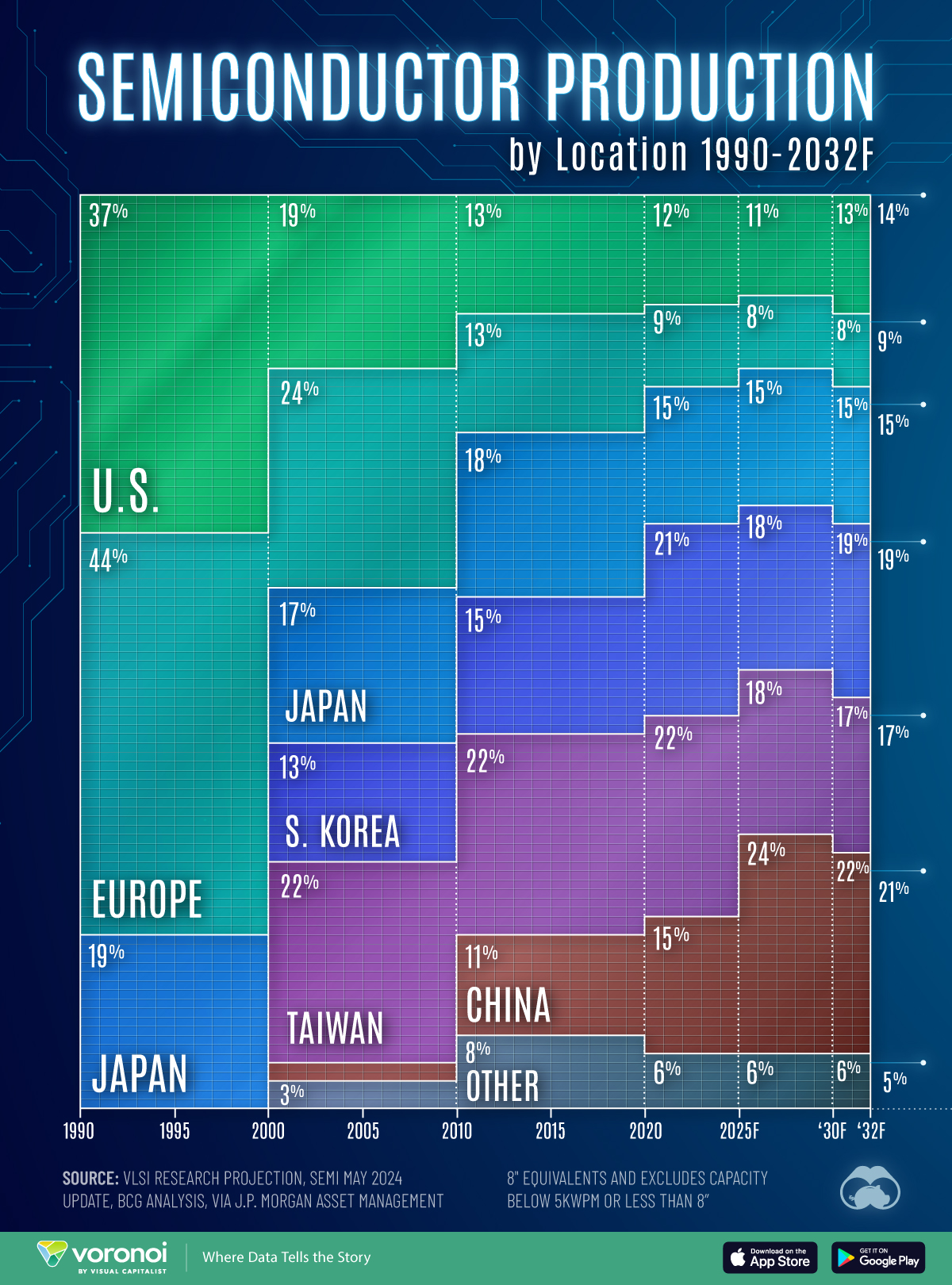
That seems a bit too simple. I saw one particular graph [0] once that really stuck with me illustrating just how decisively Europe was ejected from the semiconductor market. It takes more than just inaction to achieve results like that. In many ways it could be called an impressive feat that only the Europeans could achieve. 44% of production to 9% - losing a steady 1% of the market every year, largest to smallest player. No other region is even in a position to do that badly even if they tried.
It is possible. But that seems out of character for the Europeans, they're pretty consistent about going the distance to make absolutely sure that the next new thing doesn't happen in Europe.
It seems much more likely they had a suite of environmental, social and trade policies carefully calibrated to move semiconductor manufacturing somewhere else.
Part of it is simply the Euro being too strong. Taiwan has a (deliberately) undervalued currency that makes exports a lot more competitive, the EU does not.
It's a super simple strategy with profound effects but somehow still very underappreciated
>when they could have simply driven the few kilometers over to Eindhoven and bought an ASML machine for "Silicon Saxony"
That's not at all how it works. You're talking as if you're buying a plug-and-play Xerox copy machine that you can just unbox and start printing copies of your work and make money.
Buying the latest EUV machines doesn't get you the latest nodes and economically viable yields.
Intel, Samsung also have the latest ASML machines that TSMC has and yet they haven't caught up to TSMC because there's a lot more to semi manufacturing that just the machine itself.
If Germany just buys an ASML machine it would be an expensive paperweight without the process know-how that engineers at TSMC have amassed over the decades in order to get the most economically competitive yields.
It is so absurd to think that an investment in even the most uncompetitive fab while one has currently none is uneconomical.
Even if this fab is 3 times more expensive then other ones, the result of not having one will tank the entire economy and GDP of a nation if things go bad.
We speak here about trillions of damage while a fab costs only a few billions.
> Even if this fab is 3 times more expensive then other ones, the result of not having one will tank the entire economy and GDP of a nation if things go bad.
That's hogwash. Sorry. Human society won't simply stop working just due to the lack of 2nm chips.
There are plenty of chip manufacturers around the world, including EU ones. Taiwan only has the quasi-monopoly over the cutting edge process.
What are you talking about? There's a lot of fabs in Europe, just on much older nodes than Taiwan, US and Japan or even China have.
>We speak here about trillions of damage
Where did you get the trillions from?
>a fab costs only a few billions
Billions just to build, but then who's gonna foot the bill for running it, if the fab is not economically competitive to those from Taiwan and Japan, at EU domestic wages, EU environmental regulations and lacking knowhow supply chains that needs to be built up in the EU? The taxpayers again?
The German government (meaning the taxpayers) are still subsidizing energy costs to keep manufacturing from collapsing or leaving the country altogether because it's not internationally competitive anymore.
So how much more of the private sector should the taxpayers subsidize before we take a look at ourselves in the mirror that everything is FUBAR and that endless taxpayer funded subsidies(aka corporate welfare) are just disguising the endemic rot while not actually fixing the problem?
The only forward facing government that actually had a drive to change anything useful for the future broke apart with internal squabbles, with a big part of it by the market liberals torpedoing things left and right. And now we're back to a government of stand still, like we did the almost two decades before.
Not sure what you're talking about. The last "forward facing" government was about 50y ago, the last one at least driving meaningful reforms almost 25y ago. To me it seems the more Europe got integrated, the more Germany lost the plot.
This standstill mostly started happening when the capitalism took hold too deep and wide, look at Sweden and its golden age that lasted until all the restrictions on capitalism were silently removed.
While capitalism is a good model, it needs to be kept balanced, restricted..
Shareholder primacy is ruining everything, too much influence in politics from too many external sources.
What you are suggesting is vertical integration. If Europe goes crazy, can do that. From start to finish this chip thingy can become "magic crystals from Europe" as they already have control over the tooling. How many billions it will take to build the fabs with these tools and hire the talent from all over the planet and put all that in special economical zones? I don't know but I bet its less than those who don't have and end up buying the tools.
Europe is already a great place to build your life and despite the narrative about "EU killing businesses with over regulations", Europe is an exporter, that is EU makes physical things in large quantities(that's why USA is able to blackmail EU with tariffs). EU produces and exports so much, more than it consumes. Its closer to China than USA in this regard, you can check out the recent stats here: https://ec.europa.eu/eurostat/web/products-euro-indicators/w...
The infrastructure is in place and there are both many nuclear reactors that were decommissioned early or not yet commissioned but canceled/put on hold as well as regions with plenty of sunshine or hydro power opportunities and also has all the expertise to re-work those quickly.
It's really a political decision to push for something like that or not. Geopolitics may eventually make it happen, who knows? At this time it makes more economical sense to make the tools and send them close to the larger supply chain of electronic products production.
> Europe is already a great place to build your life
Agreed. Its countries' long-standing equivalents of America First policies mean that they spend far more on their own citizens, import far fewer people, and leave most of the charitable, defence, and research spending to the US taxpayer. Good for them.
I kind of agree that "America First" policies tend to be Europeanization type policies and as a result quite un-American and that's also why USA will end up like Europe if it keeps course.
Europe is great in many ways but lacks the dynamism exactly because of its highly controlled immigration policies instead of free market ones. Bureaucrats actually are terrible at picking who should come. A major example are the Turkish immigrants to Germany, where they imported huge numbers of Turkish immigrants for their booming car industry in the 60s and instead of just treating them like normal people they did this "guest worker" thing and as a result those Turks failed to integrate and remained in the low socioeconomic status with exception for some high profile cases like the inventors of the mRNA vaccine or the Crysis founders. In other places like UK or USA, Turkish immigrants tend to have much higher socioeconomic status.
If EU end up doing its chip and energy industry push, better be following the pre-Trump era immigration policies because that's how USA got is all the workforce that make USA leap ahead in many industries. Some French or Swedish immigration officer would not be picking people better than industrialists or startup founders. Immigration and its integration are not Europe's strong traits.
I think that's a good point, but with the caveats that:
Immigration and benefits are in opposition - the more immigration you allow (unless it's careful, skills-based) then there's a strong risk of costs of living rises (e.g. housing becomes more expensive with immigration) and benefits systems requiring higher taxes to pay for them. European countries can sometimes be very strong on immigration (e.g. Denmark) likely because of this reason.
Entrepreneurialism and benefits are in opposition - the more benefits you offer, the higher the taxes need to be, and so the less worth it it is to take risks with money or with time. It's just a tradeoff between risk and safety, and Europe in general (or Western Europe, at least) is more tuned for safety. And why not, if the US is willing to take the risks?
>Meanwhile Europe only got 40k WSPMs of 12+ nm capacity
EU leaders and VCs gave up on the electronics industry 20+ years ago and just kept offshoring it to the cheapest suppliers to lower costs and increase shareholder value.
You can validate this by looking at which sectors pay the highest EU wages and you'll see that hardware and electronics are not in the top.
And working in the electronics industry requires highly skilled knowhow and academic specialization, and you're not gonna attract people there if you don't pay them top wages if they can get more money and an easier job somewhere else like writing CRUD SW or pushing pencils in a bank.
>Not everyone is motivated by the highest wage they can get.
THis idealism always goes away once you have to buy a home, and realize you're working more hours and getting less money than your mates in other industries that are easier to get into, so you start to switch really quick.
People aren't selfless when it comes to being exploited by private sector entities, they'll always go towards the ones with the best wage/hour ratios.
People aren';t stupid. Why would they voluntarily choose to work harder and be less well off? It's not like this is working for the public good like medicine, firefighters, EMT, education, etc.
If Trump was European he would have long ago said “i only allow export of ASML machines if openai/nvidia/tsmc build 5gw urgently here in Europe with advanced nodes”. Fair if you ask me tbh
Well there you go. The EU talks the big talk on "domestic sovereignty" but never puts their money where their mouth is, or when they do, it's breadcrumbs, just enough to keep it on life support, let alone to be in the top contenders.
EU never had significant chip fabrication (instead having a lock on the tooling) whereas Japan and the US essentially pioneered high-end chip manufacturing before losing ground to Taiwan and Korea.