Canada is embarking on a trade agreement with India and collectively our greatest fear is the immigration issue. Canada's immigration is already quite lop-sided.
> Canada's immigration is already quite lop-sided.
I don't even understand what "lop-sided" means here.
Would you say that Canada's oil and softwood businesses are lop-sided because we produce and export a lot of it? Or that the groceries' market is lop-sided because we don't produce a lot of it and therefore have to import?
Canada is an importer of people (not only from India) because it can't produce a lot of people. It is not different from groceries.
Is India lacking in variety? It has more languages than Europe.
Variety isn't a bad idea in and of itself. But you're making the mistake of assuming all the people who live inside a particular nation's boundaries are the same.
India as a whole is diverse. Canada is NOT getting immigrants from all of India but rather from 2 states (mostly one). Please learn about the issue first.
The majority of Indian immigrants to Canada are coming from one state, Punjab, so the benefits of diversity within India is not necessarily reflected in the Indians coming to Canada.
Because there are so many Indians around, newly arrived Indians tend to spend most of their time with other Indians, and as a result don't integrate with the rest of society as much as previously waves of immigrants did. Canada is a cultural mosaic, but a certain degree of intermixing and assimilation is necessary, in my opinion, to preserve social and national bonds.
Honestly so is the USA. Yes there is racism, more than I used to think, but it’s below average.
Not being racist is really a pretty modern idea that didn’t become popular anywhere until the last 50 years. For most of human history it was conventional wisdom that (whatever I am) is the obviously superior form of human. Statistically this is probably still what most living people think.
I mean of course whatever you are is the master race. Isn’t it obvious?
Do you appreciate that, in the wider historical context, this position is an exceptionally radical one? You seem to not understand how there could even exist a difference of opinion on this, but I'm confident that this outlook of humans as being completely fungible, transactional economic units would appear unthinkable to anyone throughout 99% of human history. Just the suggestion that a nation's population should be restocked by swapping it out with another nation's population would be tantamount to treason any time prior to the revolution of the 1960s.
Immigration is absolutely a part of this deal. Interestingly, EU official communications and western media barely mention this, but the Indian government's official communication tout a "new framework for mobility" that will "open up new opportunities in the European Union for Indian students, workers, and professionals." [1]
The quote is “Alongside this ambitious FTA, we are also creating a new framework for mobility. This will open up new opportunities in the European Union for Indian students, workers, and professionals.”
I read it as he is working on a separate deal besides the aforementioned FTA.
As the immigration is governed by the member states themselves and not by the EU, I don't see how it can be "a part of this deal". Which is probably why the media don't mention this. There is nothing to mention.
> look to send them abroad to prevent domestic unrest
Great, now other countries can import and share that domestic social unrest from the oversupply of frustrated reproductive age celibate males, all in the name of making GDP number go up. Lovely.
Surely using hindsight of documented history and well researched human behavior science, we can't already predict this will lead to a rise in political far right extremism, and everyone will be shocked as if it will suddenly come out of nowhere, and then the local males will exclusively be to blame for it, leading to further frustration, radicalisation and disenfranchisement. Surely this is not EXACTLY what's gonna happen.
India gets a metric fuckload of money back in remittances every year. Debatable if that's actually worth the brain drain, but then there's also the angle of having your young people learn from the rest of the world and return with new skills. I lean more towards the remittances though.
Canada as a whole has been pro immigration for a long time, but our immigration system was broken in recent years, and the most visible consequence of that has been an enormous increase in low skill, low wage Indian workers. A lot of people who have never had issues with immigration policy before have become very anti Indian immigration as a result.
I think there's some particular niche immigration programs (ie. TFW) that have been broken because bad actors are aggressively defrauding the government, but I wouldn't say that Canada's system is broken beyond that.
I'm skeptical that an increase in so called "low skill" workers are even a problem considering that the country is experiencing labour shortages that have contributed to construction costs being so out of whack that building new buildings is unviable.
Now we've "solved" that problem by turning immigration down to zero but that is a kludge and not an actual long term solution to systemic problems.
It's pretty hard be critical of the need for supposed "low skill" immigration when pretty much all of our settler ancestors were penniless dirt farmers.
I agree for the most part. I said immigration is broken, but really the problems are almost exclusively to do with the TFW program and degree mills. One area the TFW program has hurt the country, is in the significant reduction in the number of jobs available to high school students. Anecdotally, I know of many high school students who have been unable to find any work for years, and a stop into any local fast food restaurant or superstore will back that up. These kids looking for part time jobs don't show up in unemployment numbers. They could help the labour shortage, but instead are silently being added to it, in favour of temporary foreign workers filling the positions.
We do need immigration long term for sure! Canada is and will always be an immigrant country. That said, I also don't think an appeal to the past (the fact that almost all of our ancestors came as penniless farmers) should enter into the conversation. To my view, this is a dispassionate conversation about politics. Concerns over hypocrisy are irrelevant.
Construction is not really a low-skill profession anymore, and needs highly qualified workforce to thrive. Buildings of 2026 are de facto complicated industrial robots.
>I'm skeptical that an increase in so called "low skill" workers are even a problem considering that the country is experiencing labour shortages that have contributed to construction costs being so out of whack that building new buildings is unviable.
I'm skeptical that those migrants helped add more to the housing pool than their own needs.
That's more related to the fact that housing policy in this country is more oriented to helping landlords stuff ever more renters into a basement suite than it is enabling people to create homes.
Questioning immigration policy is not racism. Anti-Indian sentiment in Canada is relatively recent and happened after a decade of mass immigration that is now widely agreed has contributed to a noticeable decline in the quality of life for all.
"Widely agreed" meaning the National Post and other foreign owned conservative press banged the drum on the issue endlessly for years and years and now people are thoughtlessly repeating the talking point.
This is undoubtedly happening (and we need to do something about foreign owned press in this country), but I think this is too convenient a story. I am a socialist and I have become extremely concerned about immigration in recent years. I want to talk about those concerns and work towards solutions that are amiable for our country, Canadians, and immigrants. Unfortunately, a lot of people who otherwise share my beliefs, don't seem willing to acknowledge that people like me (who strongly oppose the National Post propaganda organ) exist.
You don't understand, and your unwillingness to approach this issue with the nuance it deserves will only drive people towards right-wing extremists. These people are not racists! The federal government increased immigration (largely of TFWs and students) by far too much, and that has put an enormous strain on Canada's housing and job market. Canadians are turning against broken immigration policy, which has naturally become associated with its most visible aspect--the recently arrived, unskilled Indian worker. You must understand the negative sentiment is driven by association with bad government policy, not naive racism towards Indians. Of course, none of this is the fault of individual immigrants or TFWs, but they are part of the problem, because they are symptoms of it.
Racism is a serious allegation. Let's not cry wolf when there is a reasonable explanation here.
No one said "everyone from their country is a bad influence." Indians were viewed as model immigrants in Canada for decades. Again, their good name is being tarred due to bad government policy.
My point is is that if leftists cannot talk about immigration policy in a nuanced way, right-wing extremists (for there are no other kinds of right wingers these days) will be the only game in town, and people who want to talk about immigration policy will therefore be drawn towards them.
Humans see patterns in everything, that's how we work. You can be a naive idealist all you want, but that doesn't change the fact that people will inevitably associate the effects of a bad policy with the policy itself.
US immigration policy was explicitly racist from its founding up until the Hart Cellar act of 1965. Assuming that the 2016 election of Donald Trump is your benchmark for when immigration policy became determined by racists again, then the US's immigration policy was non-racist for 51 of the last 251 (and counting) years, or 20% of its history.
Safe to say that the 1990s "End of History" theory has been proven wrong. It may be that the ~1960s-2010s "post-national" political consensus was actually just a historical aberration that is still in the process of being unwound.
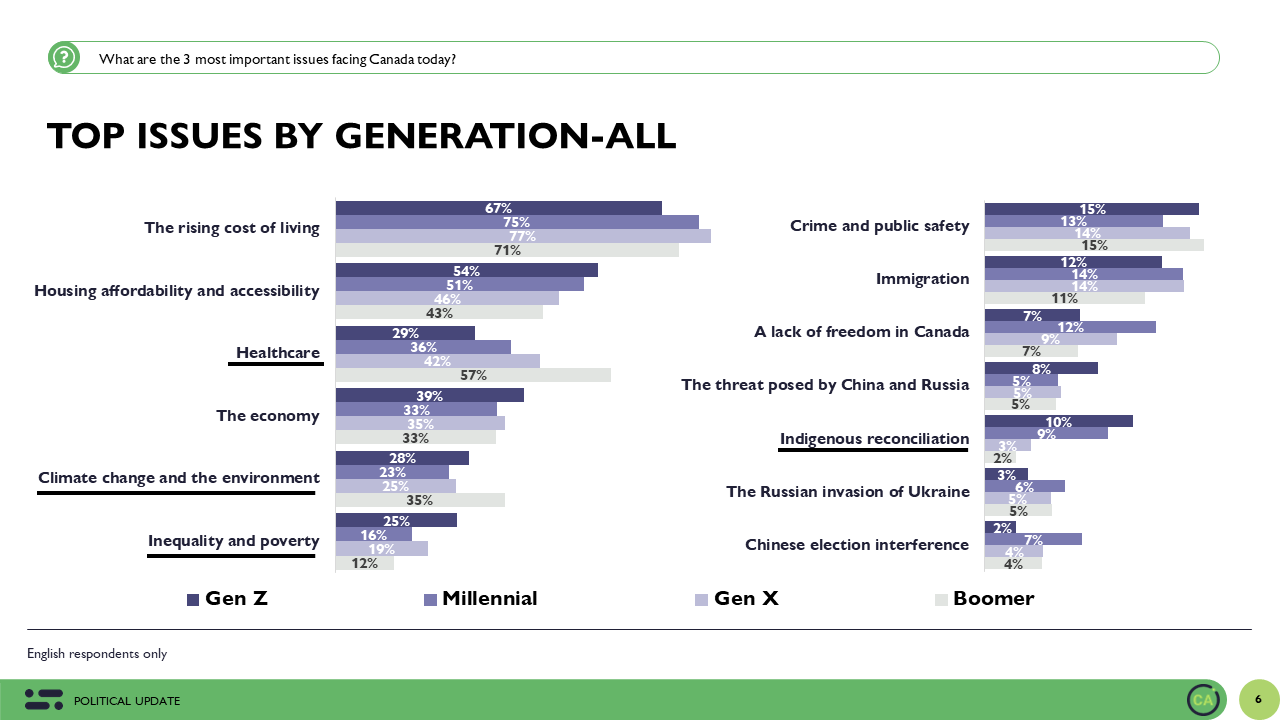
Leaving aside the fact that this is a single picture of a chart with no source provided (or sample size, or methodology)... that's eighth on that chart, not fifth, and just says "immigration" with no further detail.
Canadians don't seem to have their priorities straight if they are more concerned about having a few more Indian neighbors than the US threatening to invade.
Ironically, the chart you've pointed out doesn't indicate the raw numbers, just proportions. 30% of immigrants being from India sounds perfectly reasonable. What's the problem?
It is worth adding here that in the years after Covid began, the raw number of immigrants reached record highs, in some years more than doubling the previous (steady) intake rate.
The Netherlands is preventing is trying to prevent hyperscale data centers from being built because they require as much energy is a year as a small city. I can't imagine dismissing the import of a small city's worth of Indians quarterly as trivial.
Do you believe Trudeau could have made a speech like Carney did at Davos? Or that he would have been so active in signing new trade deals and international agreements, or on dismantling internal trade barriers? I think there is a world of difference between them.

I don't even understand what "lop-sided" means here.
Would you say that Canada's oil and softwood businesses are lop-sided because we produce and export a lot of it? Or that the groceries' market is lop-sided because we don't produce a lot of it and therefore have to import?
Canada is an importer of people (not only from India) because it can't produce a lot of people. It is not different from groceries.