Hacker News new | ask | show | jobs
by actionfromafar 235 days ago
A large amount of Fast Ram would have been even more useful, but if you are cost optimizing the BOM, just a tiny sliver of it (it being Fast RAM) would have been effectively a "manual cache" managed by the developer and would have been incredibly useful for anything computation intense, like flight simulators, spreadsheets, anything not involving just blitting graphics really.
2 comments

And it wouldnt even be that hard, just two 2kx8 SRAMs (like the ones in every NES/Famicon) and CS line going from the chipset to map it somewhere high outside the range of the chipset was very logical, easily doable in 1987 and most importantly cheap. Those 6116 srams were below $2 retail in 1987 (Byte magazine retail prices), so $4 for big performance boost.

Hell, smart Commodore would design A500 with second trapdoor near the CPU. Ship unpopulated but offer official Commodore "turbo ram" expansion carts:

- $25 4KB version. $8 BOM, 2x $1.95 6116

- $40 8KB. $12 BOM, 2x $3.5 6264

- $100 64KB. $28 BOM, 2x $12 62256

- Extreme $400 256KB. $120 BOM, 8x $12 62256. Would stick out due to big PCB so make it an attractive piece of plastic with cool logo and "EXTREME" design.

Map it at D80000 (potential 256KB of space for activities) and let software vendors auto detect fitted option by running quick memory test. Easy speed boost and easy extra money for Commodore.

I tried to answer at greater length here:

https://news.ycombinator.com/item?id=45745754

But I think in reality, less money for Commodore because of sales lost to the now-even-cheaper Atari ST.

I think I see where you are coming from now.

You are not saying "there was no uncontended RAM in the Amiga", which is what I understood you to mean. You are saying "the Amiga did have uncontended RAM but it did not ship with any as stock."

Is that right?

If so, yes, true, but the key things here IMHO are:

1. The Amiga was designed and built as a games console, one which happened to be able to do other things. It was primarily marketed and sold as a games machine.

I wrote about an Amiga-compatible OS recently:

https://www.theregister.com/2025/05/22/aros_live/

And the comments are from slightly baffled readers asking if this is any good for running their old Amiga games, or how this makes gaming any easier.

(It is not and it does not, but that is what people perceive the Amiga as being for in the 21st century.)

2. In the real 1980s market, the Amiga's glory was to a large extent stolen by the Atari ST. The ST was a much more limited machine but it was vastly better than any 8-bit machine, and an entry-level ST was more usable than an entry-level Amiga.

ST games were pretty good for the mid-1980s when a lot of people still had ZX Spectrum or Commodore 64 level kit.

Many games companies targeted the lower-end machine and ported to the higher-end one.

The Amiga was competing with the cheaper, simpler ST in the market, and keeping the costs down became imperative. That's why Commodore didn't add more hardware or more RAM to the base-level Amiga. In fact for the Amiga 600 took the spec of the A500 and cut it down.

I am not arguing that some Fast RAM as stock wouldn't have been good. It would. But probably irrelevant to most gamers, and probably would have hurt the machine's sales.

I am convinced as little as 32 bytes of uncontested (fast-ram) would have made wonders. It would almost have been like doubling the number of data registers on the 68000. Either an extra chip with address decoder and this scratch memory could have been placed on the 68000 memory bus... this would 100% have worked.

Or much better, the Agnus chip could have had this scratchpad added into it. It should have been feasible - it had about 20k transistors IIRC and a few hundred more should have been doable. I am fairly certain this would have worked but I'm not completely sure, it depends on if that addition would have complicated multiplexing and/or internal bandwidth demands, but the 68000 ran at 7MHz at the time, so it doesn't seem too difficult to me, armchair designer.

Thanks for the article! It's always nice to see AROS and Amiga get some love. :)

Achschully AROS m68k can be helpful for playing your old Amiga games in an otherwise open source way. You don't have to buy or pirate the official Kickstar ROM images if you use an AROS m68k ROM instead. But on the other hand, realistically you would probably pirate that old Amiga game to begin with, it's not like you have your old floppies lying around and if you did, you'd need a floppy drive to read them anyways...

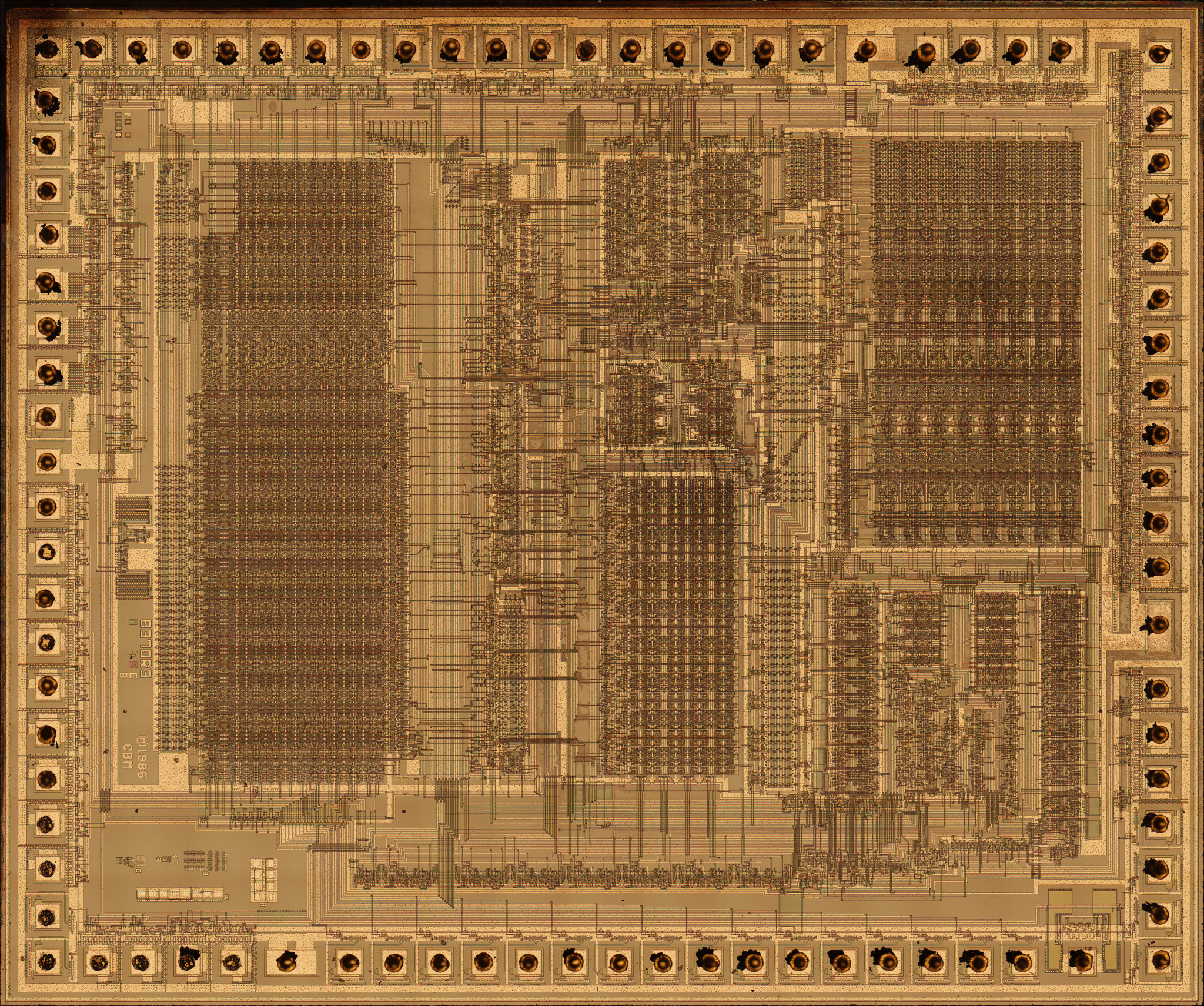
Dieshot of Agnus:

https://upload.wikimedia.org/wikipedia/commons/9/9f/CBM_8370...

You could maybe attach an external SRAM. Bit more ideal then putting SRAM in the NMOS chip on die.
This view is at odds with reality of 1 in 5 Amiga games already not working at all without third party trapdoor ram expansion. And those were the good games everyone wanted to play. Games would support or even require fast ram if Commodore made adding it easy and cheap like they did with chip ram trapdoor. That means either small SRAM scratchpad or build in fast ram DRAM controller so you are only adding ram on simple PCB instead of being forced into $500 a590 kitchen sink.

https://www.mobygames.com/game/attribute:268/include_dlc:fal...

On the other hand braindead lack of planning making early Amigas 1MB limited resulted in less than ~10 games ever using more than 1MB. Rare exceptions are for example Wing Commander loading some additional animations with >1MB available. There were also games that hardcoded check for exactly _1MB_ and refused to run with more :)

Yes Amiga was a gaming machine first. Chipset independent scratch SRAM would do wonders for games _IF_ it was introduced together with first A500 like trapdoor ram was.

Running code from 7MHz fast ram bumps amiga from 0,57 to 0,75 Mips, 30% speed bump.

Another Amiga missed opportunity was clocking CPU faster when its not accessing chipset/chip ram. This is possible at the staggering cost of one D flipflop and was figured out in 1989 https://aminet.net/package/docs/hard/14MhzA500 http://amigaga.chez-alice.fr/classic/bidouilles/hack/overclo... Works because 68000 is a horrible CPU with very long cycle count instructions.

Why bother? The 14MHz mod alone gives a diminutive but _free_ bump from 0,57 to 0,62 Mips, but marrying together 14MHz and running from SRAM fast ram bumps us into 1,51 Mips https://www.youtube.com/watch?v=2nlG8dGvq-U thats 20% faster than 5 years older Amiga 1200.

Even 8KB of dedicated fast ram would be ideal for small fast loops, and there is plenty of those in games.

Lets not mention Commodore being so incompetent they couldnt find/wouldnt pay for an ASIC designer to update Paula PLL in order to support HD floppies :| Plenty of low hanging fruits nobody at Commodore bothered or knew how to make happen.

That accelerator is amazing, thanks for sharing. It upgrades the A500, released in 1989* to be faster than the A1200, released in 1992. The design is "time period correct" too, it doesn't do anything that couldn't have been done back then.

But... how is that possible? The Amiga 1200 has a 32 bit wide bus and is also 14MHz?! Commodore did the stupid thing again and didn't put any fast-RAM on the machine.

* The Amiga 500 is basically a cost optimized Amiga 1000, released in 1985.