The Karatsuba algorithm page says "The Toom–Cook algorithm is a faster generalization of [the Karatsuba algorithm]]", and the Toom-Cook page links to the GMP document, which says:
"Toom-3 is asymptotically O(N^1.465), the exponent being log(5)/log(3), representing 5 recursive multiplies of 1/3 the original size each. This is an improvement over Karatsuba at O(N^1.585), though Toom does more work in the evaluation and interpolation and so it only realizes its advantage above a certain size."
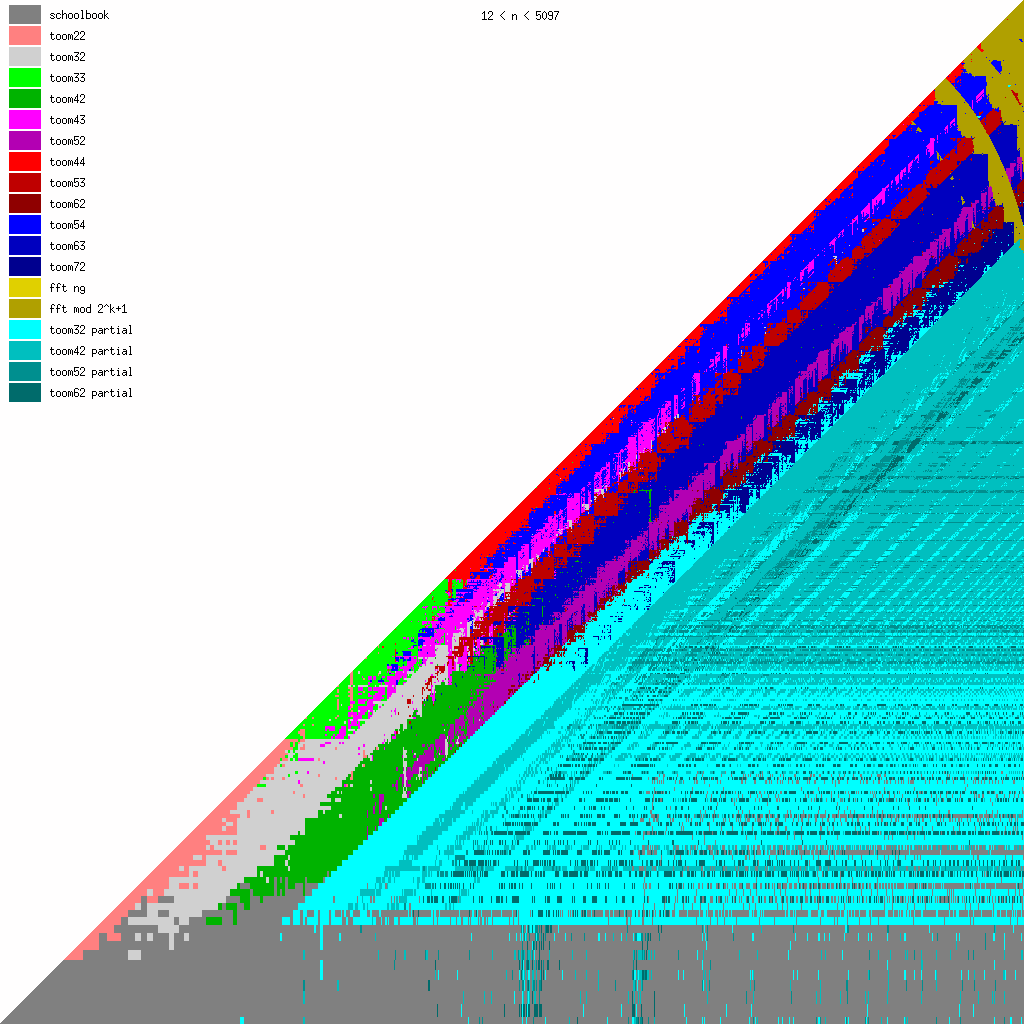
Reading http://gmplib.org/manual/Multiplication-Algorithms.html, it appears that GMP implements: Karatsuba, Toom-3, Toom-4, Toom-6.5, Toom-8.5, FFT -based multiplication methods, which I interpret to mean that Toom-Cook is useful for ranges between where Karatsuba and FFT are most useful.
i still don't consider this news - i stumbled upon this the first time i had to implement multi-precision multiplication - its a standard technique. if someone posts linked list wiki article is that news because for some situations arrays are faster and in others trees are?
"Toom-3 is asymptotically O(N^1.465), the exponent being log(5)/log(3), representing 5 recursive multiplies of 1/3 the original size each. This is an improvement over Karatsuba at O(N^1.585), though Toom does more work in the evaluation and interpolation and so it only realizes its advantage above a certain size."
Reading http://gmplib.org/manual/Multiplication-Algorithms.html, it appears that GMP implements: Karatsuba, Toom-3, Toom-4, Toom-6.5, Toom-8.5, FFT -based multiplication methods, which I interpret to mean that Toom-Cook is useful for ranges between where Karatsuba and FFT are most useful.