Hacker News new | ask | show | jobs
by Zebra0815 5020 days ago
I'm a German and therefore do have another opinion :p

The anti-nuclear movement is not based on anti-scientific and scaremongering - we have Nobel price winners who support that cause and wrote scientific papers of this very issue.

The question asked by them is different from the topic you guys are talking about currently:

* What happens to the radioactive stuff that is created at the end of every of the energy producing process? We're not even able to keep information over thousands of years, how can we be able to big a hole and protect the environment (and our children's children) from radioactive rubbish? If this material is able to somehow get in contact with groundwater we do have a big problem for a whole region. In Germany we do still have forests that none is allowed to eat any fungi - because of Chernobyl which was about 20 years ago and hundreds of miles away...

The storage of radioactive material is a huge problem which isn't solved nowadays. Look at the amount of permanent disposal facilities: there is not a single one for that on the whole world. Even the USA do only have temporary facilities to store there highly radioactive material....

The 2nd problem is trivial: I do not assume that nuclear power plants are unsafe by default. I really do think that it's hard to crash one and bring it to the point of no return where everything blows up. But we saw a few times that it happened. That's technology, it's never a 100% safe. And that's also my problem. If something happens its not only an accident with a few people hurt but a massive disaster where several hundred people are radioactively contaminated, a whole region is uninhabitable and even your children's children have a great chance to give birth to disabled babies.

As I said...it's not that simple. There are a lot of questions still unanswered and this is what we currently see in Japan and saw in Eastern Europe 20 years before. The people will suffer and not only a few years but for generations. If we're able to build more efficient devices and to create other sources of power creation we definitely should do that as we're able to get rid of the (highly unlikely) chance that such a disaster is happening again.

If there are alternatives so why don't we use them? Let's see if it is enough technology out there to generative the energy we need. If no one tries, no one knows - there are studies for both sides of this issue but we do have to at least try it...

3 comments

As knowledge increases we figure out ways to use the waste to create more power and decrease waste. blogs.discovermagazine.com/80beats/2009/06/03/could-a-new-generation-of-power-plants-turn-nuclear-waste-into-clean-fuel/
That's an ideal world scenario. In an ideal world there wouldn't have been a earthquake stronger than suspected possible. In an ideal world there wouldn't be incompetent people running nuclear power plants. We have no reason to believe that we can economicly transmute nuclear waste, let alone by using fission.

When you use a technology like nuclear that has such a big risk, thinking about the worst case you can imagine even isn't enough.

Scaremongering...
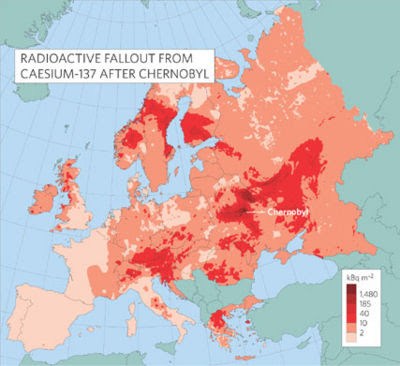
There are no such forests in Poland, and Poland is much closer to Chernobyl than Germany.
Look at the fallout map of caesium:

http://2.bp.blogspot.com/_wNICDkSSg1I/RuV773MrnDI/AAAAAAAAAA...

Poland was lucky with the weather.

> The anti-nuclear movement is not based on anti-scientific and scaremongering - we have Nobel price winners who support that cause and wrote scientific papers of this very issue

This doesn't necessarily follow, logically. In order to make the case, we'd need to go point-by-point.

> What happens to the radioactive stuff that is created at the end of every of the energy producing process?

Coal just puts it into the atmosphere.

Coal power plants filter radioactive substances, at least here in Germany.
but they spit out a bunch of other nasty stuff too. Plus: consider death tolls of each power source per KWh:

http://www.washingtonpost.com/national/the-human-toll-of-coa...

The more dramatic numbers are for old US coal power plants.

Newer or upgraded coal power plants have less effects.

But generally this is not a beauty contest. Coal power plants have to go. Unfortunately it will take a lot of time and money to replace (or even upgrade) the existing ones.

Power needs to be generated one way or another. Keeping nuclear for longer would mean we can get rid of coal sooner. Those numbers show that this would be a worthwhile trade.
And what happens with filters then?
Used as a material similar to concrete.
The fun thing about this argument, is that it's pro-nuclear. Nuclear fission reactors are the only thing on this planet that reduce radioactive emissions. By quite a bit even. Of course, after that reduction, we massively concentrate what is left and then store that absurd concentration in a really small spot, where "nothing can ever go wrong".

The problem with radioactivity is not nuclear power, it's the idiotic way we do nuclear disposal.

We should do what coal power plants do : simply process it into building materials. 10x thinner than background levels and just use it for anything and everything.

There are plenty of places on this planet where natural radioactivity levels are more dangerous than inside a modern nuclear reactor (Ramsar in Iran being the canonical example). A city built straight on top of radioactive rock, 200-500 times normal background radiation levels (like a constant dental scan, a little more than you'd get swimming in the primary coolant circuit of a nuclear reactor, 3 meters from an active fission reaction, without any separation between you and the reaction other than the water that sustains the reaction), yet you will not find a single trace of a nuclear power plant. And yes, they have a history of higher cancer rates (though not nearly as high as our radiation disease models predict they should be).

Good luck putting plutonium into building materials.
Which is fine, because those who get the cheap power breathe it, i.e. the risk/reward system is mostly local. As I have written several times before, nuclear power is a black swan type of risk with non-local risk realization, whereas coal has a more typical distribution of risk realization, and the effects are more local. This makes it hard to compare them by comparing average risk. As somebody from a country which decided against Nuclear by referendum just years before getting a lot of fallout from Chernobyl, I am also very sensitive to the fact that I have hardly any political influence on nuclear power plants that can affect me.