Hacker News new | ask | show | jobs
by spoaceman7777 298 days ago
All you really need to see is the picture of the CPU with thermal paste only on one half. Thermal throttling is tuned to work when there is 1. a sufficient heatsink (theirs was significantly below requirements) and 2. it is installed correctly so that its triggers for downclocking happen with the correct timing. This is just another instance of ridiculous PEBCAK error
3 comments

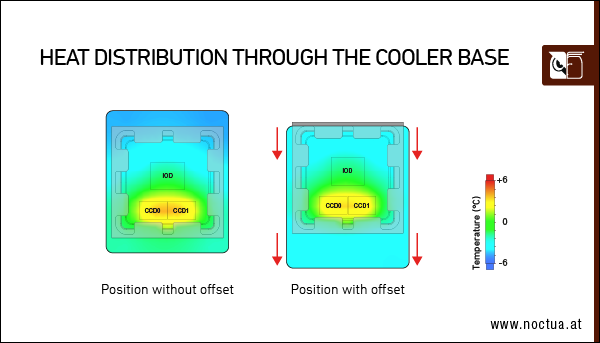
This is per design. On AM5 processors, there's a hotspot on the lower half of the processor where the dies that contain the CPU cores are located. Noctua recommends that AM5 users mount their coolers shifted towards the lower side of the processor for optimal cooling performance, see https://noctua.at/en/offset-am5-mounting-technical-backgroun... . You may have missed the paragraph in the article that explicitly points this out:

> We use a Noctua cooling solution for both systems. For the 1st system, we mounted the heat sink centred. For the 2nd system, we followed Noctua's advice of mounting things offset towards what they claim to be the hotter side of the CPU. Below is a picture of the 2nd system without the heat sink which shows that offset. Note the brackets and their pins, those pins are where the heat sink's pressure gets centred. Also note how the thermal paste has been squeezed away from that part, but is quite thick towards the left.

While it is noctua advice, I don't think AMD supports that view, so it would seem correct to at least test the cpu the way the vendor recommends before making conclusions
You may have missed the part in the article that says that they only switched to offset mounting after their first Ryzen 9950X died when the cooler was mounted centered.

> But note that the 1st failure happened with a more centred heat sink. We only made the off-centre mounting for the 2nd system as to minimise the risk of a repeated system failure.

Noctua recommends mounting their cooler so that the center is shifted toward the lower part of the CPU. From your picture with the thermal paste, it’s clear that your cooler is only making contact with about two-thirds of the CPU, meaning you mounted it incorrectly. The cooler’s contact area must always cover the entire CPU; otherwise, you reduce heat transfer capacity. On top of that, you’re already using an undersized cooler for this CPU. I think you don’t understand the basics of thermodynamics.
Welcome to Hacker News! I'm glad my comment encouraged you to join the site.

I didn't write the article, I was just commenting because other users seemed to miss information that was written in it.

The picture with the thermal paste shows that paste was squeezed out from the entire perimeter of the CPU, so the cooler is making contact with the whole CPU. The paste is squeezed thinner near the lower side of the CPU because that's where the mounting pins are located, meaning that's where the mounting pressure is the strongest. The impression left by the thermal paste matches the diagram on Noctua's site ( https://noctua.at/pub/media/wysiwyg/offset/heat_cooler_base_... ).

Noctua lists the NH-U9S cooler as being compatible with the 9950X, and claims it has "medium turbo/overclocking headroom", see https://ncc.noctua.at/cpus/model/AMD-Ryzen-9-9950X-1831 . I'm not sure how they come up with their compatibility ratings, but I generally trust Noctua knows what they're doing when it comes to CPU cooling.

It's also important to note that the author only tried the offset mount after they had a CPU die when the cooler was mounted centered on the CPU.

Overall, I think it's unlikely that these failures can be blamed on poor cooling.

i'm not sure what image you're looking at, but the picture in question here most certainly shows a CPU that did not have a properly mounted heatsync (to a very severe degree)
Clearly paste was squeezed out from the entire perimeter of the CPU. Offset mounting is used intentionally for this CPU.

Probably there's less paste remaining on the south end of the CPU because that's where the mounting force is greatest.

If anything, there's too much paste remaining on the center/north end of the CPU. Paste exists simply to bridge the roughness of the two metal surfaces, too much paste is a bad sign.

My guess is that the MB was oriented vertically and that big heavy heat sink with the large lever arm pulled it away from the center and north side of the CPU.

IMO, the CPU is still responsible for managing its power usage to live a long life. The only effect of an imperfect thermal solution ought to be proportionally reduced performance.

Many reviewers have tested that too much paste is not an issue, except being messy to clean.
The experiments comparing different paste and application methods I've seen only make 1-2 degree C difference. Which enthusiasts might care alot about, but most people wouldn't notice.
I'm not as sure about AMD CPUs (and they were known for having far worse overheat behaviour back in the early 2000s) but there are plenty of stories of Intel CPUs working for many years, sitting at the thermal limits, with the (stock) heatsink not even in contact, thanks to their cheap push-pin retention mechanism.
Those dreadful plastic knobs never want to sit right. Simple lever over that shit any time of day, pls.