Hacker News new | ask | show | jobs
by undebuggable 289 days ago
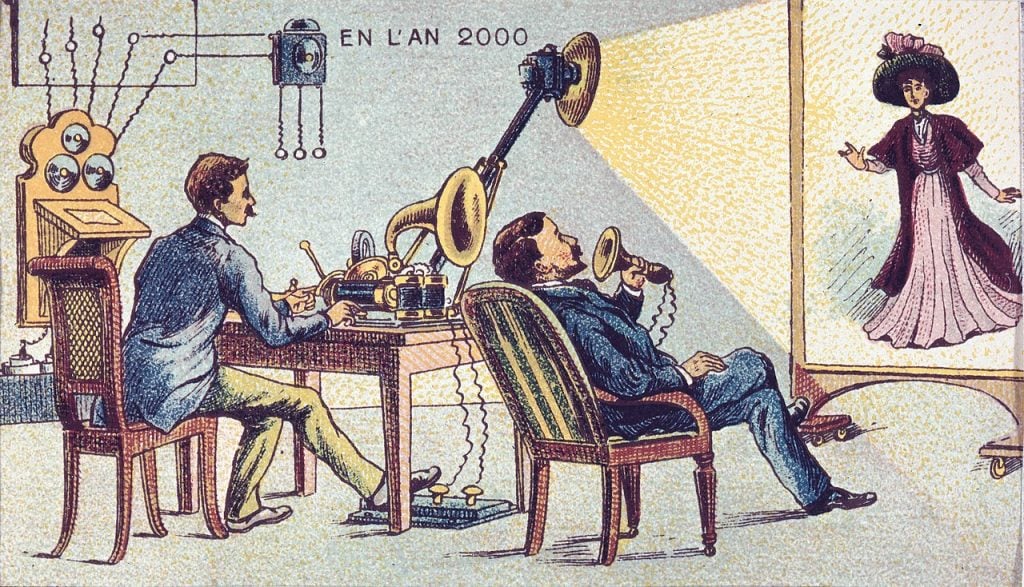
That's one of the reasons why touchscreen smartphones dominated the market in less than one decade. They made the dream of "real-time videotelephony from a rectangle" come true, a dream which had been present in literature and culture for around hundred of years.
2 comments

I read and watched quite a bit of sci-fi (including from the golden age) as a kid in the early 90s and don't recall such a dream. What media exactly did I overlook?
Jetsons cartoon, Back to The Future, Space Odyssey, even more distant predictions [1]? That's from the top of my head without even searching thoroughly.

[1] - https://news.artnet.com/app/news-upload/2021/09/1280px-Franc...

So the claim is that video calls are the interesting thing, not having a touchscreen interface or having the display cover an entire surface or being a single unfolded piece? (I had been struggling to understand what was special about "from a rectangle", since non-smart phones have had raster displays for much longer.)

Yeah, that really just never figured into my visions of "the future" as anything significant, I have to say. And even nowadays it doesn't seem like people often make video calls, given the opportunity. They'd rather take advantage of those displays to doomscroll social media, or see amazingly crisp (and emoji-filled!) text in a messaging app.

The point is it was a predicted future for 100 years and now it actually is here. Gen Z actually makes video calls all the time when elders would make normal calls.
And yet, while 90's (and earlier) TV was talking breathlessly about video communication, it feels like it just "snuck in" to our daily lives when webcams and e.g. Skype became mainstream, and it never felt magical. Of course, the demos were tightly scripted and stifled.
When I first got our labs two SGI Indy's webcams pointed at each others relevant coffeepots over ISDN, with 30km's space between them, there was definite magic.

The same when I sat in the hills of Griffith Park with a Ricochet modem and a tiBook, wondering how much ssh'ing and CUSeeMe I'd be able to do until the batteries ran out.

Once these kinds of activities became integrated into a laptop, the magic of all of the pasts' future predictions definitely became atmospheric.

Were you really still using CUSeeMe in 2001+ (when the tibook was released)?
Yes, it was a regular tool for determining if there was still power to various racks around SoCal, and the reason it was still in use was because those racks were in various locations around SoCal and nobody had the budget to switch to something else (plus, CuSeeMe binaries for SGI were a thing...)
Hah! I thought we were the only ones. I was using it to watch the screen of a machine with no other out-of-band monitoring, in a server room in 2002, mostly because "I've been using it forever and it still works".
Yes indeed, in fact my early productive use of videoconferencing mostly didn't involve humans, but rather - as you say - out-of-band monitoring of devices and systems.

On occasion it was nice to know when some tech was also in the closet, in case I knew their # and could get them to flick a switch or two, on my behalf, in lieu of the 1 or 2 hour bike ride (depending on traffic) I'd have had to endure to use my own fingers...

I saw a BBC archive video about AMSTRAD. AMSTRAD owned a PC manufacturer called Viglen. In the archive the CEO of Viglen was having a video call to someone offsite presumably on what looked like Windows 3.11. This was 1995.

https://youtu.be/XX53VbgcpQ4?t=793

In the same video the salesman was selling a Pentium 75MHZ machine. So it must have run on a PC of similar specification.

People had seen the tech working in some form on TV for some time. It just wasn't mainstream.

Skype made the the first major milestone. The software and network parts were "simply working" but the hardware part, CRT displays, headsets, and webcams, were still plasticky and tacky.