Hacker News new | ask | show | jobs
by yold__ 304 days ago
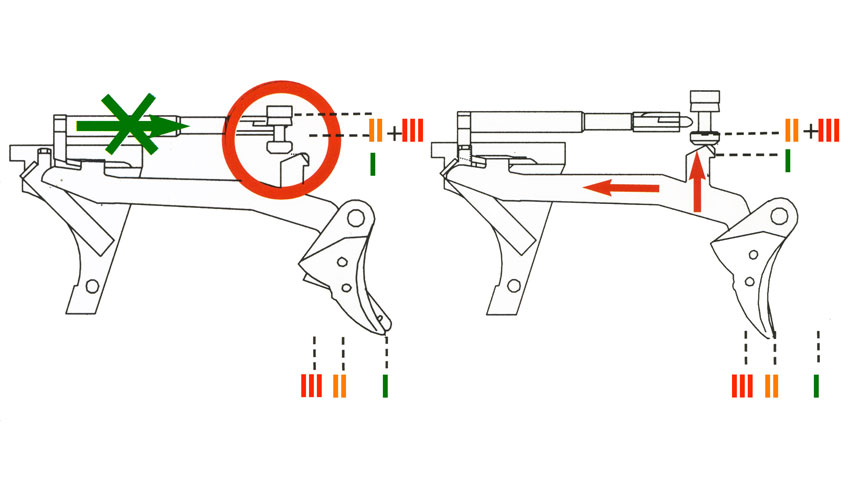
In a nutshell, the defect that causes the guns to fire when holstered occurs when there is a small amount of pressure on the trigger. If the slide (top part of the gun) is wiggled / nudged, it will fire. Also, the gun can fire when dropped. Both these issues are mitigated by other manufacturers with a trigger safety and longer trigger pull.
8 comments

>Both these issues are mitigated by other manufacturers with a trigger safety and longer trigger pull.

And just not having hot dog down a hallway tolerances at the slide to frame interface.

The trigger stuff lives in the bottom half of the gun and the bang stuff lives in the top half and only goes bang depending upon the relative position of the trigger stuff. So allowing the top half and the bottom half to move around a ton is generally unwise unless you make accommodations elsewhere in the design so that you still have proper relative position regardless of where in the hallway the hotdog is.

Also, they’ve had numerous issues with their triggers failing to reset correctly and/or otherwise misbehaving. That was the focus of the original ‘voluntary upgrade’.

That this giant mess of bad tolerances, sloppy change management, iffy manufacturing outsourcing, and a design which is sensitive to these issues it seems inevitable these kinds of random and hard to reproduce problems would occur. And the more they sold, the worse it would get.

Do that in something which literally can cause death and serious injury if it fails, in an environment where all your competitors designs don’t have these issues and hence users tend towards ‘round in the chamber’ and carrying them in all sorts of messy real world situations? Guaranteed disaster eventually.

Bad sig.

The brand was dead to me many years ago (extractor snapped in the middle of a course - seemed like bad metallurgy, or a bad design), but this is entirely another level of crazy.

Agreed. One of the greater examples of brand destruction of the 21st century.
There are videos online showing that this also happens with Glocks (when the trigger is depressed to the wall) [0]

Really, any gun where the sear is in the grip and the part it connects to is in the frame could have the same issue.

https://www.youtube.com/watch?v=OaV32HarnRY

I think Jared's video is good at conveying the mechanics of striker-fired guns, and he is completely correct that this issue exists to some degree in every striker-fired gun (and is not an issue in them). However, the parts in the P320 have so much variance that the wall is very "mushy" on some of these guns. I wouldn't be surprised if we find that these uncommanded discharges involve both movement in the trigger and movement of the slide.

It may be the case that variance is so wide that there are some P320's which are in that "depressed to the wall" state at rest, but that would require an x-ray or CAT scan of the offending guns, and I don't know if anyone other than Sig has one. There is also a safety on P320's that should be stopping this from happening, but again, it is a part with very wide variation, and on some guns it seems it doesn't work (Sig issued a recall over this already).

I agree with Jared that this problem is a lot trickier and weirder than people give it credit for. The sort of core of the issue is that everything about the gun was done cheaply and they flew a little too close to the sun, but I believe they have no idea what in particular they cheaped out on too much.

I understand your speculation on the amount of variance, but I haven't seen any data to support it.

Sig's "recall" was a drop-safety issue, where in certain orientations the weight of the trigger could generate enough momentum to allow an unintentional discharge.

There's plenty of data on the variances of P320 parts being much larger than specified by Sig, and it has been presented in a few court cases. Root causing this issue to tolerances hasn't been done, though.
I'm curious what the different levels of "cheaping out" saved in terms of manufacturing cost.
So am I. I expect that Sig doesn't know what to fix here because taking every part up to be more precise is very expensive.
This video does not show a Glock firing with a "small amount of pressure on the trigger", which is what the OP said the issue w/ the P320 is
It does. This whole "small amount of pressure on the trigger thing" stemmed from a video by "Wyoming Gun Project", in which he did the exact same thing to a P320.
Glock, unlike Sig, uses a trigger safety. It doesn't just require any trigger pressure, the lever safety needs to be pushed back. Is this bad? Of course. The Sig flaw is sig-nificantly worse.
I'm pretty sure you're not implying otherwise, but it's an outrageous design flaw regardless and selling these while being aware of the problem (to the military no less!) should carry devastating consequences for the manufacturers.
The gun firing when the trigger is being pulled is not a design flaw, and it is 100% mitigated with the safety that the military has in their guns.
Nobody is talking about the gun firing when the trigger is pulled. The gun is firing when the trigger is explicitly not pulled. Even if you're talking about the video the parent comment linked, the very first few seconds of the video show the gun discharging without a finger anywhere near the trigger. That's a deadly design flaw that in any other industry should have resulted in a full recall. Here, it was known and covered up while innocent people who made no operational error were maimed. To suggest otherwise is denying objective reality.
I think one of the best demonstrations of this, with detail on the amount of travel required for most striker-fired handguns is this video [0]. Lots of detail and relatively methodical.

[0] - https://www.youtube.com/watch?v=L17Mq7XxtlE

So a classic sig double action or 1911 wouldn't be effected? He video says striker fired specifically. Cocked and locked I'm not sure how you would make this happen.
Hammer-fired guns have a similar issue if you drop them directly on the hammer (or on parts that can move the hammer) when the hammer is cocked. When the hammer is not cocked, there's no available energy in the firing mechanism to discharge the gun. Striker fired guns are effectively in the cocked state at rest, though. In a "cocked and locked" state, you would need the drop to disengage or overcome the safety, not just the normal trigger mechanism.
Not affected in the same way. The original M1911 design has a floating firing pin held back only by spring tension, so in theory it might be possible to get it to discharge without pressing the trigger by dropping it straight onto the muzzle from a sufficient height. This is so unlikely in practice that it's not a real concern. Some newer variants also incorporate an extra internal safety that blocks the firing pin from moving.
With the safety on too. Interesting
You have to partially pull the trigger to release the safety lever on the stiker. Once you do that, all bets are off, you have manually overridden one of the main designed safety features.

It is like saying, if you tape the trigger safety down on the Glock and drop it can go off, therefore it is a design defect.

You're kidding me right? I thought guns were at least somewhat safe in general but putting the trigger safety on the trigger is...

I'm used to the kind of engineering where the goal is not to kill people I guess...

I believe you may be confusing the type of safeties that block even intentional firings with safeties that try to block unintended firings (such as from drops or other mechanical stress). Pistols have multiple levels of safeties involved.

A trigger safety is meant to ensure that the trigger must be intentionally pulled (as opposed to moving during an impact) for the firing pin to be able to release and hit cartridge primer.

The 1911 famously has a grip safety, which needs to be depressed for the trigger to move. This is to try to ensure someone has to be gripping it with intent to fire, for it to be able to do so. While much safer than other pistols at the time, 100+ years later the design is relatively flawed, and isn’t truly drop safe, as the firing pin can still move.

The purpose of a safety on the trigger is to prevent the trigger from moving due to inertia if it is dropped. There are many different safety mechanisms on guns, this is just one, for one specific case.

Sig has good engineering videos where they walk through many of the mechanisms on the M17/18/320.

https://www.youtube.com/watch?v=dPKMu47uWXQ

> Both these issues are mitigated by other manufacturers with a trigger safety and longer trigger pull.

And even by Sig themselves in other models. It seems to be a problem specific to the P320 / M17.

Also, does not help that the US Army does NOT want this FMECA document released. From the article that is cited the US Army's project manager & legal counsel gave this response to help Sig justify keeping the document sealed:

> The Army position would be to oppose the distribution to the public of the > FMECA document as it potentially reveals critical information about the > handgun (design, reliability, performance, etc.).

Wow that’s asinine. Like, russian-tier levels of lying straight to your face.

I should really know to expect less, but they yet again managed to slide under even my low expectations of sense.

Pistols are the least important weapon in a war. Their capabilities are essential identical, and you can replace every sig with a Glock and the only thing that’ll change is whose pockets the money fills.

The idea of an enemy trying to plan a battle based on the flaws of a particular pistol is exceedingly silly. Even Blackadder has gags more grounded in reality.

Army is going to try to limit distribution of any internal document, a version of deny-all security. There could be more general insights to be obtained by enemies, not specifics, and this information can add to other intel to build a theory. For example, if the pistol spec said "oh we only need 5 rounds", then that could be evidence towards Army not taking close quarters combat seriously. It would not be used to build a "just dodge 5 times then charge" doctrine.
>Both these issues are mitigated by other manufacturers with a trigger safety and longer trigger pull.

No. They are mitigated by a firing pin block that must be lifted by the full travel of the trigger, so that the block is lifted out of the way, for the firing pin to access the primer.

https://www.shootingillustrated.com/media/5nsj1a3l/firpins.j...

You forgot to mention that the gun also needs to have a bullet chambered. Not exactly how I would carry a holstered weapon, but hey, I’m 100% certain people do exactly that. Especially in a military situation so I’m not judging.
"There has to be a round in the chamber for a round to be fired" seems sort of tautological if I'm being honest.

Very, very few serious people would argue that anyone carrying a firearm should carry it without a round in the chamber. Yes, "Israeli carry" is a thing, but is almost entirely endorsed simply as a training carry-over from a time when people carried different weapons of widely varying mechanical safety features in a very unique high-threat environment.

If you're carrying a firearm professionally, or in the US "recreationally" for personal protection, carrying without a round in the chamber will be seen by most people as a pretty stupid decision.

As a Sig 320 owner, and someone that knows at least 3 other sig 320 owners, I disagree. None of us ever carry our weapon chambered. I probably know 10+ guys that own guns, including a few police officers, and I'm going to ask the officers about this because honestly, I would be surprised if they even carried their weapons chambered.
I wouldn't carry with a round in the chamber if I carried a 320 either.
There is zero chance that those police carry un-chambered
Your experience is an outlier.
My father was taught to use condition 3 carry (unloaded chamber) with a 1911 in the 1970's US Navy. It all depends on circumstances.
You might not, but this is exactly how a pistol like this should be carried.
The usual response to this is that if you don't carry with a round in the chamber, you could spend the rest of your life racking the slide.
That's exactly how guns are supposed to be carried. Exceptions exist, but if you're carrying a gun you ought to be ready to use it.