Hacker News new | ask | show | jobs
by Tadpole9181 310 days ago
Sorry, I know nothing about this topic, but this is how it was explained to me every time it's come up throughout my life. Could you explain a bit more?

I've always been under the impression that flat-plate airfoils can't generate lift without a positive angle-of-attack - where lift is generated through the separate mechanism of the air pushing against an angled plane? But a modern airfoil can, because of this effect.

And that if you flip them upside down, a flat plate is more efficient and requires less angle-of-attack than the standard airfoil shape because now the lift advantage is working to generate a downforce.

I just tried to search Google, but I'm finding all sorts of conflicting answers, with only a vague consensus that the AI-provided answer above is, in fact, correct. The shape of the wing causes pressure differences that generate lift in conjunction with multiple other effects that also generate lift by pushing or redirecting air downward.

3 comments

The core part, which is incorrect and misleading, is 'the air needs to take an equal time to transit the top and bottom of the wing'. From that you can derive the correct statement that 'the air traveling across the top of the wing is moving faster', but you've not correctly explained why that is the case. And in fact, it's completely wrong that the transit time is equal: the videos from the page something linked above show that usually the air above the top takes less time than the bottom, and it's probably interesting to work out why that's the case!

(Also, once you've got the 'moving faster' you can then tell a mostly correct story through bernuolli's principle to get to lower pressure on the top and thus lift, but you're also going to confuse people if you say this is the one true story and any other explaination, like one that talks about momentum, or e.g. the curvature of the airflow causing the pressure gradient instead is wrong, because these are all simply multiple paths through the same underlying set of interactions which are not so easy to fundamentally seperate into cause and effect. But 'equal transit time' appears in none of the correct paths as an axiom, nor a necessary result, and there's basically no reason to use it in an explanation, because there's simpler correct stories if you want to dumb it down for people)

>Air over the top has to travel farther in the same amount of time

There is no requirement for air to travel any where. Let alone in any amount of time. So this part of the AI's response is completely wrong. "Same amount of time" as what? Air going underneath the wing? With an angle of attack the air under the wing is being deflected down, not magically meeting up with the air above the wing.

But this just sounds like a simplified layman explanation, the same way most of the ways we talk about electricity are completely wrong in terms of how electricity actually works.

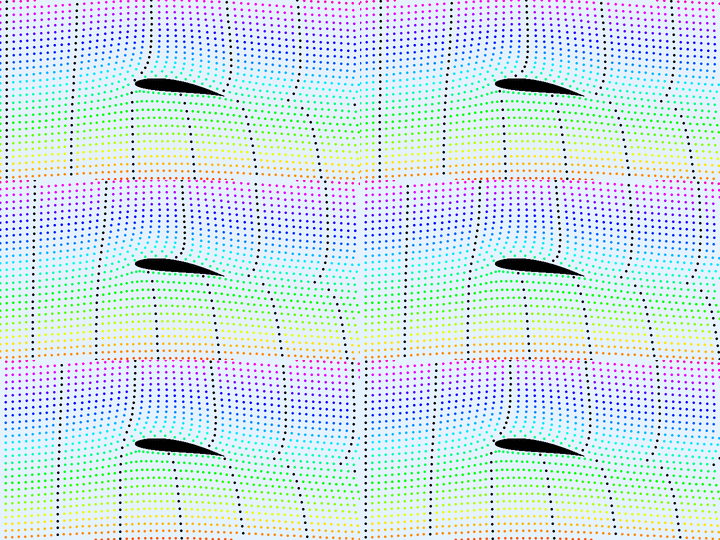
If you look at airflow over an asymmetric airfoil [1], the air does move faster over the top. Sure, it doesn't arrive "at the same time" (it goes much faster than that) or fully describe why these effects are happening, but that's why it's a simplification for lay people. Wikipedia says [2]:

> Although the two simple Bernoulli-based explanations above are incorrect, there is nothing incorrect about Bernoulli's principle or the fact that the air goes faster on the top of the wing, and Bernoulli's principle can be used correctly as part of a more complicated explanation of lift.

But from what I can tell, the root of the answer is right. The shape of a wing causes pressure zones to form above and below the wing, generating extra lift (on top of deflection). From NASA's page [3]:

> {The upper flow is faster and from Bernoulli's equation the pressure is lower. The difference in pressure across the airfoil produces the lift.} As we have seen in Experiment #1, this part of the theory is correct. In fact, this theory is very appealing because many parts of the theory are correct.

That isn't to defend the AI response, it should know better given how many resources there are on this answer being misleading.

And so I don't leave without a satisfying conclusion, the better layman explanation should be (paraphrasing from the Smithsonian page [4]):

> The shape of the wing pushes air up, creating a leading edge with narrow flow. This small high pressure region is followed by the decline to the wider-flow trailing edge, which creates a low pressure region that sucks the air on the leading edge backward. In the process, the air above the wing rapidly accelerates and the air flowing above the top of the wing as a whole forms of a lower pressure region than the air below. Thus, lift advantage even when horizontal.

Someone please correct that if I've said something wrong.

Shame the person supposedly with a PHD on this didn't explain it at all.

[1]: https://upload.wikimedia.org/wikipedia/commons/9/99/Karman_t...

[2]: https://en.wikipedia.org/wiki/Lift_%28force%29

[3]: https://www.grc.nasa.gov/www/k-12/VirtualAero/BottleRocket/a...

[4]: https://howthingsfly.si.edu/aerodynamics/air-motion

The bottom line is that a curved airfoil will not generate any more lift than a non-curved airfoil (pre-stall) that has its trailing edge at the same angle.

The function of the curvature is to improve the wing's ability to avoid stall at a high angle of attack.

According to NASA, the Air and Space Museum, and Wikipedia: you are wrong. Nor does what you're a saying making any sense to anyone who has seen an airplane fly straight.

Symmetric airfoils do not generate lift without a positive angle of attack. Cambered airfoils do, precisely because the camber itself creates lift via Bernoulli.

I stated "has its trailing edge at the same angle", not "is at the same angle of attack". Angle of attack is defined by the angle of the chord line, not the angle of the trailing edge. Cambered airfoils have their trailing edges at higher angles than the angle of attack.
Again, not an expert, but how does that jive with the existence of reflex cambered airfoils? Positive lift at zero AoA with a negative trailing edge AoA.

And that seems to directly conflict with the models shown by the resources above? They state that cambered wings do have increased airspeed above the wing, which generates lift via pressure differential (thus why the myth is so sticky).

>If you look at airflow over an asymmetric airfoil [1], the air does move faster over the top.

What is your point? Where do you think lift comes from?

My point is the wing causes a pressure differential by redirecting air. Air speed changes are a side effect of lift not a cause of lift.

The other way around is something (magic fairies?) causes an air speed imbalances, that causes a pressure differential.

Im quite sure the "air on the top has to travel faster to meet the air at the bottom " is false. Why would they have to meet at the same time? What would cause air on the top to accelerate?
I did a little more research and explain it above. The fundamentals are actually right.

The leading edge pressurizes the air by forcing air up, then the trailing edge opens back up, creating a low pressure zone that sucks air in the leading edge back. As a whole, the air atop the wing accelerates to be much faster than the air below, creating a pressure differential above and below the wing and causing lift.

The AI is still wrong on the actual mechanics at play, of course, but I don't see how this is significantly worse than the way we simplify electricity to lay people. The core "air moving faster on the top makes low pressure" is right.

That explanation doesn’t work if the wing is completely flat (with nothing to force the air up), which if you ever made a paper airplane flies just fine. All these explanations miss a very significant thing: air is a fluid where every molecule collides with _billions_ of other molecules every second, and the wing distorts the airflow all around it, with significant effects up to a wingspan away in all directions.
That's a separate component of lift, unrelated to the shape. Any surface will produce lift if angled into moving air, deflecting the air downward.

The explanation we're talking about is why cambered wings generate lift when flying level.

(Layman guess) Pressure? The incoming split air has to go somewhere. The volume of air inflowing above and below is roughly the same.