Hacker News new | ask | show | jobs
by UncleMeat 337 days ago
Abortions are not the primary reason why teen pregnancy is way down. There's actual data, you know.

Fewer teen pregnancies is a reason why birth rates in the US are declining. But it isn't driven by abortion. And it is insane to me that I'm now seeing this "oh actually teen pregnancy wasn't so bad" thing pop up all over the place.

5 comments

It’s strange to see that anecdote so highly upvoted when it’s so trivial to look at birth rates by parental age.

Reduced teen pregnancies are not the driving factor in recent fertility rate declines at all.

It is interesting how an appeal to emotion with a difficult story can lead so many to overlook the obvious shortcomings in that explanation. Honestly this entire comment section has a lot of people making guesses or putting forth their own theories without having even skimmed the article.

Maybe it has something to do with the “you are not good enough” treadmill the modern world has everyone on. I don’t think people of yesteryear contemplated if they were ready to start a family. I don’t think they contemplated if a job was the “right fit”, and I doubt they scoured the world looking for their soulmate. So, if you live in our current time period where you are never “complete”, then you may have a hard time feeling confident about any next step.

Obviously the downside to this was that just about any idiot from yesteryear saw themselves perfectly qualified to start a family.

The solution is somewhere in the middle.

No need to contemplate anything if your run-of-the-mill average job lets you support your entire family and purchase a house.
They also didn't contemplates it as something ubearable if they had to live many persons or even extended family in the same small house, including rentals, and if two persons had to work hard. Manual laborers, factory workers, etc, farmers where both father and mother worked, still had many children.

It's not like this only happened in the window between 1940s-1980s where the run-of-the-mill average job let you support your entire family and purchase a big enough house.

People are acting confounded that the birthrate is goong down.

But if people cant afford kids they wont have them.

Its like super simple.

I don't agree with the premise (data point: I grew up poor, with siblings), but certainly the inverse isn't true.
Singular data point. Were talking macro level.

Talking about the educated West where people have the information and tools to make the decision.

Context inference is important

Exactly. I suspect the lack of understanding or overcomplicating the reason the birthrate is declining may have something to do with the much higher than average salary of the average HN commenter relative to the average worker's salary in the US. It's common for people who need to go to the doctor to avoid going to the doctor because they can't afford it. A baby is an order of magnitude more expensive than that and an ongoing expense of doctor visits and potential ER visits among other costs and logistical issues.
> Maybe it has something to do with the “you are not good enough” treadmill the modern world has everyone on.

I don't think so. I think it's because

    A new couple can't support themselves when
    rent=1mo typical wages. It is impossible to pair off.    

    Parenting time is up 20-fold from the 1950s.
    Was a few hours wk. Now it's ceaseless, 24/7 adulting.

    Childhood is effectively ruined due to 
    - eradication of free ranging area thanks to automobile
    and trespassing culture. 
    - eradication of regular hours of adult-free peer time
    where critical social and growth skills are learned.
    Modern childhoods are spent in boxes w/ adults.

    Poor mental health follows and kids cope using devices.
    So adults predictably want to take that away as well.
What is the perfect amount of money and time for you? I suspect many things are not good enough for you and others.
That’s what it is for me but also because family life was super scary and uncool. Not a high virtue for the youth.
Because there's nothing in the article. It's a couple loosely correlated events around '35-'55 that anyone can Google together in 10 minutes. The article has no more authority that anyone's post around here.

My bet is still WW2. The fact that the boom started earlier than '45 is easily explained by his own quoted graph in which the birthrate plummets in the 20s (which I would assign to WW1), the first rise is merely a correction.

Why would one result in a bust and the other into a boom? For one, the economy followed the same bust ('29) boom pattern. WW1 ended unresolved, showed the evil of man in general, where WW2 resolved WW1 and showed the evil of particular man, and it wasn't us, but which we defeated.

WW2 learned a lot of lessons from WW1 which made post war society thrive for not only the rich.

One significant difference between WW1 and WW2, at least in the US -- the country realigned itself for wartime in a way it did not the first time around. You had women entering the workforce in ways they did not during WW1, which meant you had some families earning dual incomes. At the same time, the US instituted a rationing scheme, so even though households were earning more money, they couldn't spend as much.

Two other significant differences: the GI bill for returning vets (which made it significantly easier for them to get higher education) and the rise of automobiles (which in turn unlocked suburbs and mass home ownership) gave households somewhere useful to put their money.

The data doesn't exactly support your argument though:

https://ourworldindata.org/grapher/births-by-age-of-mother

Just looking at raw number of births by age of mother:

* 15-19 peaked in 1989 and has decreased 35% since then

* 25-29 is higher than at any point in the 20th century

* 30-34 is higher than at any point in the 20th century

* 35-39 is higher than at any point in the 20th century

* 40-44 is higher than the 20th century except the 1960's

Bear in mind, those appear to be absolute numbers, not relative to world population.
You are looking at the full world numbers, which isn’t really what’s being discussed in this thread. Try filtering for South Korea or the US
Sure thing, boss:

If we filter by US,

* 15-19 is down almost 80% (!!!) since the mid-century peak.

* 20-24 is down about 60% since the mid-century peak.

* 25-29 is about flat since mid-century

* 30-34 is higher than any time in the 20th century

* 35-39 is higher than any time in the 20th century

* 40-44 is higher than any time in the 20th century

In other words, the story is about the same as global.

Remember, I was responding to a comment that stated "Reduced teen pregnancies are not the driving factor in recent fertility rate declines at all."

If I was going to steel-man your argument, I would note that 20-24 is the cohort with the largest numerical reduction in the US... but then the argument still rests on splitting hairs that 20-24 are not technically teenagers, and teenage pregnancies "only" account for 40% the total reduction in fertility (while teenage mothers only accounted for 16% of births in 1970).

Of course, it's hard to square splitting those hairs with the definitive statement "not the driving factor [...] at all" (emphasis mine). In fact, the only way it makes sense is if you define "recent" to mean "since 2017", but measuring things like this over a period of less than a decade is silly anyway.

The data is also abundantly clear than older women are having more babies (not just a greater percentage, but actually more babies). In Japan women ages 35-44 had more babies in 2023 than any time since 1950. In Korea, women ages 30-44 had more babies than any time since 1980.

Change in births, by age of mother, United States

Estimated number of births each year by the age of the mother. 1950-2023 relative change. https://ourworldindata.org/grapher/births-by-age-of-mother?s...

Birth rate by women's age group, United States https://ourworldindata.org/grapher/fertility-rate-by-age-gro...

The second graph is so interesting. Pulling the slider shows less births but an average increase in the mother's age (which in turn accounts for less births if you're looking at 35+ yo first time mothers you don't expect n more kids to follow for (among others biological/medical reasons)). It would be interesting to have a complementary chart on divorces just to have a look whether existential uncertainty plays a role in age decisions.
I said "a" reason.

  > Honestly this entire comment section has a lot of people making guesses or putting forth their own theories without having even skimmed the article.
its a microcosm of our entire political discourse as of late imo: everyone is talking anecdotes and feels and barely anyone is bringing the receipts (and if they do its barely noticed)
But people's anecdotes are part of their life experience. I trust my personal life experience over anything I read, and if I trust a person, I value theirs over anything I read too.

That's just how humans are.

I get it, you like stories of individuals. We should figure out a way you can listen to more stories, so you can form an even better opinion! Perhaps we write them out, shorten them a bit. Or perhaps group them by similarity. And then if we count the types of story per category… and boom, we’ve invented statistics!
And ...boom! we lost the nuance, and shoehorned together disparate elements into a bunch of measurements, as if those explain everything (as opposed to needing explanations and a working theory themselves, and often fitting multiple theories about how they came about).

Not to mention the cases where the numbers are collected or analyzed in bogus ways (from wrong methodologies and false reporting, to p-hacking), and people are asked to cargo cult respect them anyway...

I know how to use statistics to tell nearly any story though, and I would love to trust statistics…

It has to do with unknown unknowns.

And I know how to tell any story, it's called lying. Whether you are lying with statistics or lying in a story does not matter. In the end it all comes down to whether you can validate what you've been told. Most people however will skip validation in favor of 'this sounds reasonable' and most people have a worse intuition for statistics than for stories. That's on them though, let's not blame statistics for that shortcoming.
>this entire comment section has a lot of people making guesses or putting forth their own theories without having even skimmed the article.

The article doesn't make some definitive argument either (I've read it).

It's just serves as starting point for a discussion under the subject, and just like the author the people commenting here have their own theories and hypotheses why that's the case.

As for "the receipts", most of them can be argued in multiple ways. Empirical observations and working theories are still useful.

A minority of pregnancies end in a birth in nyc among black women. There are 70 million fewer Americans than otherwise.
> And it is insane to me that I'm now seeing this "oh actually teen pregnancy wasn't so bad" thing pop up all over the place.

The other side of this is insane to me... the "oh actually looming human extinction won't be so bad" thing. Sub-replacement fertility rates are slow-motion extinction. Animal models where they "bounce back" is irrelevant, those animals have their extremely high above-replacement fertility all through their famines, plagues, and predator massacres such that when those pressures relent their population recovers. There's no known precedent for raising fertility rates that fall let alone so low.

You don't have to be an "extinction apologist" or whatever to think that we'll probably solve the problem before we go from 7 BILLION people to not enough humans for healthy genetic diversity. We've rescued animal species from extinction with populations of <100.
>that we'll probably solve the problem before we go from 7 BILLION people to not enough humans for

This just goes to show how little you've ever considered the problem. I don't think you're stupid (probably), so let me get you started...

It's not "from 7 billion to not enough", because right now we don't have 7 billion. We only have the generation(s) that are from 0 to 40 years old... everyone older doesn't even count. 80 yr olds and 55 yr olds aren't potential parents.

We will still have many billions of people even once we become functionally extinct, because you were counting everyone even the octogenarians, when you should've been counting the people who mattered in this regard.

>We've rescued animal species from extinction with populations of <100.

But there's no "us" to rescue us in that manner, and we can't do it ourselves. Why? Because doddering senile geezers don't have the ambition, marbles, or energy to do such a thing and those are the only people who would be left at that point. Not to mention that any such rescue would turn us into franken-people, no thanks. We should all be terrified of the science fiction dreams of artificial wombs and gestation chambers and so forth because just as those might be used for good things, the CCP and North Korea will use them to churn out armies of replicants.

You really are the extinction apologist you think you're not.

I think it's actually quite likely that quite a few "dominant" cultures - both in terms of nations and groups within nations - will effectively die out.

But humanity almost certainly won't? Why? Because there are sub-groups within humanity who have much higher fertility rates. As long as there are groups of people which are large enough to have viable genetic diversity, and recognise that a high birth rate is crucial for the continued existence of their culture, there will be humans.

Realistically, that means the decline of western liberal ideas and the growth of more extreme religious groups.

>>This just goes to show how little you've ever considered the problem

It's not really considered a problem. A real problem is a wellbeing of the old people, that's why it is financed better then wellbeing of future generations.

Cut elderly support and make a free childcare and education, huge tax rebates for each child, etc.

A huge pile of government debt is another indicator that future generations are fucked.

We’ve never come up with a way to correct this. No country has reversed course. That’s troubling.

When it comes to animals - species that refuse to breed have a tendency to go extinct.

There are some cultures that have sustainable birthrates. Those cultures will become dominant over time and the problem will be solved.
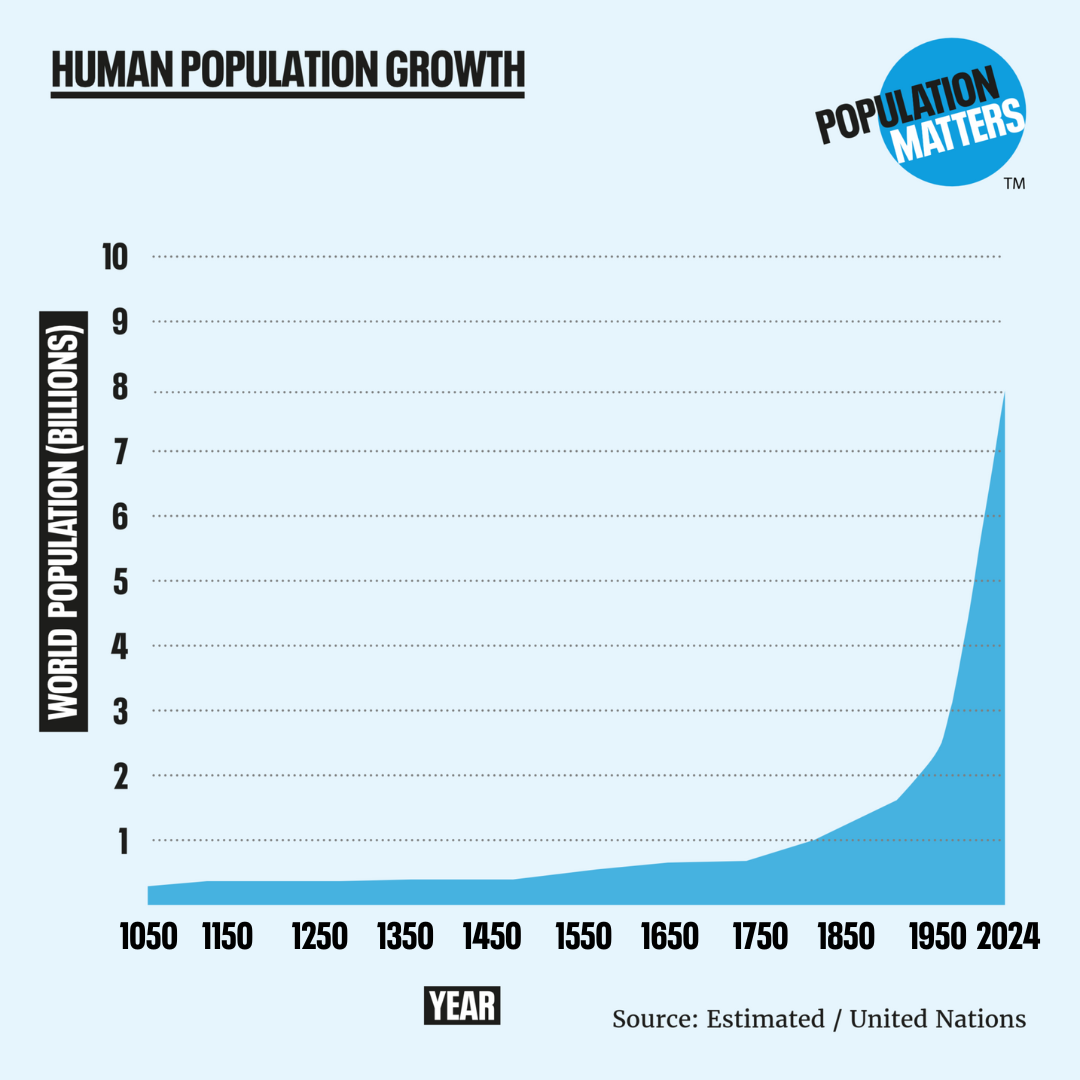
Looming human extinction? The population is still growing.
The beehive's still hatching out larva that were produced months ago... but the queen is dead. It's called functional extinction.

"How can we be out of gas if the car is still coasting forward?" asks the fool.

imminent crash? the wall is still 5 meters away!
Conveniently stops at 2024.
And of course those animals just have natural temporary dampers to their fertility, not cultural and social ones.
I’m sorry, but calling anything but above-replacement birth rates “slow-motion extinction” is ridiculous. This is the equivalent to expecting babies to be 15 meters tall by the time they’re adults from extrapolating their rate of growth in their infant years.

Below-replacement rate might be an economic issue around retirement, but as far as the human species goes, it’s a nothingburger at this scale. We’re not passenger pigeons.

There’s plenty of countries with above replacement level fertility rates. This is a nothing burger
The world as a whole is below replacement in 2025
“Developed countries have reduced population growth” is a far cry from “looming human extinction”.
Any fertility rate below 2.1 isn't reduced population growth. It is the literal, factual opposite of population growth... it is population shrinkage/decline/whatever.

These countries we discuss all have population decline. This is masked by multiple factors including immigration and increased longevity.

Pro-natal cultures have thrived vs less-natal cultures for literally thousands of years. That's how we got here. I also don't see the problem.

(I strictly used the word culture and not anything biological or genetic since I'm not aiming at that line of talk in the slightest, to be clear)

This world doesn't have the 500 cultures/civilizations that it had circa 3000 BC. It only has the one culture, it's global, dominant, and ubiquitous. It is the "less natal" culture, it is the only culture. It assimilates any subculture that dares raise its head. When it dies, there won't be another to fill the niche.

This is why, for instance, when immigrants from high-fertility countries (all in central Africa) come here, our culture assimilates them and they're back to low fertility within 2 generations. Not only that, but our culture slowly creeps inward towards the epicenter of that high fertility, damping it down even at its source. The Chinese belt-and-road initiative is likely to murder it entirely within our own lifetime.

This is something different, never seen before. Saying "oh gosh shucks, it happened back in eleventy-twenty-fourven and we survived fine then!" is dismissal, not contemplation. Never before in human history has actual fertility sunk this low (or even really sunk). People didn't ever stop fucking, and they didn't have birth control, or abortion, or a dozen other factors. When population declined historically, it was due to war, disease, and famine. But because fertility remained high, just as soon as those pressures relented, population recovered. When fertility goes below replacement, population can never recover, it can only continue to shrink. When it goes below replacement, every girl growing up learns from the adults around her that low fertility is "normal", and she's not going to grow up and decide to have 8 herself (or even 2). She'll have as many as she saw those adults around her having, or maybe fewer (it acts as a ceiling, but not a floor).

It's not “developed countries have reduced population growth”.

It's: ALL countries have reduced population growth in recent decades compared to their historical baselines. Including in "non-developed" countries, like in Africa.

Many (most) countries have also dropped to sub fertility rates or close above.

On top of cultural and other reasons, there are also objective fertility issues with sperm counts and others emerging (likely due to modern food, climate crisis, microplastics, or some such).

Combine that with looming issues emerging from population shrinkrage causing economic decline, pension collapse and things like that, and then add environmental issues and resource wars into the mix.

It's no consolation if some pockets of humanity here and there carry on the torch, if humanity shrinks down to irrelevance.

Looming human extinction? Bro, all you need to fix this "problem" in the West is more immigrants.
Immigrant countries are experiencing the same trend. Soon countries will be fighting for immigrants.
If there's no culture, development level, and way of life preferences, for different national states and ethnic groups, and humans are just interchangeable units, sure. Just add as many immigrants as you want, problem solved.

Adding, say, to a country an additional 10%-20% of its current population in people from another culture, to be the younger and more fertile group, in an aging domestic population, would absolutely go without issue.

At least, if we also ignore that immigrant origin countries all see fertility drops, many projected to reach sub-fertility rates themselves soon, of course.

While I agree, his experience is also salient.

Ease of access to birth control and ease and safety of abortion will be having a very detectable impact on the birthrate.

Not saying they need to be restricted, just that they're very relevant data points.

it is heavily politicized, atleast for the forseable future, until society reaches a conclusion, people will lie with statistics, smear their opponents in discussion as bigots, sexists, whatever.

But sooner or later it needs to be asked and acted upon. Should society structure itself to penalise abortions, and reward births of children.

Did our old religious and conservative societies where parents and grandparents helped together to give a great childhood to 2 or more children be something we need to bring back (for folks who'll say back then kids didnt have a great childhood, aborted children have NO childhood a death for themselves that they didnt choose). Should premarital intercourse be banned again or shunned ?

Religions have brought tons of miseries causing constant conflicts between communities, wars, allowing politicians and rulers to manipulate masses.

However, they also carried laws and doctrines refined over centuries, on philosophy, morality, and most importantly societal structure.

Monogamy itself and the construct of marriage was refined and finalized in all major religions Christianity, Islam, Hinduism, etc across several centuries (and in some cases greater than 1000 yrs).

One must consider, why did our ancestors come to certain conclusions globally regardless of faith around societal structure? What conditions did they want to create across society, to bring about prosperity or growth. Why were certain conservative and unpopular opinions regardless were imposed on men and women alike.

We should remove all the horrible stuff, things we can leave behind that our ancestors used to do sure. but throwing everything away is also not going to lead to anything good for us in the future.

Should abortion be readily accessible simply for the sake of liberty and freedom ? Should contraceptives be widely made available and promoted ? , should families force kids to be responsible for their actions again, and first try their best to give their newly born child a better life before allowed to just throw everything apart with divorces, single parent childhood, etc. Should premarital intercourse be banned , to encourage youth to form meaningful relationship instead of coasting between new girlfriends and boyfriends every new year ?

Im not saying we should do X, but these questions will need to be asked sooner or later, if western society or even asian societies want to survive (both have ultra low birthrates, china, japan, korea, russia, even india is now going the below tfr rate and will join them far sooner than was estimated within 20 yrs).

I really love european, american and asian societies and cultures, and i dont want them to die off, or perish away. Even my own culture's TFR is 0.98 for multiple decades and its perishing away quite fast too.

Hard questions will need to be asked in the future. It's not just a matter of what feels right to our emotional minds at a moment, but rather, whats best for society and cultures itself long term.

Not to mention, housing prices need to go way down, it needs to be removed from being a speculative asset or a way to whitewash black money, its wreaking havoc on whatever remaining part of society that does want kids, but cant afford to own a home by age of 30 even with double income household. We have enough land to house the entire world in each of the major countries, yet just out of sheer regulation, greed and laziness from politicians, policymakers, and banks who are afraid of the housing market crashing and causing problems for them, they are keeping this charade up.

There are many problems that need to be solved in coming decades, I hope each of our societies solve it.

When people feel the game is unfair, they quit. When the game is society, the society ceases to exist.

It's wild that we find it harder to change the system than to walk away from it entirely. People opt out in a thousand small ways - refusing to have kids, refusing to participate, numbing themselves with distractions, or just mentally checking out. If the core pitch of society is "keep grinding or suffer," it’s not surprising so many people choose not to bring new life into it. Liberty and freedom aren't abstract ideals. Their real absence makes people find coping mechanisms in a world that often feels rigged.

If a society truly wants to persist, it has to give people a reason to stay - something more than survival, more than struggle, more than empty promises about meritocracy or bootstrap fantasies. Otherwise, the logic of self-preservation kicks in, and people will exercise whatever autonomy they can muster, including the right to say, "No, not this."

So, yeah, access to abortion isn't simply about individual rights in the abstract; it's a symptom and a signal. When people would rather not create new life than subject it to the current system, that's not a moral failure on their part. It's an indictment of the system itself.

TLDR; make a better society bruh.

Society has been getting better and better. The privations our parents and grandparents went though were insane.

Conscription, poverty, illiteracy, I mean wow.

By almost every conceivable metric, the world is getting better.

I don't disagree, but better doesn't make up for unfairness.

Inequality isn't an act of nature. No volcano or hurricane is disrupting lives. The source is human, a system we built, the society we live in. If we can't change the system that binds us, then it doesn't deserve us.

The core conceit is, "When I win, it's merit. When you lose, it's fair."

I don't disagree with most of what you're saying either, but I don't see it's relevance to what GP is claiming. Was society more fair than it is now for the last few millennia of higher birth rates?
It’s symptoms all the way down. If the system decides it needs more births it will ban abortion, and that’s not a moral failure on the system’s part, it’s an indictment of the symptoms itself.
Hans Rowling found that one of the best way to increase numbers of births is to reduce education for women. Or at least there’s strong correlation between both.
I'm not sure how useful this is. Isn't not like we're going to throttle education for women like it's a governor for fertility rate, right?
The system has no morals, but every person operating within it does. If the system demands what it needs from us without regard for morality, it's on us, as moral agents, to refuse compliance. The system can demand what it wants, but no one is obliged to give it anything.

If the point is that the system will coerce what it needs from us, then it deserves not merely to perish, but to be destroyed, actively, deliberately, and ruthlessly. If births are the air it breathes, let us suffocate it by refusing to bear its children. Let it choke on its own demands.

>The system has no morals, but every person operating within it does.

Most people just have whatever morals the system gives them.

Abortion won’t change the game you would have to ban condoms and birth control
If you can't successfully ban cannabis and cocaine (in prisons no less). You can't effectively ban condoms and birth control
Things should be made better I agree, But at the same time.

Every single generation before ours had worse life outcomes in everyway than us. They had lower lifespans, struggled with food insecurity, Lack of travel accomodations, no access to education for the majority, nothing.

Yet if you speak to anyone from those generation or even from our generation who have lives similar to them, they have far more positivity and energy. (and higher fertility and birth rates)

More things, "non meritocracy", "bootstrap fantasies", those things arent the problem.

People of our generation and the one before, are just always whining complaining, too lazy. I dont want to believe that either, but it is the truth.

Our freedom to do anything and everything, abort children easily, control birth planning easily, making casual sex the norm, etc, making housing unaffordable to keep this stupid real estate based bubble alive for banks, and politicians alive under garb of "Regulation" and "NIMBYism".

Are 100% much more contributing to all of this. Than nihilism, doomism, etc.

Give people better things, more money, better lifestyle, and more freedoms and no societal pressure to have kids, people are just opting for the "DINK" philosophy, Double Income No Kids.... , spend on expensive cars, better homes, more travel, but no... no kids.

Go observe every major society, the top 10% of each society in almost all of them have a pretty decent life with good savings and sense of security, freedom to not overwork too much. This is the top 10% populist politicians villify as having everything.

Now go look at the birth rates of that top 10% in EVERY major society its lower than the rest of the 90%.

More money, more affordability are not linked to birth rates at all, except for a teensy minority who overthinks things and calculates 1000 different decisions from climate change to their wealth to their partner's loyalty, to decide if they want kids. They are not the majority

No amount of motivation, higher incomes, etc will reverse this trend of birth declines, (however governments and society should strongly work towards giving people higher income, less overworking, more motivation to be optimistic not for boosting birth rates, because it wont, but simply because its the duty of public servants, politicians, policymakers and the state that serves the society in return for the society serving the state with loyalty)

TLDR; make better society yes, but even that will just lead to even fewer kids, make a more responsible society while improving people's lives.

Have you ever seen that meme about having less days off than a medieval peasant?

Yes, I can get chicago, new york, italian, or tokyo style pizza from my phone, in about an hour in a city that is none of those places. Still even my weekends include work. A strong effort in high school, college, grad school and at my jobs has led to fairly regular weekend work and working after putting the LOs down for bedtime, not connecting or socializing.

The answer isn't fewer rights. Its more.

No one’s stopping you from not working on weekends, for most high income earners people who do it, it’s purely the obsession with no end to wanting more (other than those who live paycheck to paycheck and need those weekends due to having multiple jobs, that is indeed a tragedy and should be a policy priority for gov to fix).

But tell me this, If society is overworking so much.

How is the average screen time of an american adult around 4-5 hours per day ? thats 8-10 hours per couple per day. Are you saying most of that time spent on facebook, tiktok, youtube and instagram overworking time ?

Do americans work hard ? absolutely way more than europeans who have a much better work life balance, tons of holidays, maternity leave, paternity leave, none of which america has.

Chinese and american workers are some of the hardest workers on earth.

Then tell me this. How is it that western europe with better work life balance has even worse birth rates (significantly worse for significantly many more years) than america ?

Western Europe already has more rights and it doesnt work. Whatever semblance of sanity they have in birth rates (as horrible as those metrics are) most of the children are born to single income regressive households mostly north african, morocon, and pakistani immigrants in western europe and uk. So, if you exclude those, the birth rates of families with more rights, more work life balance, is even worse than the official stats.

Rights or no rights isnt the issue, but a discussion on what’s promoted by society should be had, more rights doesnt mean more children. Coercion, promotion of ideals, behavioural nudging are standard things every single country and its government does, (a good book on this : https://en.wikipedia.org/wiki/Seeing_Like_a_State)

So More rights, more work life balance while are amazing ideals that society should definitely work on, like it has for thousands of years with on average significant better results if one sees growth in 100 yr cycles.

More rights is not the solution to birth rates, atleast its not the existing bottleneck in most western societies and cultures that’s for sure.

Lol, what you define as "work" is not even close to the "work" assigned to a medieval peasant. In his eyes, you have 7 days off a week.
Empirically, how well does the "we have it better off now" response work against feelings of an unfair system. Does it tend to change perspective in your experience?
A little. The real perspective shift happens when people learn how to stop comparing their lives to stories about other people they’ll never meet, but that’s a harder and more general lesson. The idea that medieval peasants had more free time than me comes from the same place as the idea that everyone could afford a house in the 1950s, or the idea that everyone I see on Instagram is living more vibrant lives than me.
the mindset you're discussing isnt whats driving this for majority of people (im myself young and in my 20s). its a problem in your extremely small bubble of leftist spaces which i've often heard this doomism being argued.

World has never been that fair, its a work in progress that has been going on since 1000s of years heck probably 100,000s for humans.

First there was Anarchy / Stateless Societies (Pre-Leviathan), then came the notion of leviathan / Authoritarian Centralization the idea that letting a state get run by a ruler and his nobles would lead to a more stable state (the era of kings and emperors since last several centuries),

then came Theocratic or Feudal Orders : Society governed by divine rule or hierarchical feudal obligations. Middle Ages in Europe, dynastic China, Islamic Caliphates.

then Absolute Monarchy / Early Nation-States then Constitutionalism / Enlightenment Liberalism then came Democracy (but anti minority and primarily majoritarian with tons of political violence on minorities, still can see it in places like bangladesh, malaysia (singapore itself was born out of violence on such a non-malay minority) )

then came Liberal Democracy / Republic Which is what most western europeans, americans, indians, japan, etc live under or atleast the ideals its politicians promise to follow and do follow majority of the time.

Everything you and enjoy in our lives was created and improved upon by people before us, life has never been 'fair' nor will ever reach that utopian ideal of fair ever. Nor has it ever been the limiter on birth rates or growing societies.

It's just an excuse (sorry I'm not saying your concerns are invalid, but only that you share it with every human who has ever existed across time, and this has never been the bottleneck for our current problem with birth rates)

The problems are more behavioural in kind, and the norms that have arised rather than unfair system, psycological issues like that.

We have to find a new equilibrium for fertility that does not depend on opression of women. This could very well mean we need more rights, most of all more stable, plannable lifes i think. The old opressive ways of ensuring fertility are gone and without major societal upheaval they will not come back. I think that is good and we should focus on alternative solutions.
> Every single generation before ours had worse life outcomes in everyway than us. They had lower lifespans, struggled with food insecurity, Lack of travel accomodations, no access to education for the majority, nothing.

What’s your definition of our generation? What you described is true of multiple generations, and flat out wrong for things like lifespan in the United States which has been declining.

> folks who'll say back then kids didnt have a great childhood

If you count a 11 year girl child to be raped by and then married to her 60 year old (maybe wealthy) relative then yeah she indeed had a fucking fabulous childhood.

> penalise abortions, and reward births of children

For fuck's sake - there's a difference between a teen abortion and an adult abortion! But then you wouldn't understand why one "aborts"! Oh you do understand but you want that decision to be "society's" - not that person in whose body a fucking foetus is growing!

I mean is the moronity this common? For fuck's sake, freedom to abort is not what is killing the birthrate - it's the way our economy and other aspects of society is going haywire - and the way wealth and benefits are tricking up, not down, the work culture for example the way that is forcing people to work day and night and yet they can't own a house - among other things. Goodness!

Who said I'm for or promoting teenage pregnancies ????? No woman should be allowed to be married off to someone until they are 18 especially with that kind of age gap.

Marrying under 18s with 30-40 yr olds is not a solution and diabolical, no major religion even recommends that.

We need to restructure our society so that men and women aged 20-25 yrs old, can have a easy access to owning their own homes, with sustainable careers and occupation.

We need to make children before college postgraduation studies or even higher studies like phd not only more acceptable but the norm.

Pedophilia should not be encouraged and most sane societies have been vehemently against what you're saying (including me).

This cycle of people having kids after 35 yrs old, needs to be fixed that is the disaster.

> I mean is the moronity this common? For fuck's sake, freedom to abort is not what is killing the birthrate - it's the way our economy and other aspects of society is going haywire - and the way wealth and benefits are tricking up, not down, the work culture for example the way that is forcing people to work day and night and yet they can't own a house - among other things. Goodness!

I agree with what you said, but abortion is also causing the issues, its been normalized that its ok if majority of men and women attempt to have their first kid after 30 (it should not be this way). Premarital sex, casual sex and one night stands has destroyed the whole notion of commitment between man and a woman. Our Instagram feeds that constantly glorify unattainable photoshopped beauty from select actresses and actors influencing the masses all the time, has made expectations of men and women delusional.

There are many issues, and some of the main ones are what you described correctly , with it being overworking people, not giving 20 yr old stable careers instead keeping them stuck in gigwork, internships, and no career growth or help. They must be rectified, our society has enough wealth to fix this.

Why use a bot to write this?
not a single line from it is written by a bot
> actually teen pregnancy wasn't so bad

I mean, it was a thing for most of human history. There’s a reason biology makes you capable of having children at a young age. Isn’t it kinda bizarre that we think it’s weird?

People today think a 18-19 year old (which is still a legal adult in most places and for most purposes, can drive, go to war, live alone, work, and was always considered an adult throughout history) is "a child".

Of course kind of makes sense when 30 and 40 year olds also behave and live like children and find "adulting" out of their capabilities.

I can't tell you how strange it is to have become a parent at 24. It anecdotally feels like the average parents my wife and I meet (with similarly-aged kids) are about ten years older than us.

Making life is a normal part of life, and it's quite sad that we don't acknowledge the capacity of young adults.

When I was 30, I once thought to myself, "When my parents were my age, they had 3 kids and lived on a Navy base in another country. I still feel like a child that has fooled people into thinking I'm an adult."

I'm 43 now and I'm still not convinced that I'm not 3 kids stacked in a trench coat. Despite having a great career that pays for an upper-middle class lifestyle, when I travel first class or go out to a fancy dinner, I feel like I'm merely cosplaying as a functional and respectable adult that has their shit together. When I bought my house at 33 years old, I was thinking "Should someone be calling the state AG or something, they're allowing a child to sign mortgage papers".

Someone once told me this feeling is pretty common and that it goes away once your same-gendered parent dies, but my dad passed in 2019 and it definitely has not gone away.

My theory is that this feeling is the result of not enough socialization with people of varying ages. Their behavior towards you in aggregate grounds you to your age subconsciously, something like that.
> Making life is a normal part of life, and it's quite sad that we don't acknowledge the capacity of young adults.

I think it’s more that we’re all just faking it. The thirty or fourty year old that thinks they know better than the 20 year old is deceiving themselves. The differences between individuals are much larger than the differences between the averages at those ages.

Once people take responsibility for their lives and other people's lives, lots of things change. Perhaps the zeitgeist of behaving like a child in your 20s is just an emergent behaviour coming out of a consumerist economy?
I had the same experience a decade ago being ten years younger than everyone else at the park or birthday party.
For most of human history, people didn't have to worry about

- Exposure to exotic chemicals in every day items

- Regularly operating a multi-thousand pound machine just to travel

- Adversaries thousands of miles away working tirelessly to misinform and scam you

- Massive conglomerates working tirelessly to manipulate your behavior

- Being compared to the best in the world (in their skills and hobbies etc.)

- Competing against literally the entire country and sometimes the world for labor

My point is, modern life is getting more and more complicated. New challenges pop up every day. Each subsequent generation is born into an increasingly challenging situation. It makes sense that it takes longer to get ahold of things and feel stable enough to start a family

Have you seen Idiocracy, specifically the very beginning of the film?

These excuses sound similar to those made by the “prosperous yuppie couple” (who end up never having children)—contrasted with “trashy” couple, who churn out progeny without a care in the world.

https://thescriptsavant.com/movies/Idiocracy.pdf

Human biology allows your body to get sick and die from bacteria and viruses, sometimes floating in the air. Human biology let's you get a cut on your hand and die from infection. That was a thing for most of history. Do you think it's weird we don't just let people suffer from those things as well?
You say that as if having children is a disease.

If you are old enough to have a child, you are very likely old enough to successfully raise one. Otherwise the human race wouldn’t exist.

Having a child under a certain age has all the health risks of a serious disease putting the life of the mother and child at much higher risks. Why shouldn't it be treated as such?

https://pmc.ncbi.nlm.nih.gov/articles/PMC5965834/

A 5% chance of your child dying when you give birth at age 15 and lower seems pretty reasonable to me? At least I’d have expected those number to be far higher.

At 16-17 it’s 4% and at 18-19 it’s 3%, which makes it even better, but 19 out of every 20 children surviving longer than 28 days is pretty good.

> A 5% chance of your child dying when you give birth at age 15 and lower seems pretty reasonable to me?

You're fucking insane if you'd sign your child up for something that has a 5% chance of death. Literally insane. Gross. Disgusting.

I smell an evolutionary argument here that is fallacious.

For eons, tribes/villages raised children; it was not left entirely to the young mothers.

Yes, I think our cavalier use of antibiotics is a real problem, that could wipe a huge number of people out through the development of populations with huge immune deficiencies and uber-bacteria. Similarly for antiviral resistance.

Plus the need for such drugs itself is overplayed, most of the time the human body can take care of an infection itself. Things like clean water, hand washing, etc, helped for the rest many times over than drugs do.

Have you documented your turning down of antibiotics, vaccines, and other medicines so that others can see how tough you are and how modern medicine isn't needed? Have you encouraged your parents and grandparents to do the same? Have you denied your children modern healthcare as well?
> Human biology allows your body to get sick and die from bacteria and viruses, sometimes floating in the air.

Not in 99.9% of cases. It's such a twisted disrespect to millions of years of evolution of the immune system. If you had no innate immune system, even being a bubble boy in a hospital with the most advanced equipment could keep you alive only for so long. It's like saying "police lets people get murdered".

>There’s a reason biology makes you capable of having children at a young age

Biology and evolution doesn't really have a huge baseline. You basically have to survive until you reproduce successfully. Successfully here meaning that the offspring also has to do the same. If this is sustainable - the species is viable.

But, us humans like to know better. That's what the entire civilization is all about. And on the path of knowing better, we found that getting pregnant early actually is a detriment to the individual, their immediate surroundings, and society as a whole as well*. So, we do things like birth control and education and things like that.

Which is far from bizarre, if you look at human activity as a whole. Basically every facet of life goes against "biology" or rather basic nature, if you think about it. We augment ourselves and distance ourselves from it to a very large degree - stay indoors a lot, use clothing, learn abstract knowledge, look at screens, eat processed food, observe the myriad of societal rules. Which all are kinda weird - but they also aren't, if you consider the history of humanity.

*https://www.who.int/news-room/fact-sheets/detail/adolescent-...

> we found that getting pregnant early actually is a detriment to the individual, their immediate surroundings, and society as a whole

You are citing a source that talks about unintended pregnancies (often as a result of sexual abuse) in developing nations. With nearly half of those being prematurely aborted in some (medically safe or not) way.

I’m inclined to believe that the support system throughout most of history was better than what these girls get.

>But, us humans like to know better. That's what the entire civilization is all about.

You mean the kind of knowing better that led us to destroy the environment, and appears to be removing whole populations from the gene pool with way below subreplacement rates?

Exactly that kind of knowing better.

It's a bit tongue-in-cheek because of the multiple interpretations of "knowing better". On one hand, we "know better" in a way that we, as in all humans, constantly try to control nature and the natural flow of things. Our entire civilization and way of life is a result of that.

On the other hand, I mean it a bit sarcastically, because I'm not convinced on a philosophical level that this kind of living is morally, ethically, humanely superior than that of ancient people's living. Often it looks like that progress is just for the progress' sake, an eternal power struggle, a Prisoner's dilemma. In short, when I ask myself "is progress good", I don't feel strongly toward any answer. I meant to encapsulate this by phrasing it as "knowing better".

But the drive to "know better" is there for sure, even though the results vary. I do believe that good can come from it, and that many efforts actually resulted in lessening human suffering, which I consider a good thing. I mean here efforts like equal rights movements, reproductive health and education, and proper access to medical help (to stay on topic).

And now, while preventing and tabooing teen pregnancy, society is about to collapse on itself by lack of reproduction. We coddled our kids to extinction.

> Successfully here meaning that the offspring also has to do the same. If this is sustainable - the species is viable.

Raises the moral question of what kind of living is worth it, and on what level is it okay to impose on one another. Looking at how families from teen pregnancies fare*, I'm absolutely positive that mitigating these is far from the biggest contributor to "societal collapse". Doing anything to raise this number is not going to do society any good, even if it results is a larger number of children on paper. Taking proper care of this situation is not any kind of coddling, more like basic human decency.

* https://pmc.ncbi.nlm.nih.gov/articles/PMC10002018/

That was a very interesting read. Even if it leaves me feeling like the reason teenage pregnancies are ‘bad’ is mostly because society is not set up for/condemns them. A teenage mother in a healthy family unit that drops the child with their parents while they continue to attend school will have significantly better outcomes.

I’m fairly certain a teenage pregnancy in Japan would work out more or less the same, because society is set up to facilitate people working 9h/day and dropping the kids off at daycare basically from several months of age. Of course, that’s combined with massive social stigma, so it wouldn’t on the balance really help things.

>> actually teen pregnancy wasn't so bad

Except for the negatively impacting the ability to get the education needed for basic jobs.

> I mean, it was a thing for most of human history.

During most of human history there was a broad support system already in place.

For modern new parents, that experience extended support varies from mostly gone to totally gone.

Exasperating that: In markets with jobs, rents are 1mo typical wages.

Yep, we are new parents and we are almost 40. There just wasn't any moment before where it was possible to start a family. We are comfortable but utterly alone in our box, with no grandparents or extended family in sight. Also, with the expectation that outside is for cars. So, there's 1-2 hours at the end of the day for us which is largely cleaning and de-stressing. If anyone had laid this fully out for us before we made this choice, it would have been an easy heck no.
> We are comfortable but utterly alone in our box, with no grandparents or extended family in sight.

This is how we started out too (mid 20s). Isolated rural area and no family. Both of us were youngest children and had never lived around babies. Not the highest odds to start with. We birthed at home and did cloth diapers - so that tells you a bit about our mindset then.

In our favor: This was >30years ago. It was possible to work multiple entry level jobs and scrape by. That's far from possible now.

>> there's 1-2 hours at the end of the day for us

Not so bad! I feel like "time for us" is all hours you can cut from 8h sleeping time.

I don't understand why population studies people don't even mention this: we're technically wild animals, competing for survival. In absence of a specific and effective imperative stipulating population must grow, we must subconsciously modify societal frameworks exactly to impede reproduction.

It's crazy that the threshold for kids/adults is right in the middle of fertile age and no one ever questions that.

>There's actual data, you know.

Did you bother to check it out?

https://en.m.wikipedia.org/wiki/Abortion_statistics_in_the_U...

More than half a million in the US alone, per year. That's material.

Yep — adding 500,000 births per year to the U.S. population would increase our overall TFR from 1.62 to 1.85, which is certainly significant.

The impact of other contraceptive methods is likely far larger. Social pressure not to conceive being perhaps the most effective contraceptive...

My wife and I had our first child while she was in medical training — the amount of absolutely vile commentary she had to push through from fellow trainees and program supervisors was absurd. But she also paved the way for other mothers at her program. In the ~two years since, she’s had at least five other women tell her that she proved it was possible and was the catalyst for their pregnancy.

>the amount of absolutely vile commentary she had to push through from fellow trainees and program supervisors was absurd

I believe you, it happened to me as well. I'm glad you both pushed through that; it actually is a Level 0 attack, but at the right time it can be quite demoralizing. You are way better than those pieces of filth.

My best wishes to you and your family, may you have a blessed life :D.