Hacker News new | ask | show | jobs
by pbohun 339 days ago
It's interesting how more "amateur approachable" both old cars and old computers are. Old cars can be worked on by anyone with some basic tools and know-how, and old computers could be understood and programmed the same way. MacPaint was made by one employee.

I think this is partially why people want these types of objects. You can actually own them. You can understand them. You can mod them.

Modern cars, games, computers, etc. aren't owned anymore. They always have updates, and could be bricked at any moment if the manufacturer wishes, gets bought or goes out of business.

There's nothing preventing this from being the golden age of computers. The capabilities of the hardware are near magical. We just need to bring back the concept of ownership.

3 comments

What really disheartens me with modern cars is that electric cars are much simpler than than cars powered by combustion engines, which could be a huge boon to the fix-it-yourself crowd, but car manufacturers now lock customers out of their cars, so electric cars don't have the opportunity to become hobbyist friendly.

There are small electric-car companies that let customers do what they want, like Edison Motors, but they make industrial-sized work vehicles. It would be nice if a similar small company started selling consumer cars, but the automotive industry is heavily plagued by bikeshedding (https://en.wikipedia.org/wiki/Law_of_triviality) to the point that large trucks and busses are allowed to do their thing, while subcompact vehicles have been effectively regulated out of existence.

Contrary to popular belief, EVs really aren't that much easier to repair, that's just a logical expectation from people without service experience based on the idea of less moving parts, but that omits that fact that electronics die too and EVs have more of them and under more strenuous loads.

Most of the faults on EVs come from dead electronics like a fried MOSFET or PCB trace, and coolant leaks inside the motor due to gasket failures derived from race-to-the-bottom cost cutting designs to save money, which your average user won't be able to repair themselves unless maybe we're talking about completely swapping out the entire ECU/motor/battery/assembly with a brand new one instead of repairing it, parts which haven't been designed for easy repairability. And that's excluding DRM issues and the fact that those parts aren't sold to consumers and even if they would, stuff like ADAS sensors, motors and batteries still require calibration with dedicated equipment during installation and can't be plug&play like a laptop battery swap.

Check out EV clinic(no affiliation) for horror stories on EVs and hybrids failures. Due to poor design, a lot of EVs (maybe excluding Teslas) are reliability ticking timebombs whose failure is a matter of WHEN not IF.

That's what I was complaining about; non-commercial production EVs could be much easier to repair than any other vehicle type, but they aren't. Car manufacturers, for both combustion and electric vehicles, can and do lock out components to prevent end users from servicing and repairing their own vehicles. If modern batteries and IGBTs existed decades ago, we would have had a period of mass-produced electric vehicles that were as easy to work on as a Model T. Really, electric vehicles have existed since the Model T, but none of them ever sold well, because they were to slow and had too little range.

People DIY their own EVs all the time, and on the electronics side all you need is a battery, a battery management unit, a charge controller, a motor controller, and the motor. Some of those parts can even be integrated into a single module If your combustion-powered car is fuel injected, it probably needs just as complicated of computer systems as an EV. (with the exception being rare cases of mechanical fuel injection)

The rest of an EV drivetrain is the same as any combustion car, except the transmission can be much simpler or may not be needed at all.

If an electronic components dies within one of those modules, swapping it out is no more work than swapping out something like an alternator or a starter. If the motor itself needs replacement, that's much, much easier than swapping out a combustion engine. Most electric cars have motors small enough that a single person could lift and carry one. If your motor controller died, you might be able to fix it with board level repair, just as you could rebuild an alternator yourself, but almost everyone working on a vehicle, whether DIY or commercially, is going to replace it, with either something new or something repaired/rebuilt by a specialist.

It's possible to get EVs with cheap components that won't last long, but it's also possible to get components with good design and build quality that will last a lifetime. Combustion engines, on the other hand, are regulated into designs that have extremely high efficiency when brand new, with no care for their long-term performance, so pretty much any modern consumer combustion vehicle has extremely fragile piston rings that begin leaking almost immediately, making for much shorter lifespans than decades-old combustion vehicles.

Driver assist is completely unrelated to the fuel type and open-source solutions do exist, that work on both combustion and electric drivetrains.

In theory they can be mechanically, in practice high ADAS standards and functionality like regenerative breaking make it feel like a pretty high risk proposal to allow an end user in.
Also 800V lithium battery packs capable of delivering hundreds of amps of current.
It doesn't take much to make a battery pack safe to work with. Every EV I've seen has contactors on both battery terminals, as well as physical shunt that is removed before servicing, in case a contactor fails closed. There's usually also contactors within the battery, making it possible to work on the battery pack itself, without any unsafe voltage present.

It's no more difficult to make safe than household wiring, and DIYers work on it all the time.

Electrically, regenerative breaking just runs the motor driver in reverse (or really, out of phase) and it doesn't take any extra components, only requiring a few instructions in the motor drivers firmware. It's not anything a DIYer has to even know exists, let alone mess with.

Driver assist has nothing to do with what type of fuel and powerplant a vehicle has, and those features can be broken by DIYers on any vehicle type. Sometimes being able to disable them is a built-in necessity for safety, for example when driving on gravel roads where they tend to do more harm than good.

Its not about the actual mechanism of regen, it's how it interacts with the other systems on the car.

Modern ADAS is a whole lot more integrated on EVs than it ever was on combustion cars, not by some inherit requirements of EVs but due to consumer demand when considering a new ev platform.

The driver is increasingly more removed, things like drive and break by wire go through a long chain of controllers in order to allow ADAS, and the input from the user is really just one more signal from a sensor.

There is no longer any circumstance where these systems are completely "off". And none were I would consider off to be safer. (Yes, even gravel and snow)

> It's interesting how more "amateur approachable" both old cars and old computers are.

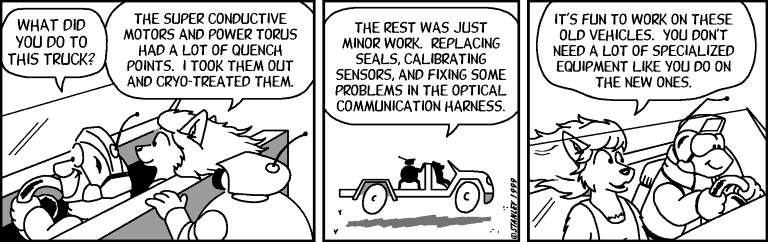
Right.[1]

I think of those guys at the Computer Museum who took years to repair an IBM 1401. They even had the assistance of some of the designers and retired IBM field engineers.

[1] https://freefallmirror.com/ff300/fv00214.gif

Comparing this mac that can be found on ebay at any given time with a 1401 feels a bit like comparing it with getting one of the first steam trains. I am surprised they made 12000 (according to wikipedia).
Old cars are wonderful except for one thing: safety. Modern cars are just so much safer with crumple zones and airbags. I would never want to use an old car as a daily driver.