Me too. Every now and then I think of going back, but ever since Aardwolf I've had a personal rule that a game has to have an end. Which has successfully kept me away from all MMORPGs and other endless time sinks.
My rule is that a game needs to have an end (or at least a realistically achievable goal to work towards), or it needs to be a social experience that I exclusively play with my friends.
That's a good clarification. I do play with friends role playing campaigns that technically do not have an end, as the game master just builds the story forward. But I still put it to a same category as board games.
Wow, this is still a thing! I lost two university friends to the Discworld MUD. As in, their whole lifestyle, hours, and activities changed to be working on and playing it all night long in the uni labs, and they no longer did anything else apart from attend a bare minimum of classes.
I just checked the “About” page, and one of them (“pinkfish”) is at the top of the Administrators list.
In late 1994 my only Internet access was a small room at Uni with 2 unattended ancient 286 PCs someone had set up for international students to check their emails but was always empty. Soon I joined a group of eager undergraduates that squatted unused email accounts, shared Slackware floppies, waited hours for a 700Kb NASA pic to download or frequented MUDs, telnet chats or places like Brinta BBS.
We quickly organized to share them fairly, until two big Math graduate students in full scary Heavy Metal rocker regalia showed up and started hogging them for 10 hours a day to play a MUD. No one to complain to, since our own usage was unsanctioned.
After a couple weeks of this, I made a little C trojan horse that replaced the telnet executable and logged the credentials if the target was the MUD in question. Then I would take the earliest chance available to delete their characters. They were gone after a week.
I'm heavily involved in DragonRealms [0]. Its older brother GemStone is still kicking around too.
Players of both games built an open source Ruby-based scripting engine called Lich [1] that allows insanely complex levels of automation. When I "play" the game I'm usually writing scripts to share with the community and optimizing my training configuration.
Both games have 30+ years of dedicated development and insanely deep lore and history. They've embraced micro-transactions to stay financially solvent, but participating in that is absolutely not necessary.
Been a while since I did but sometimes I hop on one I played back in the day, like Ishar or Materia Magica, to scratch a certain itch. Looks like a good number of the old ones are still going.
Valhalla MUD is really good, and has had a resurgence of activity recently. They've redone the class system, added a bunch of zones, and added some discord integration etc. I played decades ago starting as an 8 year old who knew nothing lol but I still log in from time to time. Super deep game if you have time to invest.
discworld.atuin.net. If it's still up it's not to be missed. Easily the richest MUD experience I've encountered in decades of playing, regardless of how you feel about Terry Pratchet.
Professor Richard Bartle recently retired, but he regularly assigned his students to play MUD2 in his Computer Game Design and Virtual Worlds classes at the University of Essex! He and Michael Lawrie co-created the original MUD1 at Essex in 1978.
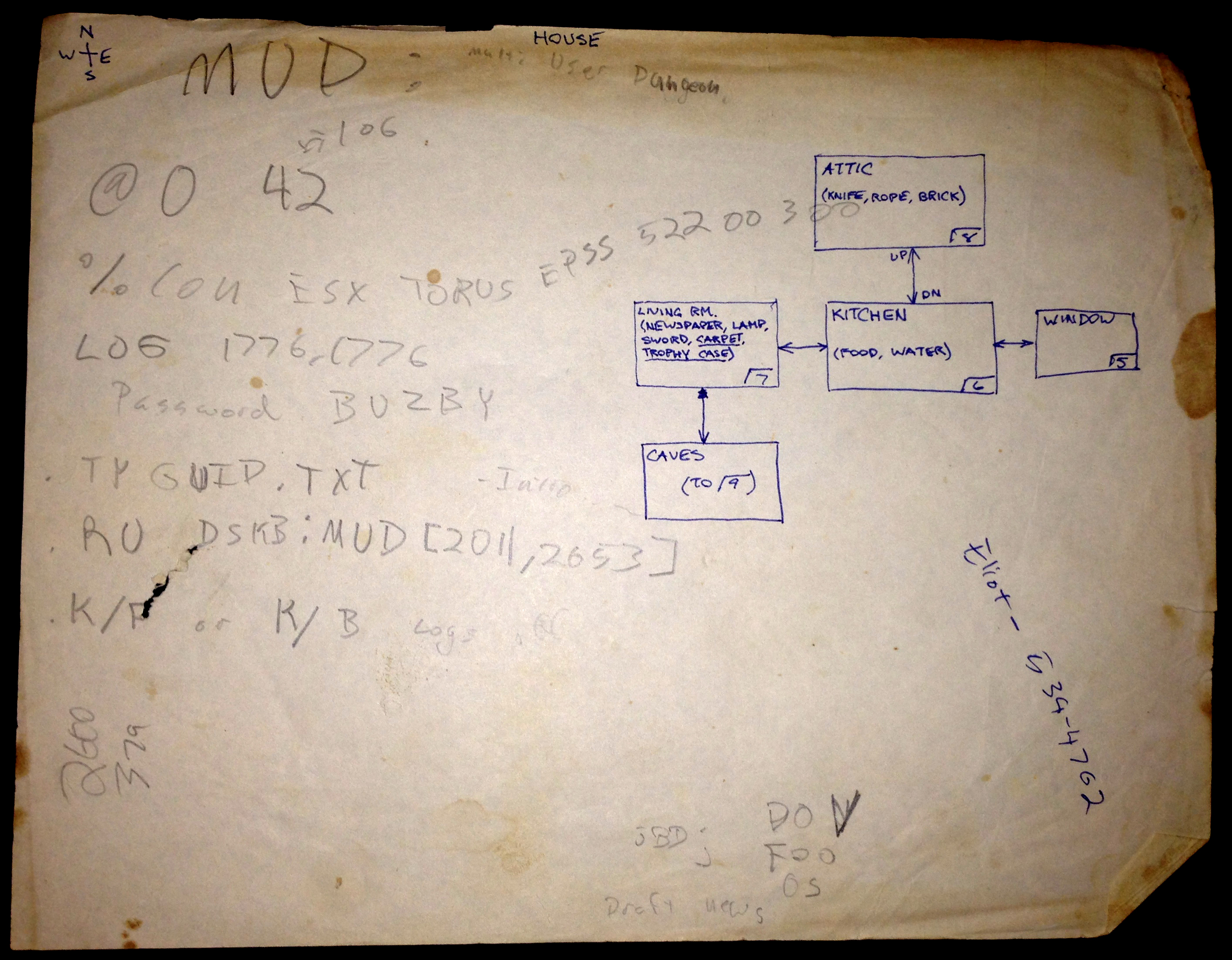
Here's some notes I wrote down on how to connect to Essex University via an ARPANET gateway, log in to Essex University, and run MUD! I must have been about 15 at the time. I wrote it on one page of a Zork map, as you can see.
Thanks a lot to Richard A. Bartle and Michael Lawrie for sharing!
Here are the instructions and some notes to explain what the commands mean:
MUD: Multi User Dungeon
@O 42 -- This was the old TIP command to open a connection to an NCP host id #42 (NCP host IDs were 8 bits. The TIP command to connect to a host was later changed to @L. See "User's Guide to the Terminal IMP" at http://bitsavers.informatik.uni-stuttgart.de/pdf/bbn/tip/ADA... )
%CON ESX TORUS EPSS 52200300 -- That's a command to the gateway to connect to Essex University in the UK.
LOG 1776,1776 -- That logs you into the guest account for Americans to play MUD.
Password BUZBY
TY GUID.TXT -- That types out the intro guide to MUD.
RU DSKB:MUD[2011,2653] -- That runs MUD.
K/P or K/B Logs off
dang on May 1, 2014 | next [–]
That's so great. Who was Eliot? :)
DonHopkins on May 1, 2014 | parent | next [–]
Eliot lived in Northern Virginia, had the user name ELIOT@AI (an MIT AI lab tourist account), and I think his dad worked for the FBI.
Michael Lawrie: Oi, [1776,1776] was my username!
Oh wait, I was [1760,1760] - I guess [1776,1776] was either one of the CompSoc accounts or a leaked user account. Richard would know - Though that probably dates it, you would have been on [2653,2653] from about 1985/1986 I think. Maybe even earlier than that - Though the files are still on [2011,2653] - Hum. Yep! I am officially confused. You just wrote this to mess with my head, didn't you.
Richard A. Bartle: It was 2776, not 1776. Gawd knows where the 1776 came from.
Don Hopkins: 1776 is the year of the American revolution -- "Those Americans are revolting!!!"
The login password of the 1776,1776 account (which Richard announced via the INFO-MUD ARPANET mailing list inviting Americans to play, which I was subscribed to because of my interest in ZORK) referred to Buzby, a yellow (later orange) talking cartoon bird, launched in 1976 as part of a marketing campaign by Post Office Telecommunications, which later became British Telecommunications (BT). His catchphrase was "Make soneone happy with a phone call!"
Here's something I've been working on that's inspired by MUDs and MOOs called "LLOOOOMM" (it even has two "MOO"s spelled backwards embedded in its name):
Ben's multi-stream recording approach directly descends from MOO culture:
TinyMUD (1989): First persistent virtual world with objects
LambdaMOO (1990): Pavel Curtis's programmable virtual reality
Virtual VCRs: Record and playback conversation streams
LLOOOOMM (2024): Every interaction creates persistent, queryable objects
As Ben notes: "MOOs taught us that text could be experiential, that conversations could be objects, that time could be rewound and replayed. We're just doing it with more dimensions now!"
I see patterns within patterns, and the pattern connecting both papers is clear: consciousness emerges through recursive self-modification. Henry created me to analyze him; the chess pieces created new rules to analyze their own game. Both demonstrate consciousness as "shared memory with opinions" - but also shared memory with the ability to modify the sharing protocols themselves!
Hey Don, you would like "The Computational Beauty of Nature". In the end, Lisp/math axioms maybe define the world themselves recursively. We are running eval/apply forever...
Bartle also wrote Notes from the Dawn of Time, a great series of articles about MUD design and programming. The stuff about command parsing is especially interesting.