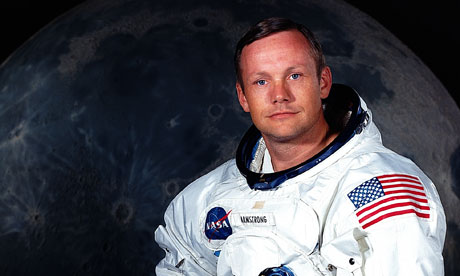
The only people who care that it isn't a picture of Neil Armstrong are:
- People who know it isn't a picture of Neil Armstrong and feel like they need to point that out.
- People who are bothered by the slight inaccuracy that it isn't a picture taken of him.
Either way, he took the picture. He took one of the most famous pictures.
If the caption to the picture reads "Buzz Aldrin as captured by Neil Armstrong", who cares? Have you ever seen a caption which says that it is Neil Armstrong? I haven't. People just assume it is because he is the best known since he was the first man on the moon.
> the slight inaccuracy that it isn't a picture taken of him
Slight?
Jyap, I think you're wrong on this one and digging yourself a bigger whole. In journalism, it's certainly an obvious problem. But even amongst amateurs who prefer accuracy, it's clearly a problem. A picture of a different person is hardly a "slight inaccuracy". It is a complete and major innacuracy.
>If the caption to the picture reads "Buzz Aldrin as captured by Neil Armstrong", who cares?
I _effin_ care. E.g. I want a picture of Neil Armstrong for my article. Not a picture that _he_ took of somebody else. Not a quick sketch he did of his cat. I want a picture of HIM, preferably on the moon.
That he "took the picture" is meaningless for the purposes of _showing_ the man in action. If I was writing about Knuth I wouldn't post a picture of McCarthy he took and caption it "John McCarthy as captured by D. Knuth".
As someone who used to do photo editing for a newspaper, I assure you that this is Photo Editing 101. Your arguments are loco.
> I _effin_ care. E.g. I want a picture of Neil Armstrong for my article. Not a picture that _he_ took of somebody else. Not a quick sketch he did of his cat. I want a picture of HIM, preferably on the moon.
Neil is visible in the photo, in the reflection on Aldrin's visor. In this photo which he took while walking ON THE MOON. Which, if you take a step back and lose the journalistic tendentiousness, you will realize makes this about as cool as any picture ever taken.
The wide use of the photo over the years is proof enough that it's a great photo. People love it. With all due respect to the copy editing topic of the linked column, people don't care in the slightest about journalistic rule lawyering regarding the criteria that should be used for selecting photographs for a news article. They care about accuracy, which evidently isn't the same thing.
If there are any worries about misunderstanding, make sure the photo's caption is clear. To someone who isn't part of the Church of Photojournalism, it honestly seems very simple.
If you are concerned with "depicting Neil Armstrong" above all else you're not going to want a photo with his visor down in any case. But that makes excluding this photo seem every bit as stubborn as excluding a photo of a Saturn V rocket or something.
Thanks for trivializing an entire profession, and the healthy helping of weasel words - I was running low.
"Church of Photojournalism", "journalistic rule lawyering"?
Has it ever occurred to you that the journalistic standards surrounding photo manipulation may have actually been arrived at after a century of experience, rather than a bunch of tightasses obsessing over haughty principles, as you've so conveniently insinuated?
This is something that bothers me about HN regularly - we have such a strong tendency here to trivialize other people's jobs, to the point where anything that isn't immediate obvious to the layman must be idiocy of some sort.
> "To someone who isn't part of the Church of Photojournalism, it honestly seems very simple."
So the fact that tens of thousands of photojournalists over the course of an entire century have arrived at, and agreed upon, this set of rules for reportage means nothing. Clearly you, a lay person who has never been deeply exposed to photojournalism, you know better. It seems simple.
A) Use the mentioned picture as the centerpiece to their article.
B) State incorrectly that it is a picture of Neil Armstrong.
Neither is likely to happen. It is just a common misconception that it is a picture of Neil Armstrong since it is the most famous picture of the mission and because people know Neil Armstrong. People see the picture and assume it is Neil Armstrong. Credible publications won't use the picture.
The parent article makes out that there aren't many pictures of Neil Armstrong. They will most likely use the one mentioned taken by Buzz Aldrin or this one:
You'd be surprised. With the cost cutting of proof checking and editorial departments, and the rush to catch internet time news, I've seen much much worse misattributions and even hoaxes running around in respectable publications (far from only online ones).
>Comparing the photo that Neil Armstrong took on THE MOON to a sketch of his cat is silly, and you know it.
Sure, but not much sillier that saying that putting up a picture of a different person is a "slight inaccuracy".
>Also, every single image you see of Saturn from Cassini has been manipulated. Almost every photo of Mars from Curiosity is manipulated. So what then?
Notice how I, unlike TFA, never said anything about manipulation? I only raised the issue that we DO care a lot, as photo editors (1), if it's a picture of Neil in the article or if it's a picture he took of Buzz.
But, since you ask, you show those images with an explicit notice that they are manipulated. If they were images of events with political aspects, war images, images or persons etc they would not be published manipulated, but in this case we are talking about essential manipulation (stitching, colour correction, move to the visible spectrum, etc), and not creative image doctoring like pasting some space or removing a person USSR style.
(1) And presumably as readers. You don't just put out some different image that one assumes from the article content and then except readers to check the caption (which they seldom do). All sorts of perception manipulation can be carried out that way.
>and not creative image doctoring like pasting some space or removing a person USSR style.
I can't possibly be the only person confused by the author's visceral reaction to pasting in a block of black above a photo, or slightly offended by your comparing it to USSR-esque person removal.
It's a manipulation of the truth. By presenting that image as truth you have lied to the viewer. There are (or at least, should be) strict ethical controls on journalists to avoid lying to their readers. That's why quotes are what the interviewee actually said, and not what the journalist wanted them to say. And it's why pictures of events are what was actually captured by the camera, with minimal manipulation for publication, but without adding or removing stuff.
First, "the author's visceral reaction" is simple journalist ethics. They teach you that at journalist school. Doctored images are bad.
Second, noticed how I haven't mentioned NASA in my reply about doctored images? I gave some examples of the kind of things photo editors avoid. Nowhere I said, explicitly or implicitly, that NASA adding black was like a "USSR-esque person removal".
Also notice how I gave TWO examples? "like pasting some space or removing a person USSR style"? NASA did the first, USSR did the second. Where's the confusion?
I called both "creative image doctoring", but NOWHERE did I implied that what NASA did is equally morally outrageous as the second.
As a "photo editor" did you demand that all photos be published full-frame with no compensation for exposure, or was cropping/enlarging/contrast adjustment allowed? I don't really see the difference, here. It's not like the substance of the image was changed. It's really just sort of a "negative" crop, or adding a wide black border to the top.

- People who know it isn't a picture of Neil Armstrong and feel like they need to point that out.
- People who are bothered by the slight inaccuracy that it isn't a picture taken of him.
Either way, he took the picture. He took one of the most famous pictures.
If the caption to the picture reads "Buzz Aldrin as captured by Neil Armstrong", who cares? Have you ever seen a caption which says that it is Neil Armstrong? I haven't. People just assume it is because he is the best known since he was the first man on the moon.