Hacker News new | ask | show | jobs
by jballanc 5047 days ago
The article focuses on the same things have been hammered on for a while now (other countries do health care better, other countries do education better, other countries do education better...), but I think there's another reason to get out of America: other countries have different cultural strengths.

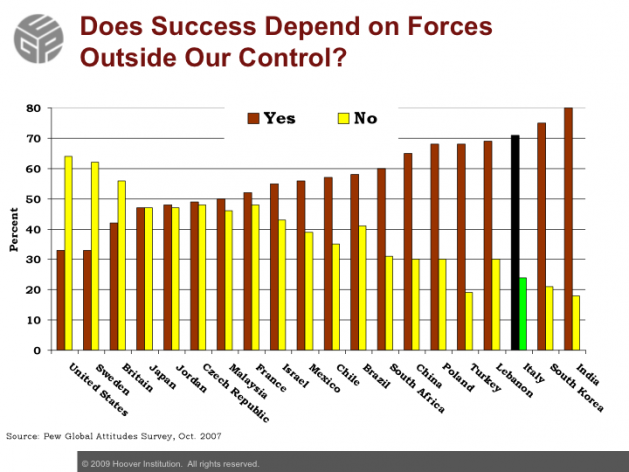
Antonio Cangiano wrote a post a while back about why Italy doesn't do enough startups (http://programmingzen.com/2011/11/10/the-real-reason-italy-s...). In that post, he has a chart (http://programmingzen.com/wp-content/uploads/2011/11/does-su...) that shows that Americans, more that the citizens of any other country, believe that their success or failure is a direct result of their own actions. This is a blessing and a curse, as it means that Americans are willing to work harder to get what they want, but they are also willing to believe when a politician says that there's no need for universal health care or help getting people jobs because "anyone who wants it enough can work harder and get it for themselves".

Regardless, I would argue that this is America's defining cultural strength.

I recently moved to Turkey. Turkey has "hospitality" as its defining cultural strength. If you go to a little shop and look around for more than 10-15 min, you can expect to be offered a drink (free of charge, of course). When I go to the bakery, the woman who works there frequently slips me a cookie or pastry after I've already paid. Most of the malls in Turkey have systems in place that tell you exactly where there is an open parking spot so you don't have to spend 15 min driving back-and-forth.

In America, people celebrate blog posts about pricing tricks that will convince customers to part with a few extra cents. In Turkey, cab drivers regularly round fares down to the nearest lira (well, assuming you aren't a tourist in Istanbul, which is a whole different issue). Now, you could do extensive studies to show that hospitality leads to customer loyalty over the long term, and greater profits blah blah blah...but Turks don't need that. Hospitality is second nature, and my anecdotal experience is that it makes for a generally happier populace, even when all the objective metrics indicate that Turks should feel worse-off than Americans.

What really strikes me, though, is that I have experienced Turkish-like hospitality from one company in the US: Apple. So, now you have every MBA student in America racking their heads trying to figure out what Apple has done to become the most valuable company in the world, where if they had only spent a couple of years living in Turkey they might already have their answer...

2 comments

> What really strikes me, though, is that I have experienced Turkish-like hospitality from one company in the US: Apple.

Could you explain this? Because I haven't ever gotten a free iPhone for browsing in the Apple Store for ten minutes.

You wouldn't get a free rug in a Turkish rug store but Apple do go out of their way to appear inviting and helpful way beyond any of their competition.
This. I've found that business in America have a tendency to try and monetize the entirety of every business transaction. For example, I used to work at Circuit City, and if you came in to buy a TV you'd be amazed how quickly the salesperson would shift the conversation onto cables, power supplies, protection plans, etc. When the end of the day rolled around, and praise was divvied out by the store managers, no one ever talked about the size of the TV so-and-so sold. The praise focused entirely on the "attach".

On the other hand, a Turk will recognize that you are there to carry out a certain business transaction. Turks can haggle and negotiate with the best of them (another aspect of their culture). But you'd better believe that, as you spend half an hour negotiating the price of that rug, the rug seller will have had his assistant bring you tea and simit, and you'll have the most comfortable seat in the place (none of this "make the floor as hard and uncomfortable as possible so that customers complete their transactions quickly"...yes, that is a well known trick in the American retail industry).

Apple does the same thing, especially with their stores. Their computers are not cheap. But Apple will hold free workshops telling you how to use them. Store employees will help you transfer data from your old computer if you need it, and when you come back in a week, you'll get the same reception as you did before you made your purchase, even though you're unlikely to be buying another computer.

Mostly, it's about recognizing your customer as a fellow human being, as opposed to "the next mark"...

Note that you are comparing a big chain store (Circuit City) with small business (a Turk). Most businesses in the US are small businesses, which behave differently than chain stores. And if you think that that the Turk wouldn't get back the price of his tea hundredfold when you buy that rug, then you're very naive :) It's just different styles of conducting business - in some cultures, the negotiations are supposed to be personal and simulate closeness and friendship (even if parties are hoping to cheat each other as much as possible), in some it is supposed to be businesslike and impersonal.

As for the Apple store, I had been a number of times in Apple store in San Jose, that's abut 15 minutes drive from main Apple campus. Almost each time I had the worst experience. I had to wait for a long time, workers kept redirecting me from one to another, and since the policy is that there are no lines in Apple stores, I had no idea when I am going to be served - I just had to aimlessly wander around the store and wait for the moment where some "genius" is ready to grace me with his attention. I had to explain what I need to multiple people, which for some reason didn't talk to each other, and I observed multiple store workers not busy with anything but somehow still unavailable to help me. I am totally unconvinced about that being the paragon of customer service.

Well, you're wrong about one thing: that's not just small businesses in Turkey. Even very large chain stores have the same level of hospitality. And it's not just stores. As an example, tomorrow is the start of Şeker Bayramı (literally translates as "Sugar Holiday" but is just what Turks call Eid al-Fitr, the end of Ramadan). The holiday lasts for 3 days. I received a text from Turkcell the other day stating that they were giving everyone unlimited texting during the holiday.

Edit: Also, of course the Turkish businessman is making back the cost of the tea. It would be foolish to think otherwise. The point is that (if you want to go all Econ 101 on it...) Turks tend to think in terms of straight profit, whereas Americans are much more obsessed with opportunity cost.

Are you saying short-term discounts and freebies are unheard of in USA? http://www.huffingtonpost.com/2011/06/02/national-donut-day-... https://www.facebook.com/events/353010928105586

There are many more examples of stuff regularly given out by companies for free, it's just two things I could remember immediately due to you mentioning "sugar holiday" :)

Minus the whole "rounding down" thing.