Hacker News new | ask | show | jobs
by shaboinkin 408 days ago
What I wonder about sea level rise is what happens to all of the development that gets swallowed by the sea? I’m not optimistic that there will be proper cleanup of the stuff that was built up over time. If I recall from the LA fires last year, the burnt down homes left some toxic stuff behind that require proper disposal. The same stuff in those homes presumably exists in the buildings and infrastructure that will be taken by the sea. How much pollution is going to be introduced into the environment? And what long term consequences will result from that?
4 comments

Here in the UK parts of the east coast are regularly lost to the sea (not caused by climate change), and the answer is we just let the houses fall into the sea. https://en.wikipedia.org/wiki/Coastal_erosion_in_Yorkshire
In my city, there is a relatively large, man-made lake not too terribly far from the downtown area. Apparently, there are still buildings, cars, etc. at the bottom of the lake. Instead of clearing out the area, the city just decided to flood the entire area over. In times of drought, some of the building foundations can still be seen from an arial view.

I doubt the environmental impact was positive, but the point I am trying to make is that I wouldn't be surprised if current infrastructure was just left to be swallowed by the sea.

Sure, but we’re talking about hundreds of miles of coast line all being affected, within various regions as the article points out, at relatively the same time. Thousands of coastline if we want consider a worst case rate of increase. The leaching of whatever is soaking into the water will likely occur in localized areas at similar rates. It seems reasonable to me it’ll introduce shock to the ecosystem if considered in geological timescales.
I am in complete agreement with you, and I wish the environmental aspect would be considered more.

However, based on what I understand of the human race, I think nothing will be done to prevent the issue. I guess the closest thing I can think of off the top of my head would be tsunami damage. Though that is probably not a good comparison still. I am curious what environmental changes can be observed in pre/post tsunami ecosystems. I suppose I will have to look into this when I have more free time...

Honestly, I am rather jaded when it comes to climate change. Humans are very reactive and less... proactive. I would argue that much of these environmental concerns could and should have been addressed decades ago. Thus, by the time cities are swallowed by the sea, I believe it will be too late for us to do anything. As in, whatever ecosystem that could be affected will probably already be affected by other downstream issues, if not completely destroyed already.

Though, I once had an environmental science professor that had a tongue in cheek saying, "Dilution is the solution to pollution." While unlikely as it may be, I am going to have my fingers crossed that hopefully any ramifications will be diluted enough. (I know they probably won't be.)

It is probably far less material than what gets deposited from that plus slightly inland property from hurricanes and other major homeshredding storms.
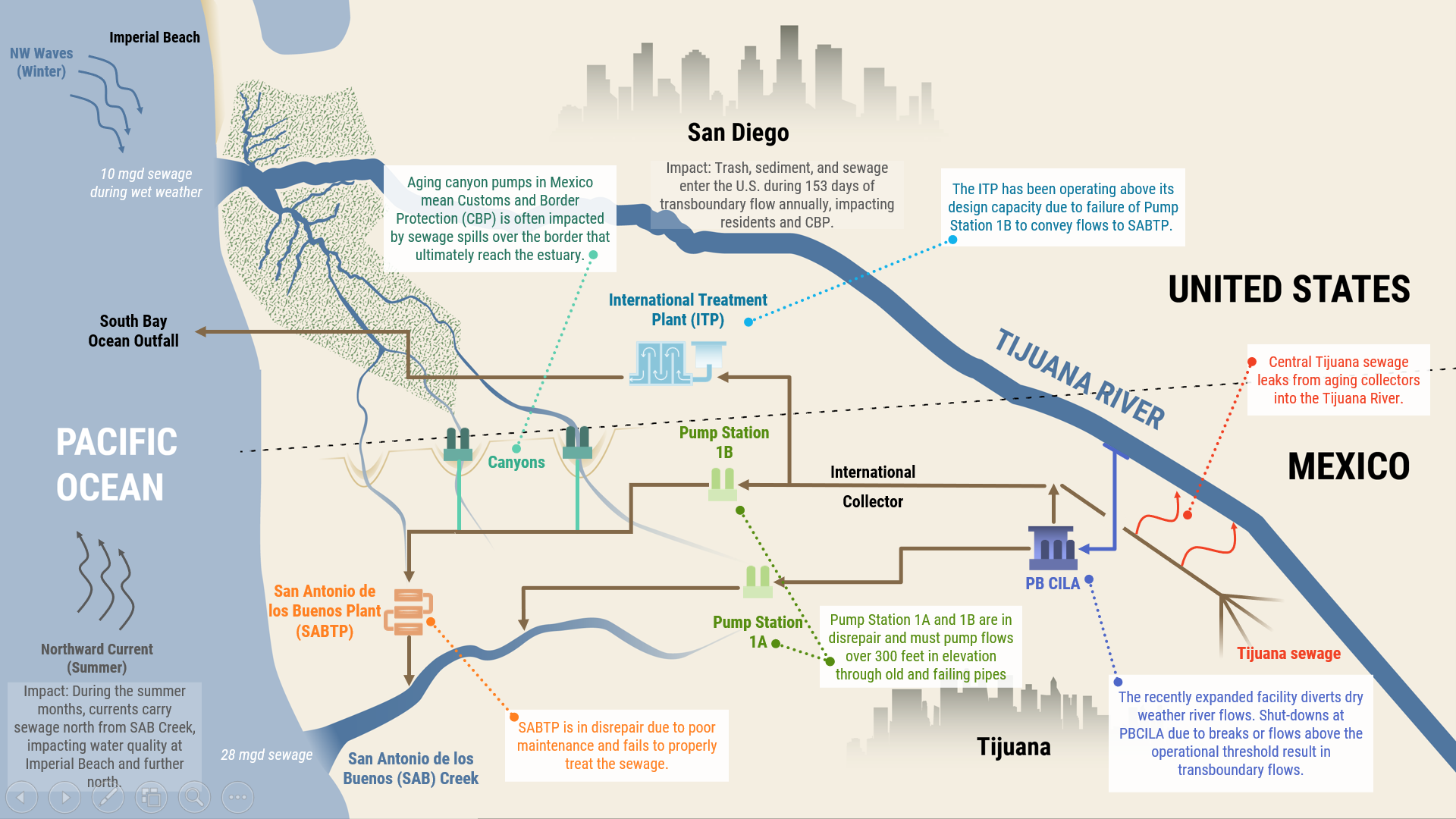
We still have decaying nuclear material off the west coast and Tijuana has been flooding the border with polluted water for years now so anything more will just cause additional strain and more beach closures / illness.
The tijuana situation is pretty untenable when you view it less along internatial border lines and more along metro region lines with SD and TJ being part of one megacity. They very much are a megacity in practice.

Now imagine the flack that would happen if you say took the Bronx and subject it to border security checkpoints and let the people have materially significantly worse sewer and other living conditions. People would call it a travesty and a dark mark on nyc as a whole for allowing such a thing to happen to its own people.

Yet over in SD that very situation happens with all the commuters and trade that goes on between there and TJ. And people don’t bat an eye to it, if only to blame TJ for the sewer situation.

The US gov has allocated money and resources to help build infrastructure on the Mexico side. King Groceries is obviously delaying it though.

People do view this as a major issue but comparing it to the Bronx when it’s in another country drastically oversimplifies the issue. I’m sure many people would be unhappy for the US gov to spend money on Mexico…

What are you suggesting though? Annexing TJ?
Of course they aren't. SD could pay or part-pay for TJ sewage facilities (since it daily flows up to SD and LA anyway).

https://www.nbcsandiego.com/news/local/epa-administrator-vis...

SD is broke but the Fed is supposed to help out.

https://www.axios.com/local/san-diego/2024/11/19/biden-fundi...

Noone said "SD is broke", can we have a good-faith discussion please?

It's not a question of the Fed "helping", it is a federal issue, just as much as TX, FL, AZ etc. spending federal money on any other transborder matter. The sewage is caused by Mexico (not SD) and affects as far up as LA, and it's a federal and foreign-policy issue as much as a local issue for the SoCal counties.

I don't know much about SoCal water treatment, here's a useful explanation [0] + infographic [1] from EPA.

As to arguing that a couple of hundred million in federal funding to do something useful that improves both SD and TJ (quality-of-life, tourism, watersports, etc.) is unthinkable, compare to the waste in the ICE budget for FY 2025: $10.5 billion, several billions of which is being spent on privatized prisons for unnecessarily holding people up to 18 mths (when Congress could simply e.g. expand H-2A/B visas for the agricultural/manufacturing/services workers which the US is dependent on). TJ is essentially the outsource manufacturing hub on the US's doorstep, and will be increasingly so when some manufacturing moves back to N America (e.g. from China), we might as well constructively engage with reality. Really this decision should be non-partisan and a no-brainer.

[0]: https://www.epa.gov/sustainable-water-infrastructure/usmca-t...

[1]: https://www.epa.gov/system/files/images/2021-08/concerns-map...

I would guess it should be more about cooperation on the problems and maybe some money needing to flow from the richer side to the poorer, and the poorer side agreeing to some policies.

Annexing wouldn't work because a new city would pop up along the new border. The border is the attraction.