|
|
|
|
|
|
by georgewsinger
469 days ago
|
|
|
Yes, however Claude advertised 70.3%[1] on SWE bench verified when using the following scaffolding: > For Claude 3.7 Sonnet and Claude 3.5 Sonnet (new), we use a much simpler approach with minimal scaffolding, where the model decides which commands to run and files to edit in a single session. Our main “no extended thinking” pass@1 result simply equips the model with the two tools described here—a bash tool, and a file editing tool that operates via string replacements—as well as the “planning tool” mentioned above in our TAU-bench results. Arguably this shouldn't be counted though? [1] https://www.anthropic.com/_next/image?url=https%3A%2F%2Fwww-... |
|
|
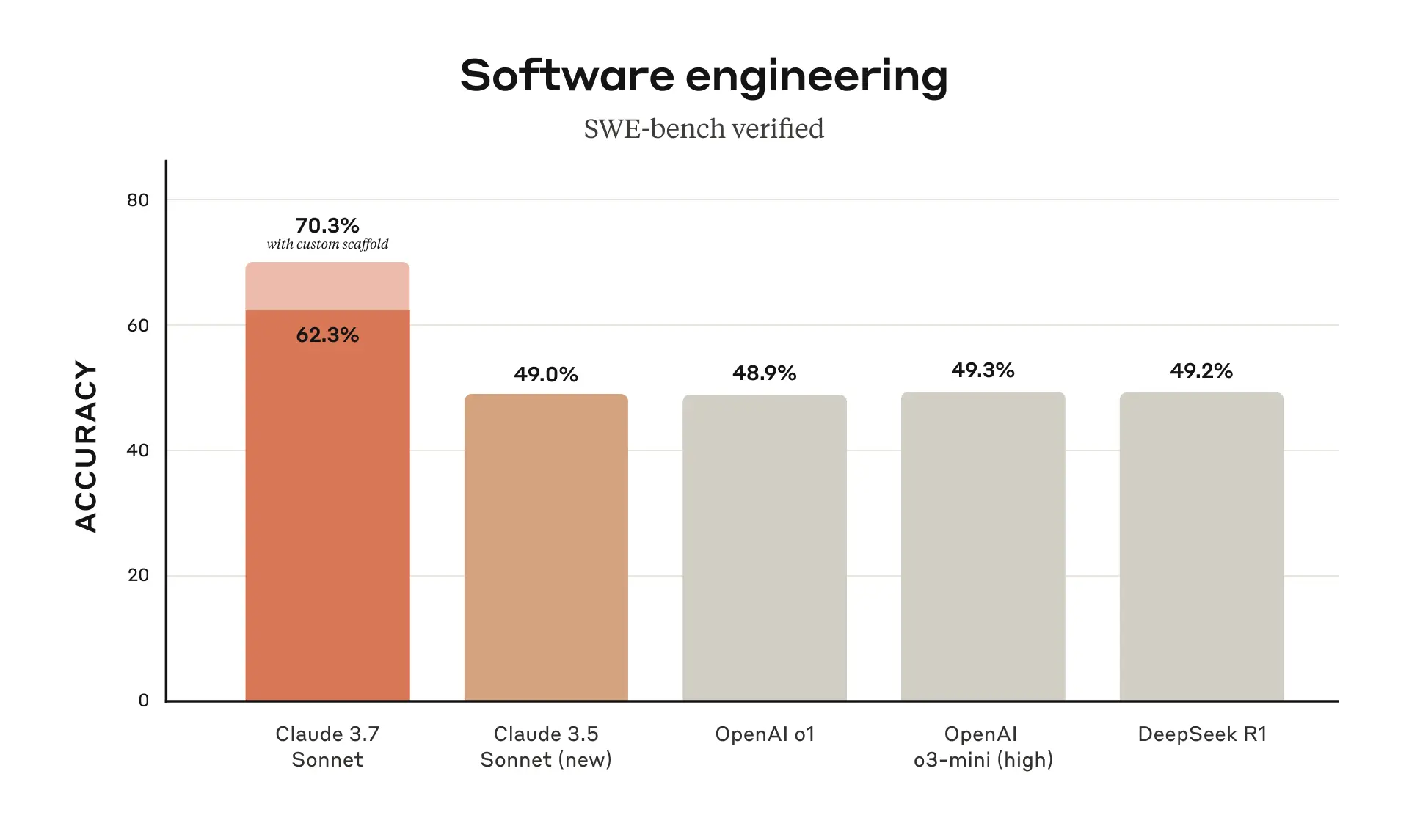
> For our “high compute” number we adopt additional complexity and parallel test-time compute as follows:
> We sample multiple parallel attempts with the scaffold above
> We discard patches that break the visible regression tests in the repository, similar to the rejection sampling approach adopted by Agentless; note no hidden test information is used.
> We then rank the remaining attempts with a scoring model similar to our results on GPQA and AIME described in our research post and choose the best one for the submission.
> This results in a score of 70.3% on the subset of n=489 verified tasks which work on our infrastructure. Without this scaffold, Claude 3.7 Sonnet achieves 63.7% on SWE-bench Verified using this same subset.