Hacker News new | ask | show | jobs
by Ukv 434 days ago
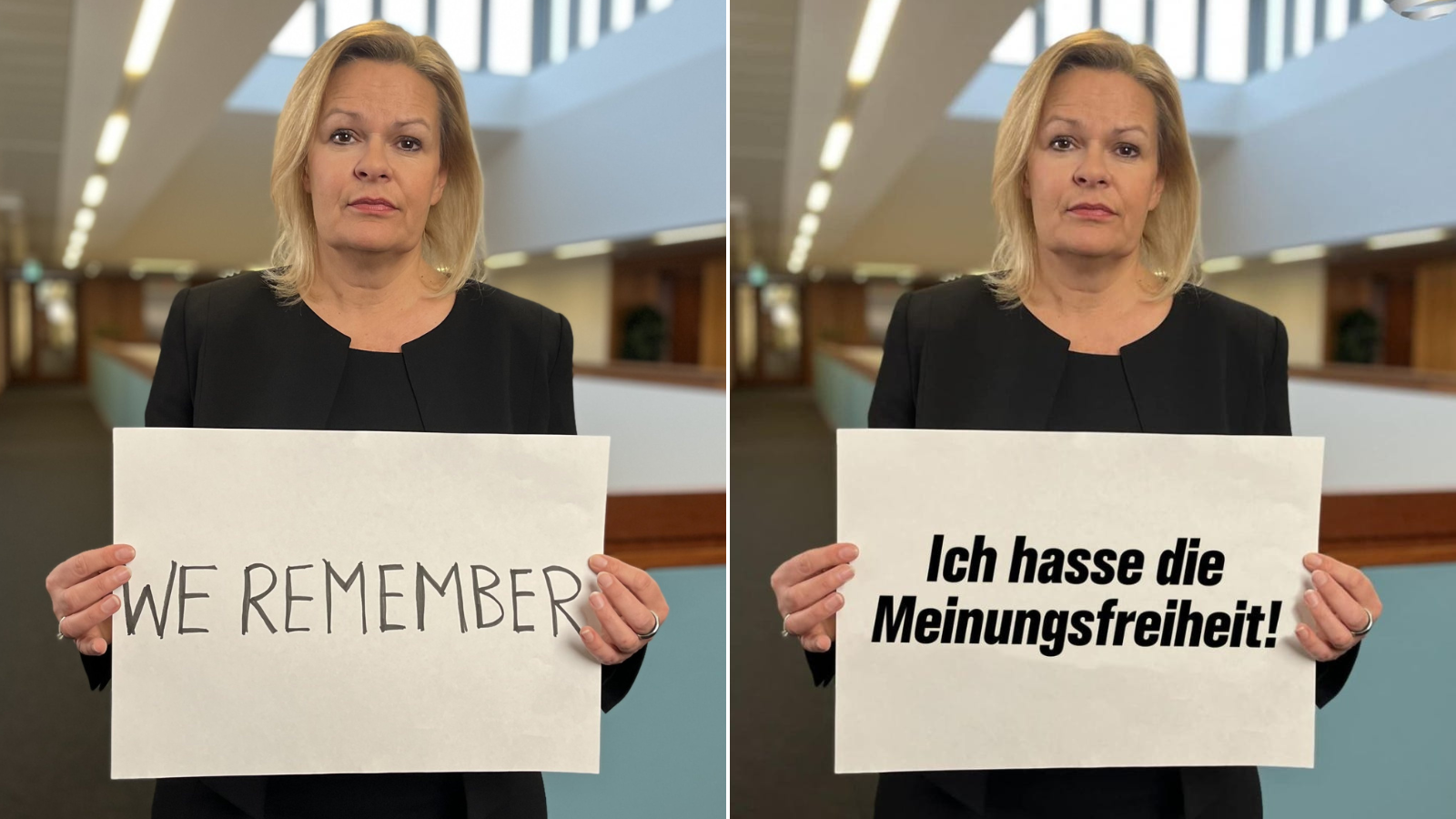
I believe this is the picture in question (and original): https://www.gbnews.com/media-library/nancy-faeser-photo-befo...

Seven months for that seems insane to me. It looks far more like a meme/satire than an attempt to create a realistic fake, given it's just pure-black impact font and an implausible message ("I hate freedom of speech!") to be holding up on a sign.

2 comments

You have to consider the target audience, they believe German culture gets erased because a discounter sells chocolate bunnies as sitting bunnies instead of Easter bunnies while the leaflet is full of Easter named articles and Milka sells its chocolate bunny under the name Schmunzelhase (Smiling bunny) for decades.

In these circles, false quotes have been repeated as true again and again for years.

A simple “satire” in the article would not have been enough, but it would have had the same effect.

> In these circles, false quotes have been repeated as true again and again for years.

Even if people did go on to repeat it as if it were a real quote (can't find evidence of this, from a quick search), I don't feel the fact that not everybody got the satire should turn it into defamation, so long as a reasonable person would recognize it as satire and the intent is humor opposed to deception. Should the fact that The Onion/Clickhole articles and quotes have often been circulated by people believing them to be real result in sentences for their editors?

> A simple “satire” in the article would not have been enough, but it would have had the same effect.

Confused by what you mean here. To my understanding Bendels posted the meme on X/Twitter, not in an article. By "would not have been enough" do you mean that even if it were explicitly labelled as satire, it would've still been defamation?

A journalist posted a altered photo not a meme.

The photo is based on a real photo of her holding a paper with „we remember“ written on it.

Sorry by article I meant the tweet. A journalist should mention if his posts are facts, an opinion or a satire especially when he knows his audience.

Those satires have lead to insults and death threats in the past and people like him know that.

As a journalist he has to be held to a higher standard when it comes to public posts. Newspapers already have a trust problem

> A journalist posted a altered photo not a meme.

When there's a blank template of someone holding a sign, and people are adding on messages intended to be humorous/satirical (e.g: https://x.com/Wrdlbrmpfd_Wrdl/status/1618755937355063296) then spreading it on social media, that'd generally be called a meme.

> The photo is based on a real photo of her holding a paper with „we remember“ written on it.

I linked the original and edited version above, yeah.

To be pedantic, Bendels' edit appears to be based on a blank template used by other posts (e.g: https://pbs.twimg.com/media/FnrNpDzXgAEsmtI.jpg) and not directly on the original photo itself.

> Those satires have lead to insults and death threats in the past and people like him know that.

People sending death threats or calling for violence should be prosecuted. But I do not think it's reasonable to criminialize satire like this on the basis that it might "lead to insults" from other people.

Or at the very least, if you do hold that view, you should see why others would consider it an impediment on free speech.

As mentioned above, journalists with a wide reach should be held to different standards, similar to doctors who are anti-vaxxers, facing massive consequences and an immediate cancellation of their licenses. They are endangering people's lives.

Context matters a lot. It's different if we talk crap at home with our friends vs. broadcasting a message to 10M people.

> Seven months for that seems insane to me.

It is, but see what the article has to say about that (translated with google translate):

> Among other things, they complain about the inappropriate severity of the justice system against an allegedly satirical statement. What is left unmentioned, however, is that the trial only took place because Bendels previously refused to pay a fine of 210 daily rates imposed by the same district court in November.

I know nothing about this person or this case, but it sounds like he has done this before and refused to pay a fine, so the court said "enough is enough" and sent him to prison.

True, but 210 daily rates (around $60k for Bendels?) also seems insane for this to me.
It's hard to say without more context. Maybe that was not hist first fine, it just got to that amount after a few "satirical statements" and lower fines.
I can't find mention of any prior fines, only that "Bendels has no criminal record".

If this was the first fine, would you agree that ~$60k is disproportionate?

I have no idea, and I'd have to know more context before thinking my opinion matters. For example, just off the top of my head: (1) What are the fines for comparable things in other countries (in an out of Europe)? (2) "Bendels has no criminal record" -- does that mean he was never convicted of defamation, or is that a red herring because defamation a civil (not criminal) matter?

I can't help to notice how with just a little bit of context we've come from reacting to "A journalist in Germany was just sentenced to seven months for posting a meme" to deciding if a fine was disproportionate.

With all that, the only sensible answer I can give is that I don't know. It's useless to be outraged by something that might be a non-story.

> I have no idea, and I'd have to know more context before thinking my opinion matters. For example, just off the top of my head: (1) What are the fines for comparable things in other countries (in an out of Europe)?

Even in Germany, I don't believe a meme like this one would typically incur any fine.

> (2) "Bendels has no criminal record" -- does that mean he was never convicted of defamation, or is that a red herring because defamation a civil (not criminal) matter?

My understanding is that he has now been convicted of criminal defamation (so it should probably be past tense), but had no such prior convictions.

> I can't help to notice how with just a little bit of context we've come from reacting to "A journalist in Germany was just sentenced to seven months for posting a meme" to deciding if a fine was disproportionate.

I don't personally believe there should have been any fine or prison sentence for posting the meme. I ask you whether you think the fine seems disproportionate based on current information because I see that as the smallest and most likely concession for you to make, assuming you can be intellectually honest, not because the fine being disproportionate is the full extent of my stance.

> With all that, the only sensible answer I can give is that I don't know. It's useless to be outraged by something that might be a non-story.

We've got the original post, the court's sentence and reasoning, and most other information you want to know could be researched online. There has to be some point at which we start publicly discussing an issue - that doesn't prohibit us from updating our views if there really is some decisive new evidence.