Hacker News new | ask | show | jobs
by H_L 5055 days ago
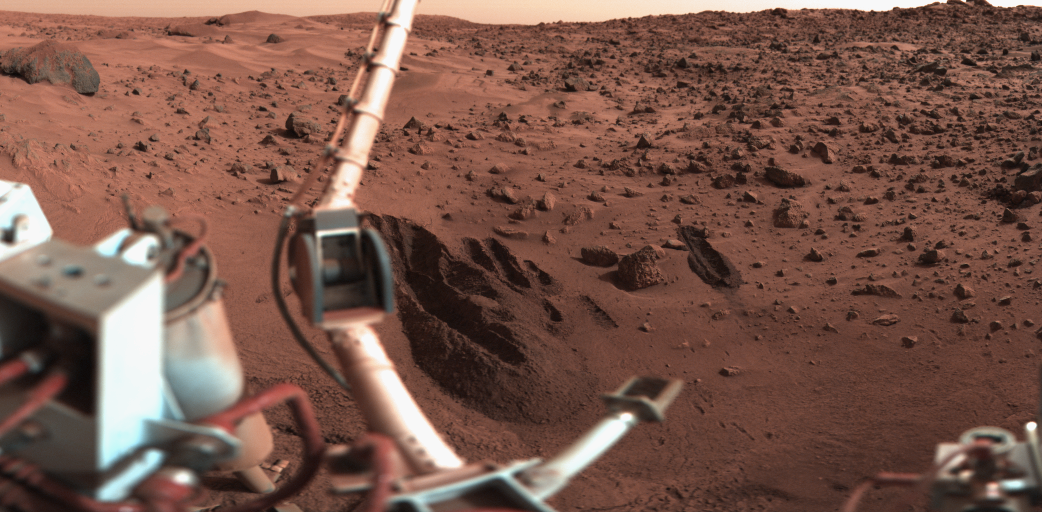
While yes, the original pictures from the low res camera look bad, the new raw pictures from the higher-resolution cameras aren't really that much better. Better than the images from the iPhone 1, probably. But better than Viking 1 images from 1976? Honestly, it doesn't look like it.

http://upload.wikimedia.org/wikipedia/commons/1/1b/Mars_Viki...

Just look at the detail per pixel. It's amazing. You can see tiny details in the sand. It's looks like if you took an image on a 20 megapixel DSLR with a high-quality lens, then scaled the image down to web size. The resolution isn't higher than a camera-phone, but the detail is remarkably better. And that's from nearly 40 years ago.

1 comments

That image was taken in 1977. Actually, this is how people saw it until 2009

http://nssdc.gsfc.nasa.gov/imgcat/hires/vl1_11d128.gif

when Mr Van der Hoorn "used the original 11d128.blu, 11d128.grn and 11d128.red images from the NASA Viking image archive, converted them to .png, manually removed the noise and finally merged them into one image"

Details: http://en.wikipedia.org/wiki/User:Van_der_Hoorn/Viking/Filte...

The Viking 1 camera(s) were of the Vidicon type: http://en.wikipedia.org/wiki/File:Vidicon.png

While yes, the full color image I posted was re-compiled from the original red, green, and blue channel images sent from the rover by a non-NASA source, even NASA's B&W images look better back then than they do now.

I made an image to illustrate this: http://f.cl.ly/items/0k2w2d1C1O3w3e0t300f/NASAQualityDegreda...

Remember that the images we have from Curiosity so far are from the navigational guidance cameras, though. The heavy equipment hasn't been fired up yet.

If I recall, the Mastcam will take a panoramic colour view later today, and that'll take a few days to download. Then we'll have a proper image, for the first time.

Here is the panaromic view from Mastcam. But as you can see by image's description, we're all still waiting for the big picture though! Excerpt from [1]: "As engaging as this color panorama is, it is important to note this is only one-eighth the potential resolution of images from this camera." [1]http://www.nasa.gov/mission_pages/msl/news/msl20120809.html
Some of the images, and the one I used for my comparison, are from the Mastcam, I believe.

The MAHLI is the only visible light camera that hasn't been used at this point.

Interesting. I'm just going on a hunch here, but maybe getting better photographs of the Mars surface is not a priority anymore? From the wikipedia page of Mars Science Laboratory the goals of the mission are:

To contribute to these goals, MSL has six main scientific objectives:

* Determine the mineralogical composition of the Martian surface and near-surface geological materials.

* Attempt to detect chemical building blocks of life (biosignatures).

* Interpret the processes that have formed and modified rocks and soils.

* Assess long-timescale (i.e., 4-billion-year) Martian atmospheric evolution processes.

* Determine present state, distribution, and cycling of water and carbon dioxide.

* Characterize the broad spectrum of surface radiation, including galactic radiation, cosmic radiation, solar proton events and secondary neutrons.

By those I can understand why carrying a high res camera was not a priority because it would have added weight, taken up space and also consumed more bandwidth while transmitting? :)

How are you supposed to maneuver a 2 ton (or any rover for that matter) rover without cameras?

And I guess today they are cheap and easy enough (I mean, cheap as space exploration goes)

> How are you supposed to maneuver a 2 ton (or any rover for that matter) rover without cameras?

It's one ton, and you can't, which is why it has 2 navigation cameras and 4 hazard cameras near the wheels.