Does AV1 need a successor right now? At least as of some years ago SVT-AV1 was stronger than x265 on both software encoding speed and quality/bitrate[1], and a successor would reset the timer on getting hardware decoders rolled out.
It looks like VVC (H.266) will be significantly better compared to HVEC and AV1.
But due to the patent issues it'll bound to have, I suspect common usage will practically be nonexistent, just like HVEC.
> I suspect common usage will practically be nonexistent, just like HVEC
HEVC is used in all TV broadcast station. FaceTime and other Cameras, Netflix, Amazon Prime, Disney+ and many other large streaming services outside US. The only one that doesn't have any usage of HEVC is Youtube.
The problem with the patents are largely misunderstood. Most importantly the patents do not directly apply to the individual consumer downloading and decoding such audio/video content. The patents only apply to commercial settings - the sales of software that can encode or decode audio and video in the MPEG formats, and sales of audio and video content encoded in those formats. This is why Mozilla made a big fuss over not wanting to include H.264 decoding in Firefox years ago, because they feared they'd have to spend a bit of their money since they are after all a commercial endeavour. No, really, it was never about wanting to "protect" users, it was always about their earnings. You can happily encode AAC audio and H.264 video and share it free of charge with everyone, and they can always listen to and watch that content, without any worries.
And pardon the nitpick but it's H.264 and H.265, not x264 and x265.
Seems like the last h264 patents expires in about 5 months, silly to start moving around to options that might have submarine patents when we'll have something functional that's patent free in quite a short time.
Can you be more specific? I can't really tell what you mean by "normal" here.
And while I do like smaller files, if I compare with a few years ago my connection is faster and my drives are bigger so presumably the limit for "normal" has gone up...
H.264 does just fine with 4K. If you know what you're doing you really don't need to throw 10 Mbit/s at it to get crisp quality.
(p.s. I'm fully onboard with H.265 being fantastic, it's amazing to see what e.g. x265 can do for it, being able to provide practically identical output at 30-50% lower bitrate. I'm just saying that H.264 isn't in any way incapable.)
H.264 may allow 2160p video, but the 4K UHD standard is more than just 2160p. For example, HDR is absolutely critical to 4K, and the only way to do that in H.264 is to use Hi10P which isn't supported by most devices.
In fact, I'd say HDR is more important than 2160p resolution in that I'd rather watch 1080p HDR video than 2160p SDR video.
The trick is knowing what the optimum settings are to use.. with h.265 as you lower the bitrate it smooths more and more and you lose detail. h.264 does blocking instead, so there is an image quality difference.
At the lower end of useful bitrate there's absolutely a difference. Video encoding is complex territory and there's no way around knowing and understanding "optimum settings" when wanting to keep bitrate down, no matter MPEG-4 ASP, H.264, H.265, AV1, what-have-you.
They've been working on it for years but I'm not sure there's any great need for it right now. The various MPEG alternatives seem to be eating themselves with patent infighting and fragmentation.
It says AV1 is open source and royalty free, and all modern hardware seems to have hardware decode for it. It doesn't seem any of the big players are realistically worried about bogus patent claims.
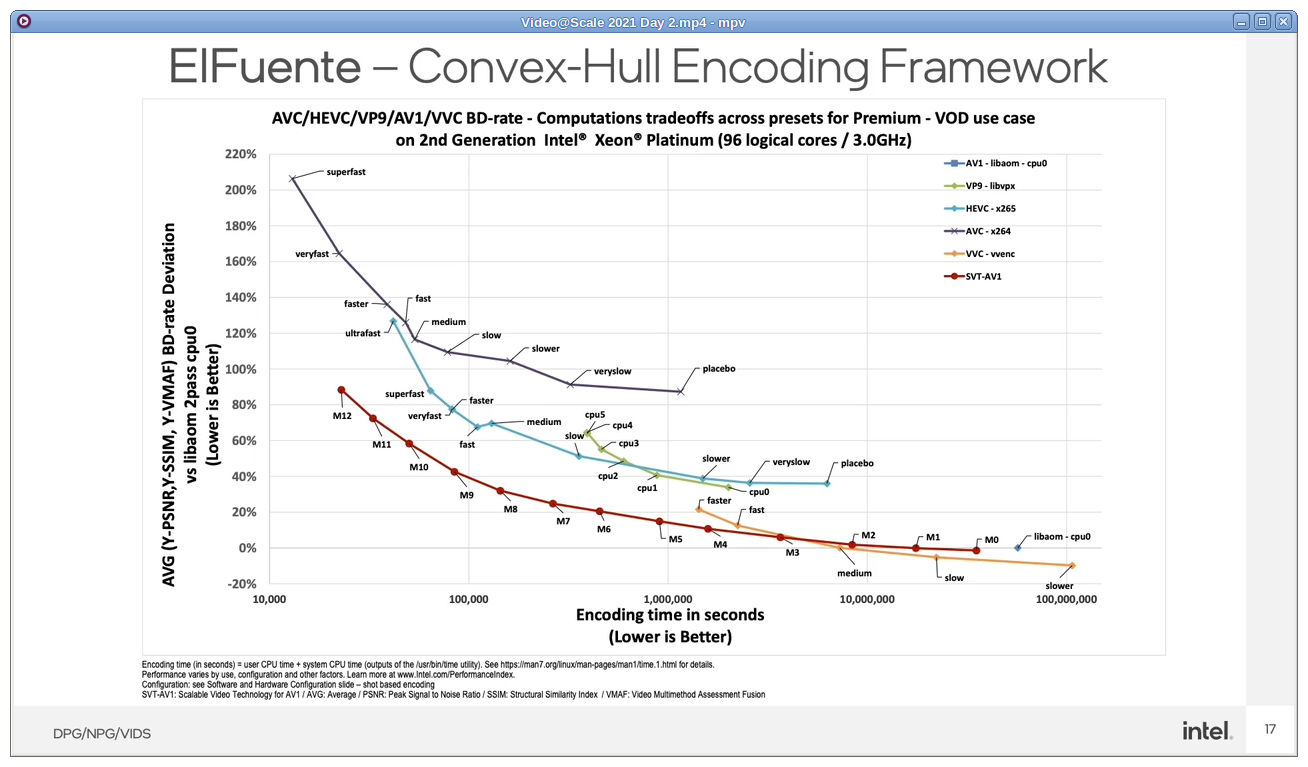
[1] https://medium.com/@ewoutterhoeven/av1-is-ready-for-prime-ti...