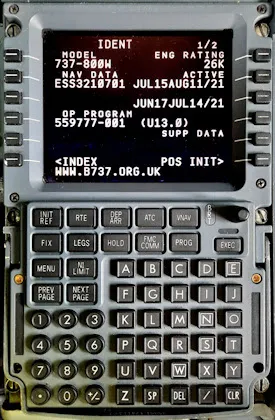
Interesting that the keyboard for these[0] is not a QWERTY keyboard but instead has the buttons arranged alphabetically. That must be a pain in the ass to type in. Is that because the tech is 50 years old from before QWERTY was the standard? Do newer planes have QWERTY?
Keyboards in aircraft instrumentation certainly do NOT predate electronic devices. Given that one-handed operation for instrumentation is almost always the primary mode of interaction, and instrument panels are really just face-plates on quite deep electronic device containers, the idea of a widescreen panel hole profile just to fit the input keys in a different format/aspect ratio does not make sense.
Some of the most interesting aviation research in the past few decades have been around human factors like psychology, perception, and cognition. If there was some substantial effect to having the buttons be arranged in a different pattern, I do legitimately hope it would have been found by now.
Do keep in mind these devices are cost-prohibitive in the extreme to design, build, and certify. The idea of having separate, parallel processes in order to have a different button layout between regional devices creates a thousand headaches of its own, both before and after production. The issue goes even further, in that just the FAA alone requires simulators of these aircraft to have replicated button look and feel criteria that would make your head spin. Is there even going to be a question as to if you're going to have to have two simulators? Will type-ratings be transferrable? Will there be separate differences training and/or currency requirements between the two distinct input methods?
Some or even most of those answers might turn out favorably for manufacturers or operators or pilots. But just having to ask them drives costs up considerably.
As a counterpoint... 50 or 60 years ago your average person wouldn't be familiar with QWERTY unless they were in one of a fairly small number of professions (secretary, author, journalist...). QWERTY was something you had to learn.
These days everyone types on a keyboard. It's way more universal, to the point where a non QWERTY layout has to impose additional cognitive load.
>if you're going to have to have two simulators? Will type-ratings be transferrable? Will there be separate differences training and/or currency requirements between the two distinct input methods?
I've seen a YouTube video in the last couple of years that explained the true origins of the QWERTY keyboard. Originally, the keyboard was alphabetical and arranged two rows, based on a piano keyboard, the black keys went A-N left to right, and the white keys went O-Z, right to left. Then it got shortened in width and the letters got folded over (this is why at the right edge of the middle row you have HJKL and the bottom row has MN reversed as NM).
You don't really need to type long form text on it. The primary use of the keyboard on the MCDU is for the flight management computer, and aviation fix names are 3 or 5 letters at most. That is the primary design case for the keyboard. ACARS is secondary, and on a typical flight only a few long-form text messages are sent.
Every aircraft that I've ever flown has an alphabetical keyboard. Typically horizontal space is valuable, yet vertical space is less valuable, so it's easy to make the keyboard long but not wide. However, as others pointed out, it seems to be changing in newer jets.
I think it’s long past time to reorder the alphabet to follow QWERTY order. It will make keyboarding much easier for children. We just need to write a new alphabet song.
Different languages have different keyboards (e.g. QWERTZ or AZERTY). I wonder what problems would happen if we reordered the alphabet...
For one thing the ASCII ordering is now suddenly jumbled up. Maybe our great supreme intellectual leader Elon will issue Magacode to supersede Unicode, kym epcy epc ngy vky yxcohy!
Swedish sorting traditionally and officially treated v and w as equivalent, so that users would not have to guess whether the word, or name, they were seeking was spelled with a v or a w. The two letters were often combined in the collating sequence as if they were all v or all w, until 2006 when the 13th edition of Svenska Akademiens ordlista (The Swedish Academy's Orthographic Dictionary) declared a change.
How is it that Sweden seems dramatically more inclined to make major changes to things most other societies wouldn't touch?
I'm thinking of the Swedish calendar[1] and Högertrafikomläggningen[2] when they switched which side of the road they drove on.
[1] https://en.wikipedia.org/wiki/Swedish_calendar: TL;DR: The plan was to skip all leap days in the period 1700 to 1740. Every fourth year, the gap between the Swedish calendar and the Gregorian would reduce by one day, until they finally lined up in 1740... he Great Northern War stopped any further omissions... 1712 had 367 days... 1753... The leap of 11 days was accomplished in one step, with 17 February being followed by 1 March
> f and v would make more sense in terms of the actual sounds made?
Depends on the language. In German, f and v sound similar. And from your profile description I am guessing you are from the Netherlands, which I guess also might have f and v sound very similar to one-another.
In Swedish, Norwegian, and Danish, we have pretty clear distinction between f and v.
Only until you're used to it. Then it's just as natural as switching between a keypad with a 1 in the top left versus one with a 7 in the top left. Your brain just takes the wheel.
My guess would be: QWERTZ touch typing was not a common skill in most pilots at the time these were introduced, and an ABC layout is slightly more ergonomical than QWERTZ for users not familiar with either.
Now that's changed, but changing the keyboard now would ruin older pilots' muscle memory.
You’re likely not touch typing with two hands anyway because it’s often down on the centre console. Besides they’re primarily used for entering flight info into the FMS, not for long form messages.
Oooohhh!!! Back in the day I had an "opportunity" to implement a virtual CDU interface, even re-created that font to do it. It talked to a real FMC (and later anything on the ARINC 629 bus). Good times :)
You do get used to it, but also the workflow is not entering words as much as it is things like waypoint codes, and a lot of numeric bits, which is why the number pad has its familiar layout.
Avionics is the area that is the least tolerant of radical redesigns in human interfaces. This FMC form factor has been around a long time. There are newer ACARS/FMC systems that have an actual QWERTY keyboard.
Use bépo, of course! More seriously, Airbus uses qwerty since at least the A380. This means that the A350 and the A330, two aircrafts that share a type rating, do not use the same layout.
QWERTY predates electronic devices.