Hacker News new | ask | show | jobs
by joss82 472 days ago
If it’s cooled in an “open cycle”, it means that the water vapor is released in the atmosphere, via these huge aero refrigerators towers. It will eventually fall back down as rain or snow. Water is not a scarce resource in Germany. Shutting down those plans was an ecological and economical disaster bordering on high treason.
3 comments

Actually, water is scarce in some parts of Germany [1], it might not look like it, but there are still drought conditions in the soil of some parts of Germany [2].

[1] https://www.umweltbundesamt.de/themen/wasser/extremereigniss... [2] https://www.ufz.de/index.php?de=37937

nonsense. the economy didn't even notice the shutdown. and those plants were more costly to operate than renewables are, so we're enjoying cheaper electricity now. it also wasn't an ecological disaster, in fact it didn't change anything in that regard.
1. Renewables have currently offset less than half of year 2000 nuclear generation -- https://www.iea.org/countries/germany/energy-mix

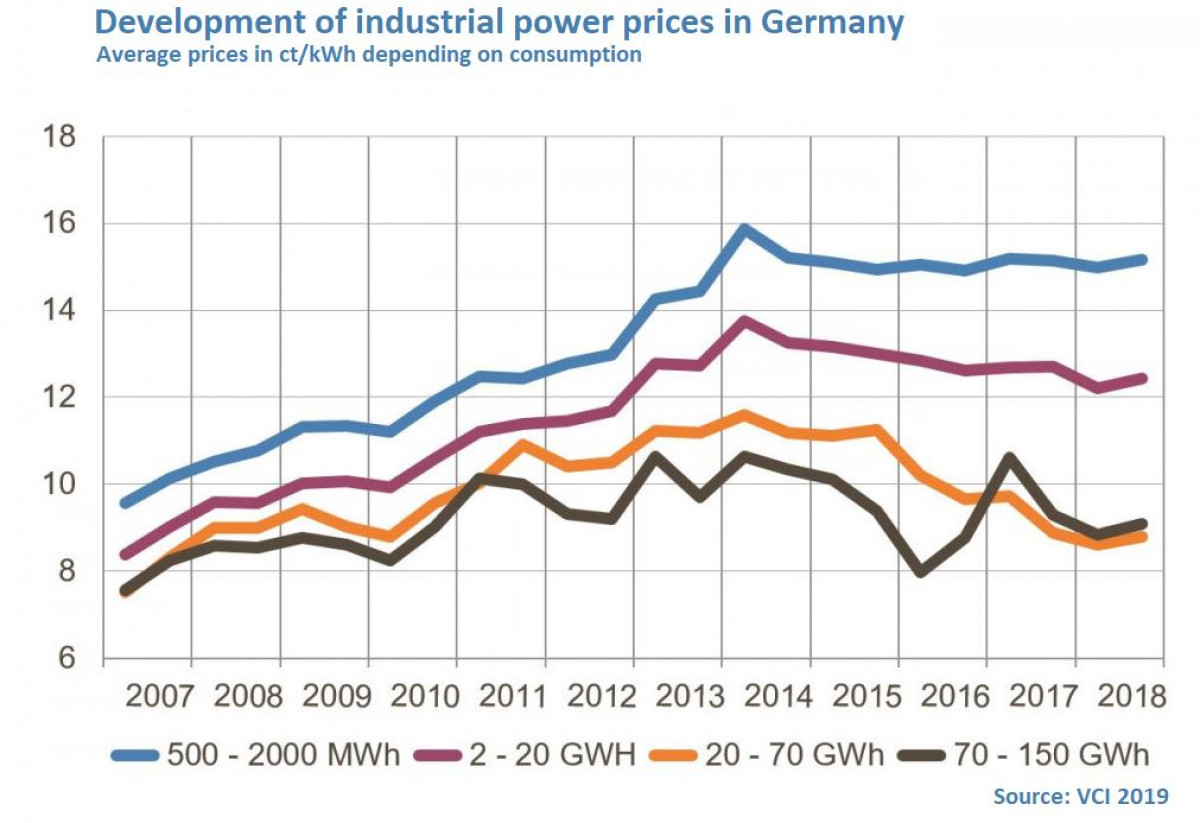
2. Industrial energy prices seem to have risen pretty consistently since 2000: https://www.cleanenergywire.org/sites/default/files/styles/g...

I'm pro renewable build-out, and a lot of new nuclear projects seem to my layman's eyes uneconomical, at least at today's cost (maybe we'd get better at doing it cheaper again if we invested, I don't know), but your claims seem false.

> Renewables have currently offset less than half of year 2000 nuclear generation

This is simply incorrect. You cite the iea as source, which is of course incentivized to creatively present the facts. In this case, by counting created heat (instead of electricity generation) for nuclear plants, and comparing this with purely electrical output power of PV/wind energy.

Actual power from nuclear plants in Germany, year 2000: ~180TWh, Solar + Wind now: >190TWh. Note that total electricity demand has decreased. Electricity from biomass has also grown significantly (also renewable).

Renewables are very cheap if you only consider LCOE and not the systemic costs - which is what people like Zoadian love to do. Just ignore all those grid and backup costs. The grid fees alone have been increased substantially and Germany pays out an additional 7 cent per KWh through a fund that is not shown in the electricity bills anymore.
no cause cheap Russian gas and oil replaced it, now with the war on the economy is cratering with expensive energy
actually mostly coal was used to fill the energy gap, increasing pressure to expand rollout of renewables. The media pitch making all this highly political is that fossil fuels from Russia should be / must be used instead of nuclear power, framing the choice to be either pro-Russia or pro-Nuclear (discarding renewables or potential pan-European energy coalitions).

In reality the impacts of the shutdown are foreseeable transitional pains. Of course Germany wasn't producing a massive surplus of energy that made it seamless to switch off their nuclear power-plants, so now they need to compensate the gap and make plans to close it.

Let's hope they're not all giving up again half-way thanks to politics and revert the decision...

Is this true? This chart[0] says otherwise.

[0] https://tradingeconomics.com/germany/electricity-price

Did you miss the natural gas crisis? All of Europe has been scrambling to replace Russian gas with LNG. If I remember correctly Germany even decided to postpone some nuclear reactor closing because of it. European industry and especially Germany industry is facing major stress due to high gas and energy prices.
Is that why Germany is pissing and shitting itself over issue of energy from Russia, America and NS2? This is not symptomatic of a healthy and secure energy economy.
how much is the cost of a kW in Germany?
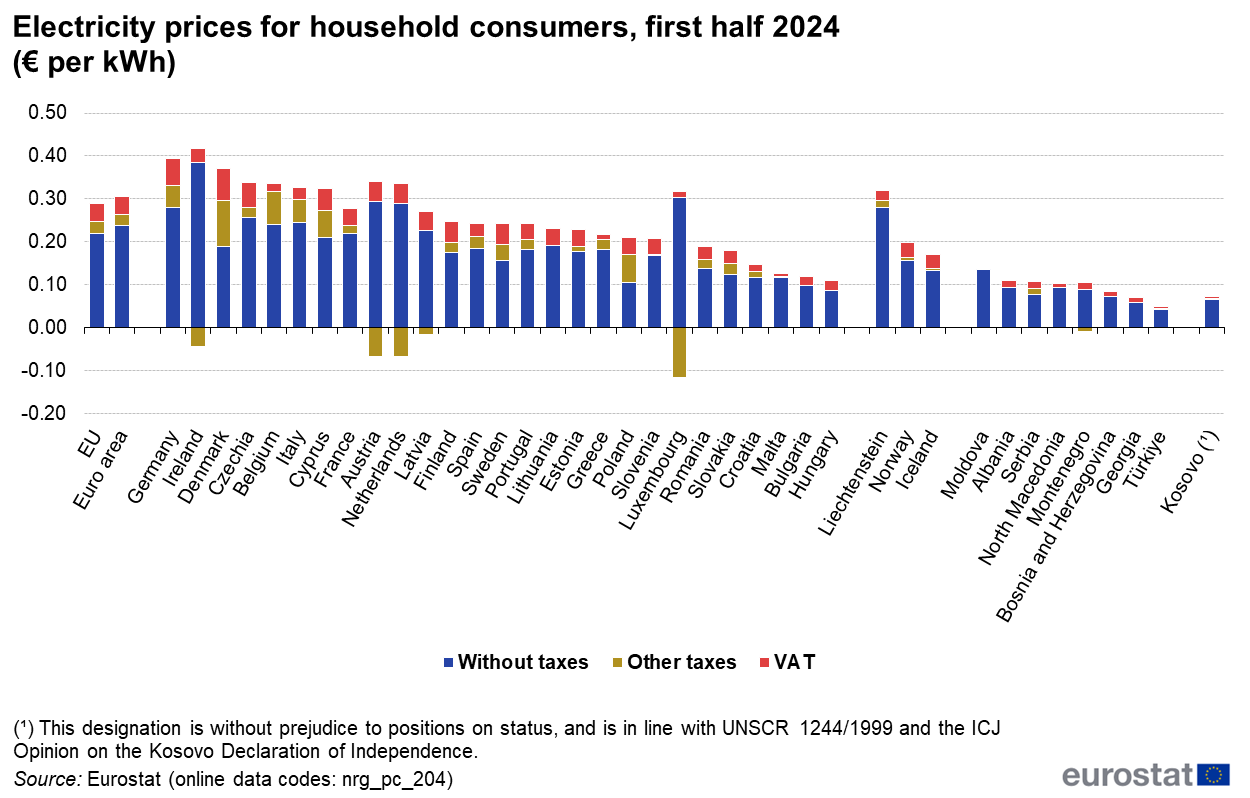
According to eurostat [1], Germany has one of the most expensive electricity (if not the most expensive due to a negative tax in Ireland) in Europe at ~0.35 to 0.40 EUR per kWh.

[1] https://ec.europa.eu/eurostat/statistics-explained/images/8/...

And an additional (!) 6-7.5 cent per KWh is payed by the "Klima und Transformationsfonds" to the producers of renewable energy.
it's for households. Energy prices for industry is much lower and in 2024 actually cheaper than 2017 (2024: 16,99, 2017: 17,09) Source: https://www.bdew.de/service/daten-und-grafiken/bdew-strompre...
Production cost share for industry:

2017: 08,02 Cent 2024: 15,50 Cent

Total cost is only less, because there are fewer levies and taxes.

28.72ct/kwh is the cheapest for my location and 45.51ct/kwh if im in the Grundversorgung(if i fall out for whatever reason out of my regular contract this is the fallback)
Why would shutting down the reactors be an ecological disaster?
Shutting down a nuclear reactor means postponing a coal plant shutdown. Coal being the worst way of generating electricity regarding CO2 emissions.
Solar and wind cannot replace base load power. Especially not in Germany. They have to rely on peaker plants even more, and those are burning gas, emitting CO2. And they built more coal power plant units, like Datteln 4: https://en.m.wikipedia.org/wiki/Datteln_Power_Station
> Solar and wind cannot replace base load power

This is incorrect, and also completely misunderstanding how electricity pricing dynamics work.

Power grids don't need base load providers at all. They need enough dispatchable sources (and/or imports) to cover demand at all times (at least if they want to avoid rolling blackouts like in SA).

Providing base load is a privilege you get to enjoy if you have the lowest marginal price at all times (or are technically unable to regulate your output down, and would rather pay not to)-- cheap intermittent sources (solar/wind) make it very difficult for conventional plants to act as "base load provider" profitably.

It's a fair point to distinguish that baseload is just one mechanism to reduce the amount of surplus renewable capacity required to cover demand. However, what is the alternative in the face of a grid that's designed for centralised large power producers, and an environmental policy that disincentivises us from using gas?

Yes, in a hypothetical world we can just scale up storage and decentralise production, but what are the timelines and costs on that? Because my understanding is that realistically something like nuclear is the best way of making that problem tractable over the timelines that e.g. a nuclear plant can operate.

> Yes, in a hypothetical world we can just scale up storage and decentralise production, but what are the timelines and costs on that?

Why a hypothetical world? I think that current timelines, while not particularly awe-inspiring, are quite realistic (Germany: no more coal for electricity within 2038).

I also see no problem in using gas peaker plants provisionally for the next decade, and gradually phasing them out in favor of storage as batteries get even cheaper.

Newly built nuclear power is basically useless by comparison-- construction alone currently easily takes a decade (see: Olkiluoto 3 >15y, Flamanville 3 >15y, Vogtle 3/4 >10y, Shin-Hanul 1/2 >10y), local resistance is very large, costs are astronomical.

ROI for those plants is completely abysmal already and continuously getting worse, because they are completely unable to compete with solar/wind energy prices whenever those are available.

So going "full nuclear" now would mean that all the extremely expensive effort is completely useless (climate-wise) for at least a decade (until first plants finish), while spending the same on solar/wind improves the situation right now (by allowing us to rely on fossils less often), and those projects also tend to finish within years instead of decades, and they don't need astronomical sums (and guarantees) from taxpayers to get financed.

> I think that current timelines, while not particularly awe-inspiring, are quite realistic (Germany: no more coal for electricity within 2038).

I am not an expert on this, at all... but I'm not sure that's the case. c.f. Wikipedia:

> In March 2024, Federal Audit Office published a report in which it assessed the policy as not meeting goals on a number of points: the planned 80% share of renewable energy requires dispatchable sources but the assumed 10 GW in fossil gas generation is neither sufficient nor on schedule; extension of electric grid is behind the schedule by 6,000 km (3,700 mi) and 7 years; security of the supply chain is not sufficiently assessed; system costs to ensure 24/7 generation are underestimated and based on "best-case" scenarios; capacity installed in renewables is behind the schedule by 30%, whereas demand is expected to grow by 30% as result of electrification of heating and transport

As for

> ROI for those plants is completely abysmal already and continuously getting worse, because they are completely unable to compete with solar/wind energy prices whenever those are available.

That's because the pricing model is arbitrary. If we need nuclear, we can make it economically viable through reforming the way we purchase electricity. But,

> construction alone currently easily takes a decade

is the real problem. Unless SMRs actually materialise _and_ have fast build times, it's just not happening (and realistically, I think _that_ ship has already sailed).

I'm not really making a point here much beyond "it's one thing to say nuclear is no longer viable given our lack of investment" and another to say "it was a good thing to drop nuclear N years ago". You're not saying that for the record. By dropping nuclear, we have to deal with a bigger shortfall and that means gas peakers, etc.

Germany relies mostly on oil, coal and gas for energy production [1]. Shutting down reactors that produces energy at a very low carbon cost (especially since a huge part of that was building the reactors) means you keep using fossil fuels. At the time of writing, Germany produces power at 432gCO2eq/kWh [2] (compared to 169 for UK, 13 to 37 in Sweden, 42 in France, 309 to 600 in Italy and 759 in Poland).

In practice, Nuclear was replaced with renewable but fossil fuel usage didn't go down.

[1] https://ourworldindata.org/grapher/electricity-production-by...

[2] https://app.electricitymaps.com/map/72h/hourly

Not to mention, it plays right into Russia's hands by keeping Germany dependent on foreign gas.
You could not replace them entirely with renewables, so fossil fuels were used