Hacker News new | ask | show | jobs
by jimmaswell 529 days ago
I'm considering what flat-surfaced shape you could construct with equal gravitational pull at all points. Maybe something where the center is thin as a point, the edges have a lot of depth, and they curve towards the center either convex or concave. Might run some calculus to figure it out.
2 comments

That way you should be able design a disc-shaped earth with constant strength of the gravitational force on the whole surface. But it would still have a center of mass (likely lying outside the shape you're describing, in the void beneath the center point), and the direction of the force should still be pointing towards that center, no? So the problem the GP has described, that you're starting to tilt as you move towards the edge, should remain in principle.
I believe the strength of gravitational force would not be constant either, as your center of mass would still have a fixed location, so every point on the disc have different distances to that center of mass (in addition to not being orthogonal to the surface). But maybe it might be approximated with an infinitely long cylinder, so the center of mass is infinitely far away below the surface ?
The thinking in the other post, that the mass increases as you move away from the center, in a manner that the two effects cancel out, intuitively seems like it should be feasible. Remember that the center of mass is just an abstraction, you need to take the full integral over all mass to get the force vector at each point. And if you're closer to more mass further away from the center, which a shape like the one described above should give you, it might work. But one would have to do the math to be sure.

Edit: come to think of it, maybe that effect would let you adjust the direction of the force, too. Thinking about center of mass can be treacherous with more complex shapes...

yes, we call it a sphere.

I am just joking with you, I know what you mean, however the fruit was hanging too low not to pick.

A sphere is only locally approximable by flat surfaces, but it's nowhere actually flat, which was a requirement in the previous post.
Eh, the original post wanted a convex disk that would have a uniform gravitational pull, flatness was already thrown out as a design requirement. Once convex disks are allowed, a specific category of convex disk that provides a uniform perpendicular gravitational field comes to mind. The sphere. The very object we were trying to avoid. It is one of those it's funny because of the irony things.
The post clearly described a non-convex shape, and "flat-surfaced shape" should be a pretty clear instruction as well. The shape described may be visualized as a cylinder with a cone cut out, where the base of the cone aligns with one of the bases of the cylinder, and its tip with the center point of the other cylinder base. Except that the cylinder may be modified so that, seen in a cross-section, the line going from the base to the tip on either side may be a (convex or concave) curve. It makes sense as a starting point in the search for a shape with the desired properties. And it can immediately be seen to be non-convex in both described configurations, given that there's a cavity cut out.
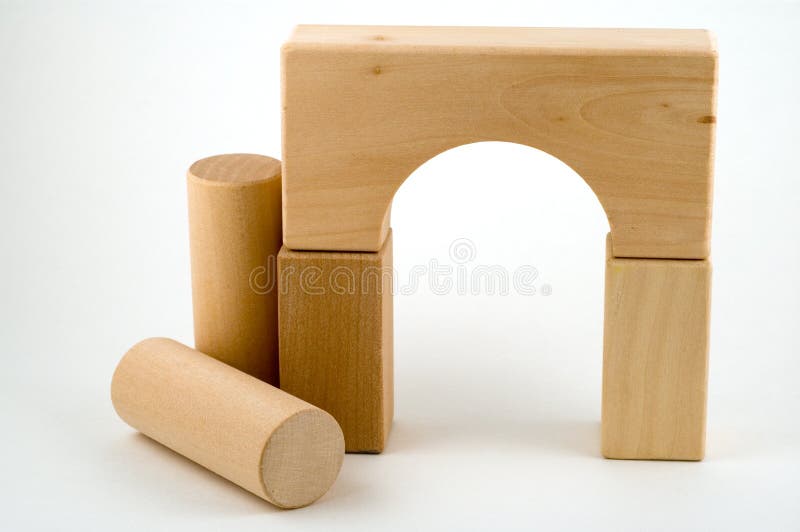
You misunderstood, I mean for the top to be flat but the "underground" to have some kind of shape to compensate for the gravitational pull at all points on the flat surface. For a 2Dish example in the ballpark, you could think of one of these wooden toy bridge blocks: https://thumbs.dreamstime.com/b/natural-wood-blocks-364582.j...

I think you could construct a curve such that the mass's gravitational pull on the right cancels out the pull on the left, for any point on the surface.