Hacker News new | ask | show | jobs
by Xcelerate 5087 days ago
I didn't read the entire paper, but to someone who did, how much of a link is there between genetics and IQ? I know this isn't a popular subject, but if I remember correctly I believe that Ashkenazi Jews constitute 3% of the population yet have won 27% of the Nobel prizes in science.

I would think that much like how different types of people from different regions have differing athletic capabilities, there would also be differences in mental facilities as well -- some better at music, some better at math, etc. Thoughts?

5 comments

It says a lot about it. For instance:

"She examined the IQs of Black and mixed- race children averaging 8.5 years of age who were adopted by middle-class families who were either Black or White. The children who were of half-European origin had virtually the same average IQ as the children who were of exclusively Black origin. Hence European genes were of no advantage to this group of 'Blacks.' Children (both Black and mixed-race) adopted by White families had IQs 13 points higher on average than those adopted by Black families, indicating that there were marked differences in the environments of Black and White families relevant to socialization for IQ; indeed, the differences were large enough to account for virtually the entire Black–White gap in IQ at the time of the study."

It says less about Jews in particular, which I'd guess is because of a lack of data. There's not a heck of a lot of Jews up for adoption, relative to blacks. But it does note:

"It is important to note that even at the highest estimates we have of Jewish IQ, Jewish accomplishment exceeds what would be predicted on the basis of IQ alone. Nisbett (2009) has argued that the numbers of Jewish Ivy Leaguers, professors at elite colleges, Supreme Court clerks, and Nobel Prize winners are greater than one would expect even if average Jewish IQ were 115. He has also noted that remarkable as the superior achievement of Jews is, the achievement difference between Jews and non-Jews is far less extreme than differences between groups in many other comparisons that cannot be explained on purely genetic grounds, such as the achievements of the Italians versus the English in the 15th century, of the English versus the Italians after the 18th century, of Arabs versus Europeans in the 8th century, of Europeans versus Arabs after the 14th century, and of New Englanders versus Southerners throughout American history."

While it is certainly plausible that there is some big genetic influence on intelligence due to ethnicity, like there is in athletics, we have yet to find convincing evidence of it.

People always ask this incorrectly. The real question is "To what degree does genetics determine the difference of average IQs between groups." The link between genetics and IQ is near 100% in an absolute sense, as tapeworms and dogs generally will score a 0 on any test.

Even the worst possible environment...say, repeated concussions to the head via a hammer, will still result in a human scoring far above any non-human.

Even the worst possible environment...say, repeated concussions to the head via a hammer, will still result in a human scoring far above any non-human.

I'm pretty sure you're wrong. I think research suggests that dolphins, parrots, bonobos and some other animals have tested higher than humans.

At standard IQ tests? Surely the creature doing a a standard IQ test needs at the very least opposable thumbs?

There will of course be exceptions, but a brain damaged but somewhat functioning human will always score better than a non-human at human-designed intelligence tests.

The argument isn't that a dolphin or bonobo isn't potentially smarter than a brain damaged human, but that by designing our tests for human use we are explicitly excluding non humans.

What are you trying to point out? That IQ tests as they are written for humans are biased in favor of humans?

Intelligence between humans and animals can (or could) be compared, but--like when testing between human populations--you wouldn't use a test that is so heavily biased against one of the groups that they can't even attempt it.

Both scientific and athletic achievements have an alternative explanation: culture. If there was a good sample of adopted children from a group with such achievements, one could examine these hypotheses in more detail.
These kind of studies have been done, and it is my recollection that genetics still appear to have a significant impact. Of course, people can still argue that various sociological effects can explain most of this, like lowered expectations for certain races, etc.

Would love to see some cites.

That's an incredible statistic. If the cause is cultural then it's a wonder there isn't a plethora of books advising on how to raise children the Ashkenazi way. Are there any such books?
Typical HN racism and misogyny aside, why not go to the top of the intellectual world and listen to Chomsky and Einstein? There's no end of opinions from them. Chomsky in particular answers emails quickly. So no need to ape some culture's forms, but rather ask their most successful members.

The problem is, their answers don't please many who'd ask such questions. Einstein claimed:

"This crippling of individuals I consider the worst evil of capitalism. Our whole educational system suffers from this evil. An exaggerated competitive attitude is inculcated into the student, who is trained to worship acquisitive success as a preparation for his future career."

Or take Chomsky:

"A lot of the educational system is designed for that, if you think about it, it's designed for obedience and passivity. From childhood, a lot of it is designed to prevent people from being independent and creative. If you're independent-minded in school, you're probably going to get into trouble very early on. That's not the trait that's being preferred or cultivated. When people live through all this stuff, plus corporate propaganda, plus television, plus the press and the whole mass, the deluge of ideological distortion that goes on, they ask questions that from another point of view are completely reasonable...."

So let's turn the question around (because it's not about Jews being the Master Race or being culturally superior to say Africans): how do we triumph over dominant institutions which are out to turn us into idiots?

We don't want to know what Chomsky or Einstein thought about the educational system, that's irrelevant. What we really want to know is how their parents treated them. Actually, we want something more general -- commonalities in Jewish upbringing, especially of those who went on to be successful.
But that's the cargo cult way. You end up replicating a lot of unrelated random things and may still lose the essense of it.
I'm not sure who "we" are, and why "we don't want to know" things despite wanting to be smarter. In any case, Chomsky certainly wasn't secretive about his education and parenting. Did you look it up?

"My father was, professionally, a Hebrew scholar, and worked with Hebrew grammar. And my mother was a Hebrew teacher. My father sort of ran the Hebrew school system in the city of Philadelphia, and my mother taught in it. He taught in Hebrew College later. There's a Graduate University of Jewish Studies, Dropsie College, which he taught in."

"Actually, I happen to have been very lucky myself and gone to an experimental-progresive Deweyite school, from about the time I was age one-and-a-half to twelve [John Dewey was an American philosopher and educational reformer]. And there it was done routinely: children were encouraged to challenge everything, and you sort of worked on your own, you were supposed to think things through for yourself -- it was a real experience. And it was quite a striking change when it ended and I had to go to the city high school, which was the pride of the city school system. It was the school for academically-oriented kids in Philadelphia -- and it was the dumbest, most ridiculous place I've ever been, it was like falling into a black hole or something. For one thing, it was extremely competitive -- because that's one of the best ways of controlling people. So everybody was ranked, and you always knew exactly where you were: are you third in the class, or maybe did you move down to fourth? All this stuff is put into people's heads in various ways in the schools -- that you've got to beat down the person next to you, and just look out for yourself."

Ok, raised by teachers/scholars who even ran a school system, and went to a school which cultivated critical thinking. Surprising that he turned out to be such a successful academic...

No need to turn to racist theories, or cultural mysticism. Answers are quite simple, but not everyone wants to hear them.

Sort of. In achievement-obsessed South Korea, there's wide reverence for judaism and study of the Talmud, despite the country historically being very non-jewish. http://www.thejc.com/lifestyle/lifestyle-features/48771/why-...
While not completely the same or as limited in scope, I have come across this a number of times. http://en.wikipedia.org/wiki/Minnesota_Transracial_Adoption_...
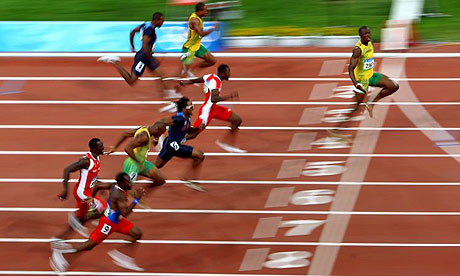
Certainly culture plays a role, but it's hard to argue that the reason a non-representative proportion of olympic runners are black is due to culture. http://static.guim.co.uk/sys-images/Sport/Pix/pictures/2008/... really demonstrates this fact.

What that picture doesn't show, though, is that there are a lot of almost-world-class sprinters who are european, asian or of other ethnicities. The edge that being of a certain ethnic background gives you in sprinting is only really important at the very top of the competition. I'd imagine that for the majority of people, training and dedication make up a far larger component of their success or failure at sprinting.

Interestingly, in the article it indicated that genetics appeared to play a bigger role in the intelligence of wealthy people. I'd imagine this is a similar situation. Genetics may give you a slight edge at the very top of academia, but otherwise education is the key.

Education is the low hanging fruit in increasing overall intelligence.

Right, but my question is for only the genetic effects (even with adopted children of different cultures there will be other differences that are not genetic). It would be difficult to determine, but there are enough statistical techniques that one could get a good idea. Surely different races can't have identical distributions of various "skills" -- the only question is how much they are offset from each other.
>but if I remember correctly I believe that Ashkenazi Jews constitute 3% of the population yet have won 27% of the Nobel prizes in science.

Can we get a citation on this?

"Nobel Prizes have been awarded to over 800 individuals, of whom at least 20% were Jews, although Jews comprise only 0.2% of the world's population.": http://en.wikipedia.org/wiki/List_of_Jewish_Nobel_laureates

Although this need not be explained by genetics. It could just as easily be explained by culture.

It would be strange to assume uncritically that Nobel prizes were given out in a way which was completely unbiased. For example, it is at least highly plausible that there are biases on the basis of nationality, connections, school background and other things which have nothing to do with merit, ethnicity OR culture as such. So it seems strange to me to suggest that it must be some aspect of Jewishness that determines this difference.
I'm actually not assuming that - I tried to write something to that effect, but I wasn't pleased with what I wrote. Take my comment with the pre-condition that if we're going to assume it has something to do with Jews themselves, it need not be attributed to genetics.
Absolutely understood, and I apologize if that came across as a sharp rebuttal.
@slurgfest

Oh, I don't think anyone doubts that. The question we are discussing is: to what extent does their innate genetics (categories of similar DNA, if you prefer) influence their intelligence?

Page 3 of Natural History of Ashkenazi Intelligence: "During the 20th century, they made up about 3% of the US population but won 27% of the US Nobel science prizes and 25% of the ACM Turing awards. They account for more than half of world chess champions."

http://harpending.humanevo.utah.edu/Documents/ashkiq.webpub....

What's important to note here is that, assuming normal distribution, group differences can account for large differences in the number of individuals at the very top (and bottom). If a group A has a mean IQ of 100 and group B has a mean IQ of 110, group B will have four times more individuals with IQ over 130 than group A.