Hacker News new | ask | show | jobs
by ilya_m 558 days ago
> Oh yeah, and that anecdote you told about tectonic plates screams survivorship bias; that's the problem with anecdotes.

Very good point. For every tectonic plates theory or heliocentric system or H. pylori causing ulcers there are thousands of claims that are plain wrong. Statistically speaking, knowledgeable critics acting in good faith (eg, not having strong conflict of interests) are correct with the overwhelming probability.

1 comments

I'd add to this and say the probability being against a theory creates a risk of less than thorough dismissals of claims.

You get this all the time with perpetual motion machines. The near certainty of the claim being false leads to confident dismissals that go 'blah, blah, laws of physics, blah blah thermodynamics, therefore can't happen'

The real question to be asking about a claim of a perpetual motion machine is 'Where does the new energy come into being?'.

Citing laws of physics won't help you because any claim to have made a perpetual motion machine is implicitly claiming to be a proof by counterexample that one of those laws is wrong.

> Citing laws of physics won't help you because any claim to have made a perpetual motion machine is implicitly claiming to be a proof by counterexample that one of those laws is wrong.

Citing the laws of physics in this case is the shorthand way to point the overwhelming number of proofs by example that the laws are correct.

It doesn't matter how many examples you have for a law. A single genuine counterexample counts as a disproof.

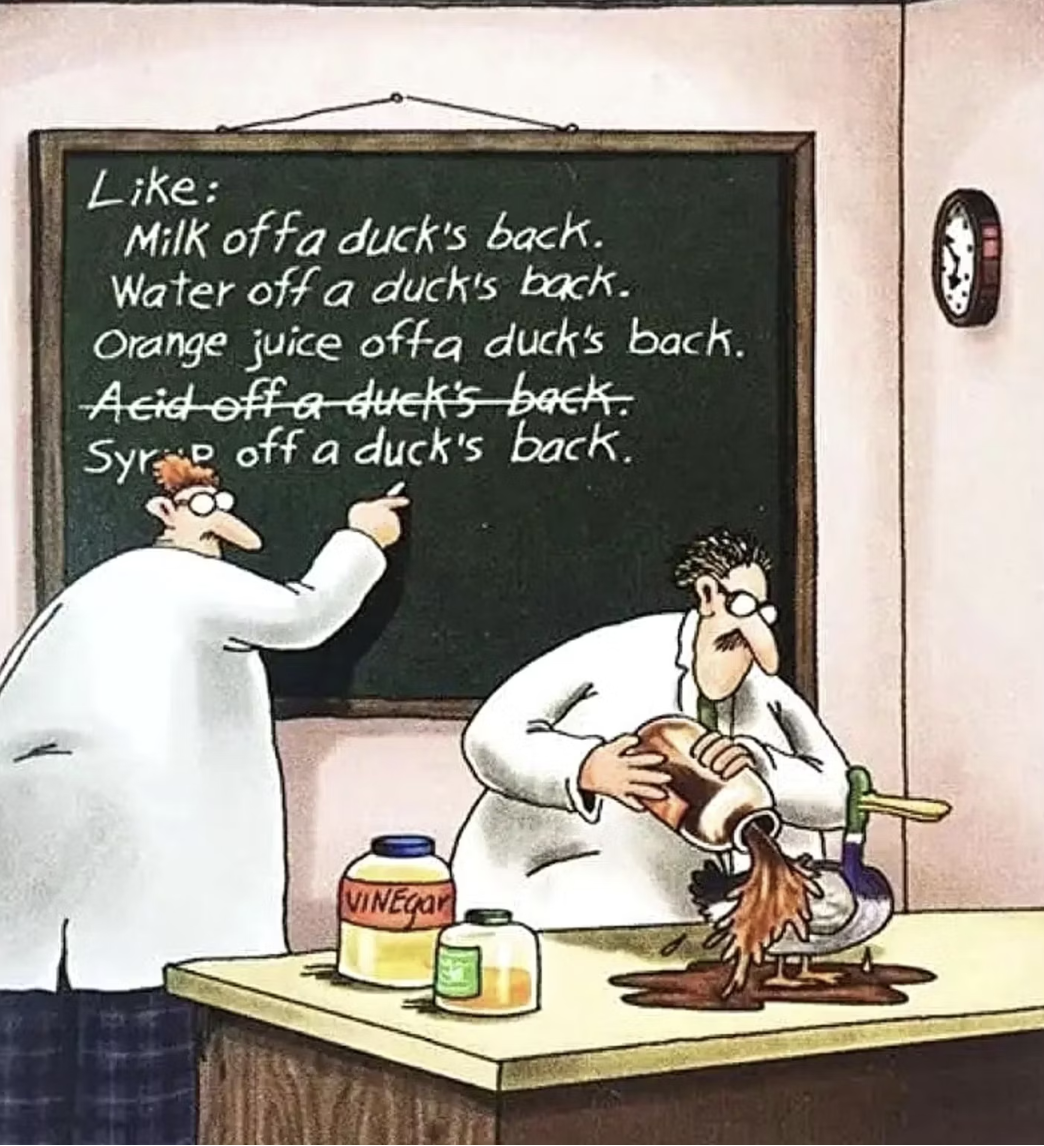
If your law is all liquids flow off a ducks back. Water off a ducks back does not prove it. Acid off a ducks back disproves it. https://i.imgflip.com/7waajp.png

I don't think it is a matter of a shorthand. I think it is because humans have a tendency to express a strong opinion when they intend to express that a weaker opinion is strongly held. Citing laws of physics does not say "Your perpetual motion machine won't work" but rather "I am confident that your perpetual motion machine will be shown to not work".

Yes, that’s fair and I was sloppy with my phrasing. What I meant was that if you have 1,000 practical applications that function on the assumption the law is true and they behave as predicted, and then you have a single example that appears to disprove, then extraordinary claims require extraordinary evidence.

A single device, made in some garage, that appears to disprove it is simply not rigorous enough to prove anything and isn’t worth third party investigation until the creator has shown they’ve ruled out possible explanations.

Still, most laws of physics found by humans are wrong, every so many years they get refined by laws that are a bit less wrong.
Nobody wants to seriously engage with the perpetual motion cranks who CC the entire department on a novel length email.