Hacker News new | ask | show | jobs
by AdieuToLogic 564 days ago
> When dealing with large YAML files, I find myself frequently popping them into online “YAML to JSON” tools to actually figure out WTF is going on.

YAML is a strict superset of JSON, so defining the former in the syntax of the latter is fully supported by the spec. Perhaps not by every YAML library, to be sure, but those which do not are not conformant. From the YAML spec[0]:

  The YAML 1.23 specification was published in 2009. Its 
  primary focus was making YAML a strict superset of JSON.
0 - https://yaml.org/spec/1.2.2/
2 comments

I'm confused about your point about YAML being "strict superset of JSON" leading to being able to convert YAML to JSON.

If YAML is a strict superset, wouldn't that mean that YAML must have at least one feature that is not part of JSON? Wouldn't that make it impossible to define all YAML files as valid JSON?

They all turn into the same data types in the end. You can import a YAML and output a JSON.

For a feature like references, you'd have to do the annoying thing and duplicate that section of the file.

For a feature like unquoted strings or extra commas, you just quote the strings or remove the commas.

The various YAML features are in between and mostly close to the latter.

> If YAML is a strict superset, wouldn't that mean that YAML must have at least one feature that is not part of JSON?

Yes. One of the features YAML supports is the widely documented format we are all familiar with.

However, being a "strict superset of JSON" also means a conformant YAML implementation can load a "pure" JSON resource without issue. The converse is not generally possible as JSON cannot express what YAML can, such as octothorpe ('#') comments.

HTH

EDIT: see also https://news.ycombinator.com/context?id=42361994

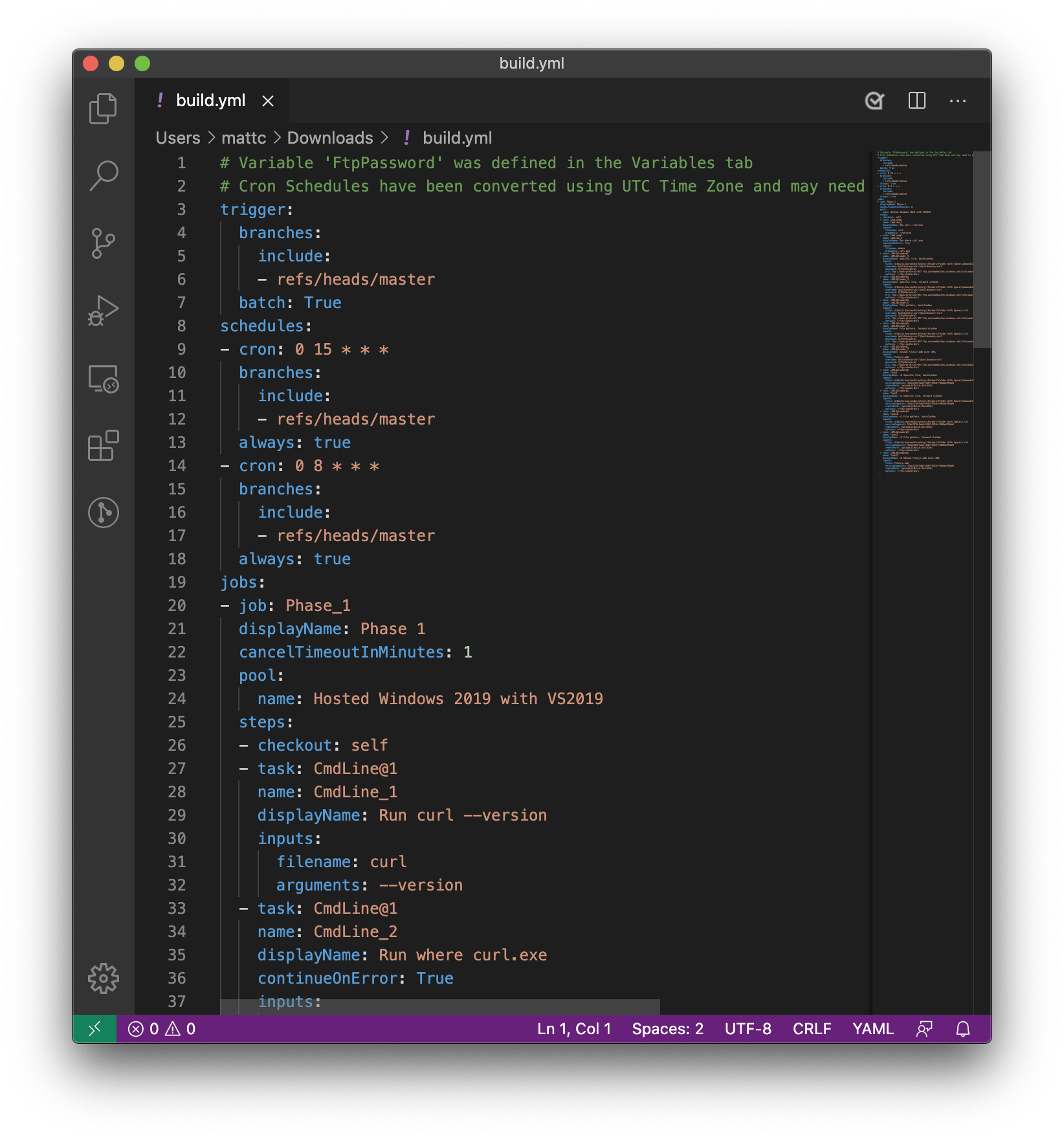
For sure, but most YAML you actually encounter does not use much in the way of JSON syntax, it looks a lot more like this: https://devblogs.microsoft.com/devops/wp-content/uploads/sit...

Where arrays and objects just look too similar (IMO), white space is significant, most strings are unquoted, etc. And personally I find it quite difficult to really understand what’s going on there, at a glance, compared to JSON (or JSON5).

> For sure, but most YAML you actually encounter does not use JSON syntax

So what? YAML can be trivially mechanically translated between flow and block syntax.

I want to be able to easily read and understand configuration without having to pop it into a converter. The YAML I encounter in the wild is ~80% pure block style, ~20% mixed (within a single file, mostly block style with some flow style). And I just find the block style hard to read, I have to either spend significant mental effort trying to understand where the objects vs. arrays are, or I have to pop it into a converter (to either JSON or flow style) to understand. Whereas JSON/JSON5, it’s immediately clear without any mental overhead.