> In reality the modal life expectancy of adults (most common age of death other than 0) has been pretty stable in the 70s-80s range for most of human history- the low average was almost entirely due to infant mortality.
From this article:
"Researchers also collected data about hunter-gatherer societies. The 17 different societies include paleolithic and modern-day hunter-gatherers and the mortality rate was high in all of them. On average, 49% of all children died.[5]"
Which categorically states:
"Unfortunately there simply is not enough direct paleodemographic archaeological data to make definite claims about the global patterns of infant and child mortality rates of our Paleolithic hunter–gatherer ancestors."
The author of the Our World in Data piece seemingly intentionally conflates the proxy with actual archaeological evidence of the actual child mortality rates. Given the clear warning in the cited article about making definite claims, I cannot read the deception any other way.
After seeing this error, I do not know how you could possibly trust anything they have to say on the matter.
It mostly is. The biggest gains are in childhood. Aldo consider that you’re looking at figures for England and Wales, which isn’t necessarily representative.
The largest contribution to improving life expectancy is measured by reductions in child mortality. The factors that drove those improvements (infection control, improved hygienic practices, food quality, regulation of food and drug purity, medicine) benefited everyone, but had the biggest impact on the old and young. In the 1850s, 8,000 infants died annually from adulterated milk alone.
I think of my own journey. In 1824, 200 year ago Spooky23 would have died 20 years ago, a half blind cripple. 2024 Spooky23 is healthy with no back issues and god willing a few more decades.
In 1850 a 0 year old would expect to live to 41.6 years. A 5 year old would expect to live to 55.2.
If we waved a magic wand and let all infants survive past childhood with nothing else changed in 1850 life expectancy would still be 27 years lower than it is today. Or put another way you'd have the same life expectancy as someone in South Sudan or Somalia.
Nobody waved a wand. The contaminated milk that killed infants killed adults too - alcohol and milk were alternatives to unsafe water. Public health, medicine and other factors improved things.
We don’t really have great stats from before the 19th century. Was 1850 a nadir in life expectancy? I’m not sure - but I suspect it varied by region and rural/urban conditions. 1750 NYC wasn’t as gross as 1850.
Indeed, this conversation is a good illustration of the damage that Bayesian statistics have done to the "educated" populace. Not that they're inherently bad--it's just a different statistical approach, and it's generally good not to assume a universal background, that everything is normal, etc.--but by telling people it's fine to question statistical conclusions because the distribution might be different, it liberates certain people from ever having to actually change their minds based on new information, because they can just posit a different distribution that satisfies their own biases.
I realize this is a bit of a "no true Scotsman" but what you are talking about is a gross misuse of Bayesianism- where your own biases are incorrectly treated as extremely strong evidence.
I am partial to using unform priors over all possibilities, and then just adding in the actual evidence for which you can actually quantify its quality/strength. Your "prior" for a new situation is constructed by applying the data you already had previously to a uniform prior- not by fabricating it from whole cloth via your biases. In practice this may be impossible for humans to do in their heads, but computers certainly can!
> It mostly is. The biggest gains are in childhood.
The life expectancy of a 60-year old going from 74.4 to 84, or a 70-year old from 79.1 to 85.9, is significant and meaningful. Not as much as a newborn's LE going from 41.6 to 81.1. But far from "pretty stable in the 70s-80s range for most of human history."
Also, recent life-expectancy increases have come from adult morality reductions [1].
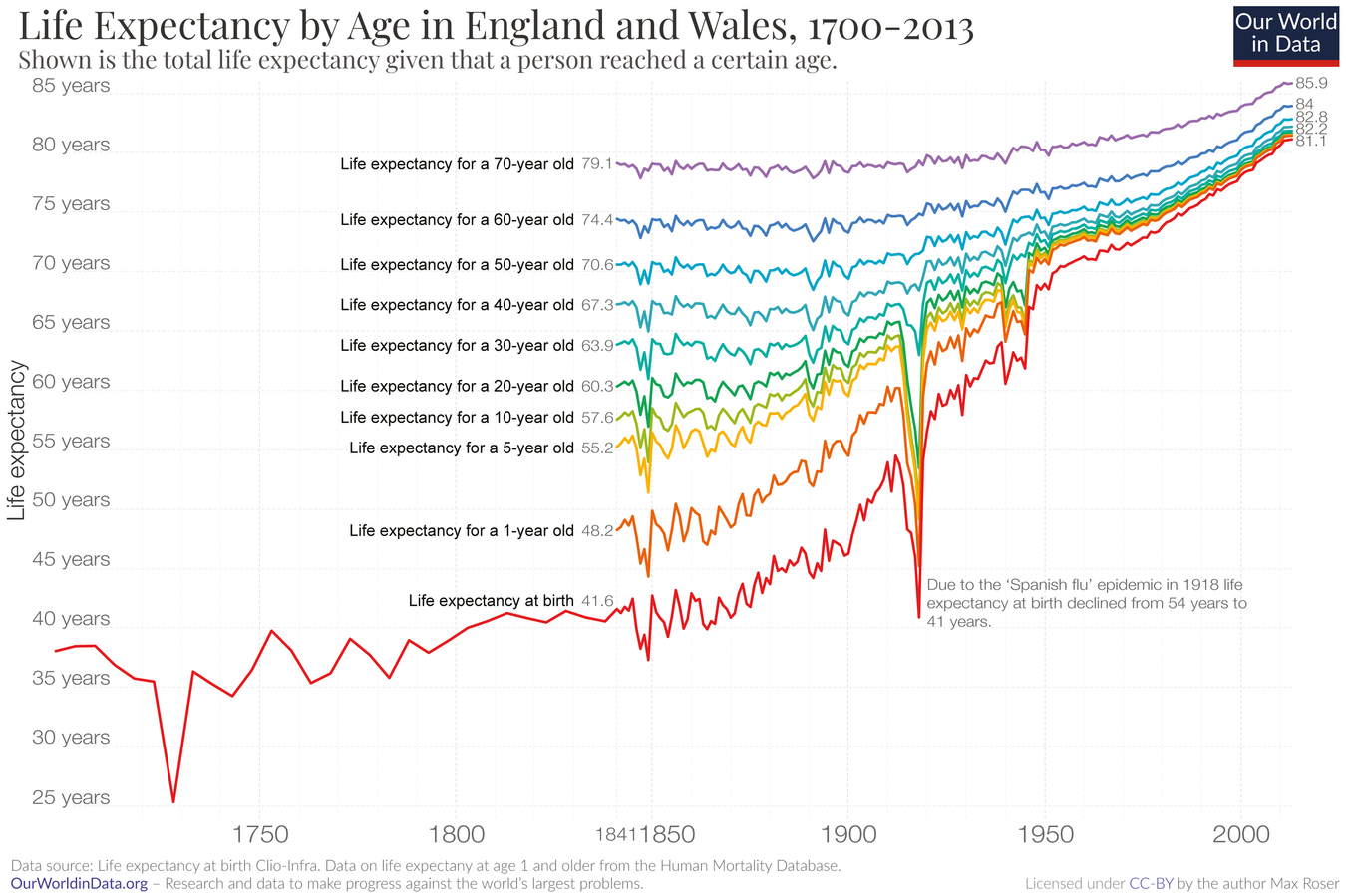
Consider: https://ourworldindata.org/child-mortality-in-the-past
From this article: "Researchers also collected data about hunter-gatherer societies. The 17 different societies include paleolithic and modern-day hunter-gatherers and the mortality rate was high in all of them. On average, 49% of all children died.[5]"
This is cited as coming from: https://www.sciencedirect.com/science/article/abs/pii/S10905...
Which categorically states: "Unfortunately there simply is not enough direct paleodemographic archaeological data to make definite claims about the global patterns of infant and child mortality rates of our Paleolithic hunter–gatherer ancestors."
The author of the Our World in Data piece seemingly intentionally conflates the proxy with actual archaeological evidence of the actual child mortality rates. Given the clear warning in the cited article about making definite claims, I cannot read the deception any other way.
After seeing this error, I do not know how you could possibly trust anything they have to say on the matter.