Hacker News new | ask | show | jobs
by xb95 5121 days ago
I've played off and on since 2003. The corporation I'm part of now has built an ERP and manages a trillion ISK (which at the legal rate is $35,000 USD in assets).

We have production facilities -- several of them. We have distribution facilities. Transportation units (local and long-haul). We have combat pilots to protect the transportation. And we have the final delivery points where we actually sell goods -- both retail (on the market) and bulk (contracts to buyers).

To manage all of this, we have built an ERP system. It tracks our inputs, outputs, and processes. It makes procurement decisions (build vs. buy) and submits orders to the various groups of people who actually make things happen -- the producers, researchers, haulers, marketers, etc. The game is very manual on that front, but we use an automated system to actually submit very small, easy to understand orders that people can do in a few minutes usually. In aggregate, it powers a rather complicated machine.

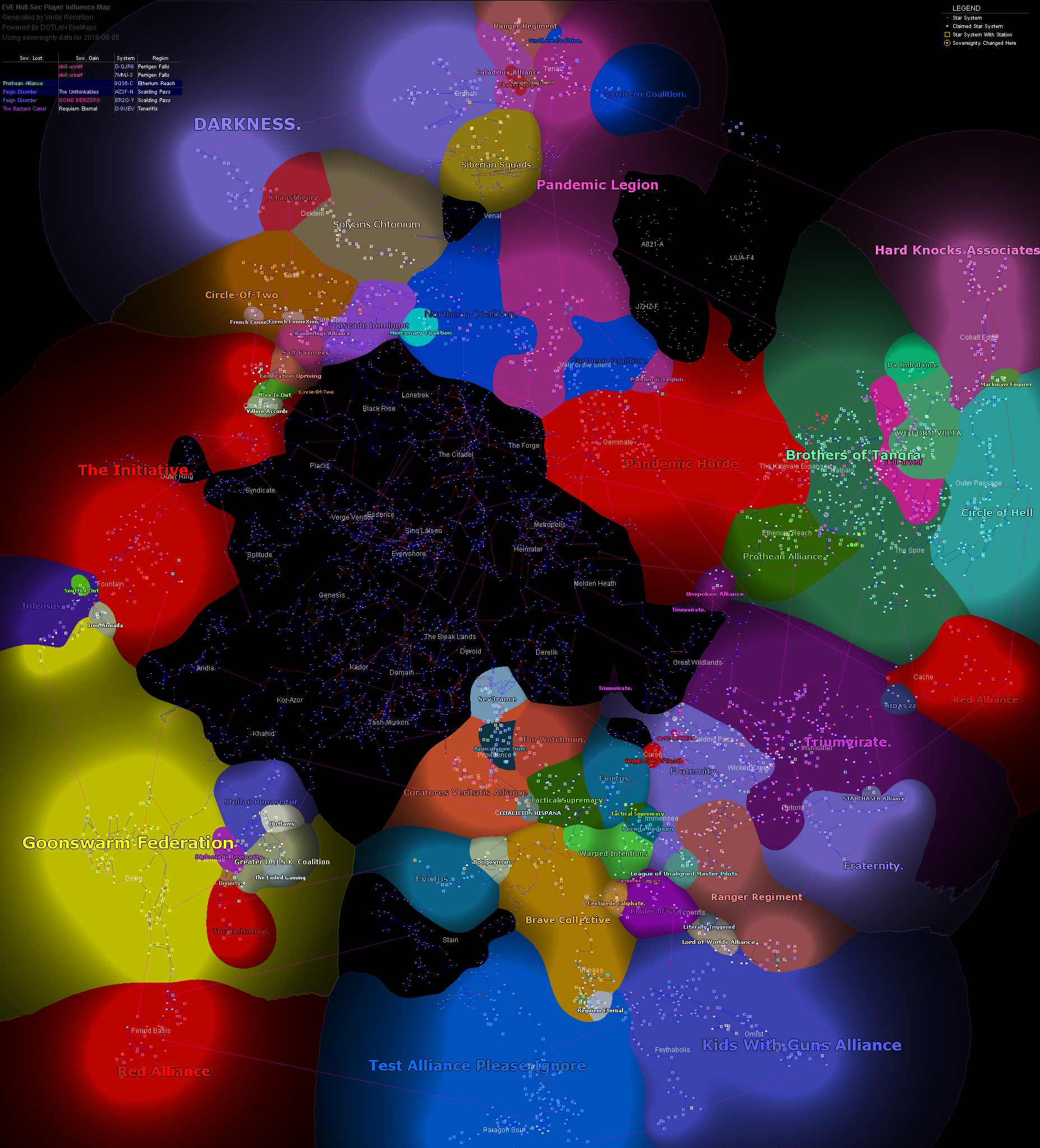
As an example... let's say somebody places an order for 10 Widgets out in the edge of space. We live out near the edge -- actually, look at this map:

http://go-dl1.eve-files.com/media/corp/Verite/influence.png

That's the sovereignty map. It's updated daily. My alliance is Intrepid Crossing in the top right in green. That's 0.0 space (null-security aka no police and lawless -- players own and control everything). Now, let's go through that example of a user ordering 10 widgets.

* Delivery order is submitted if we have it in stock. If so, someone will deliver it via contract. Done. * If not in stock, start the decision tree for this item. * Do we have this in stock in production/stock facilities? If so, submit a transportation order. When it gets transported, the system detects this and submits a delivery order. * If we don't have it in stock, check the market prices for the goods required to build this item as well as the cost to purchase it from a reseller. * If it's cheaper to buy, we submit an order to our procurement team. (Automatic, still.) Once they procure it, the order goes to transportation and then finally delivery. * If it needs building, we do another process of seeing if we have what we need -- or if we have to buy minerals, blueprints, etc. * If we had to buy things, those orders are submitted to procurement and transportation. * If we have it (or the minerals arrive), the production order is submitted. * When we finally have the good, then transportation and delivery happen.

The entire thing is mostly automatic. We carry out the whims of this machine and we supply (rather efficiently) a pretty large alliance. It's a really impressive system.

Yeah, it's a video game. Sort of.

I love it.

And I haven't even touched on the politics, wars, and everything else. It's a beautiful, wonderful, maddening thing.

7 comments

For those who find the map interesting, I recommend a time lapse from 2007.08.09 to 2012.04.12:

http://www.youtube.com/watch?v=to7CHVR-Mxk

There is an appeal for UNICEF donations in the beginning, so the video pauses long enough for you to read and close it.

And when you see drastic changes in color/influence? Serious crap just went down. Those are likely the events that even non-gamers read about on news sites.

One cool thing is that even the map linked in the post was auto-generated by a player's program, and populated I believe by API data. The color hulls/bubbles are all algorithmically drawn, and this was done back in '06 or so before the popularization of visualisation libraries. That's the level of innovation made possible by open APIs and a very dedicated and skilled playerbase (average age is apparently way above 20, unlike virtually every other MMO).
I think it would be interesting to build a game like EVE which maps the management of spaceships and cargo to the management of real world businesses like a toilet seat manufacturer in Iowa.

While users of the game are creating distribution networks and building custom ERP solutions they would really be managing businesses (without their direct knowledge). If you were really successful in the game then you would find yourself managing the logistics of a much larger real world company.

I guess the challenge would be to create game mechanics that mapped in a way to real world business constraints that made sense.

Sounds a lot like Ender's Game to me, except you are tricked into managing a business instead of wiping out an alien species.
This was actually touched on in Neal Stephenson's novel REAMDE.
May I ask what platform/language your ERP is coded in? Is there a sufficiently well-evolved in-game development environment for such things, or is it just your corporation membership have hacked something together in ruby or .. ?
EVE Online has always had what we call the "in-game browser". It used to be this rather terrible system that was a custom built environment that had maybe 15 HTML tags supported. It was not a very good system.

Eventually, CCP made a deal with someone (I forget which framework they went with, I want to say it's webkit based?) and they embedded a modern browser with JavaScript support.

They've also done some modifications of the system -- when you are in-game, you can instruct your browser to "trust" the remote web site. If you do that, the browser starts sending along headers that include information like your location in-game, your character name/ID, what corporation you're in, etc. It's a rather abysmal system of authentication, but it works OK for basic things.

They also added some JavaScript APIS so you can do some things in-game from the browser. I.e., display "show info" windows, do some UI stuff, etc. This makes you able to build web sites that are slightly more interactive and useful and actually connect with the game you're playing.

The ERP we've built is, unfortunately for me, in .NET. It's an ASP.NET system (maybe C#?) and so I can't really work on it. (I'm a Perl/Python/Go guy mostly.) I have built some other systems that my corporation and alliance uses, though, that are not part of our ERP or EMC (corporation management application).

A screenshot of the production view of our ERP:

http://xb95.com/pics/eve-erp.png

Note that it has order priority, build location, item, quantity. The icons on the right allow the producer to handle the order -- "resources ordered" (turns out we didn't have it, so I had to order stuff), "build started" (it's in build, wait for it to finish), "buy instead" (turns out it's better to buy it, resubmit this to procurement), and cancel, comments, info, etc.

WebKit is open-source and yes, that's what the IGB is run off now.

http://wiki.eveonline.com/en/wiki/IGB_Development

Wow, that is really fascinating. Thanks for explaining it to me - its a very interesting thing to see a whole sub-internet exposed in such a fashion, predicated around a virtualization of galactic trading/warfare. Of all places to observe a sub-/-sub-internet ..
I see that reddit no longer dominates to anywhere near the same extent.

(Reddit is "test alliance please ignore." Also, "goonswarm federation" is the Something Awful forums. They used to absolutely run the show as well IIRC.)

One fun note on Test is that they initially tried to find space as far away from goonswarm as possible, but had the map upside down, so ended up very close by. However, they ended up as close allies, so all's well that ends well.
Awesome, you guys have taken it to the next level. I played a bit over 2006-2008, but was only ever a grunt. I do know the logistics guys in big corps/alliances have to do a ton of work. It sounds like you put IT properly to work for yourselves, as proper hackers would.

For those observing: There's an in-game internet of sorts, but the real-life Internet plays the same role in EVE as it does in Real Life: it lets players chat, trash-talk, coordinate activities, steal information (hacking and "social engineering"), maintain databases and wikis, write web apps to organize their businesses and optimize their ship fit-outs, and keep track of all the info in the game through APIs (yes, APIs).

For many serious players, EVE is a huuuuuuge time-sink. It's mind-numbing at the micro-level but engaging on the macro-level, and crazy fun/euphoric at the peaks. Some people put more effort into running and expanding their corporations than they do into their real-life jobs.

It's a second job and a second social circle. Essentially a second life. I'm not saying that's a good thing, not at all - it consumes many players' lives and well-being - but the results of all this human labor unleashed in an unfettered free market are fascinating to watch.

I believe it would be interesting to use EVE as the front-end for real management. If we get robotic space-probes off in the near asteroid fields in the next few decades, and little doubt EVE will still be around by then, well .. maybe a robotic-space explorer plugin to EVE will result in something even more awesome.
Re: map

Why center is not occupied? What do long red lines represent?

The vast majority of the unoccupied systems are unclaimable space - they're owned by non-player (NPC) factions and are effectively a 'neutral zone' that any player (with a few exceptions) can visit. The center area is all NPC space and there are a few patches of it in other places.
The lines on the map represent stargates which link between systems. systems are organised into constellations, constellations into regions. blue lines are intra-constallation, red are inter-constallation, and magenta are inter-region (and often the longest ones).