Dithering just black, red, green, and blue is sufficient to produce a full-colour image. Everything else is a combination of those. That's effectively how normal LCD or OLED monitors work!
No, normal monitors use additive color mixing, but dithering isn't additive, it's averaging. With just red, green, blue, black you couldn't dither cyan, magenta, yellow, white, just some much darker versions of them. E.g. you get grey instead of white.
You can check this by trying to dither a full color image in a program like Photoshop. It doesn't work unless you use at least the 8 colors.
In fact, ink jet printers do something similar: They use subtractive color mixing to create red, green and blue dots (in addition to cyan, magenta, yellow and black ink and white paper), then all the remaining shades are dithered from those eight colors. It looks something like that: https://as2.ftcdn.net/v2/jpg/01/88/80/47/1000_F_188804787_u1... (though there black is also created with subtractive color mixing).
The color mixing type used by dithering is sometimes called "color blending". Apart from dithering it's also used when simulating partial transparency (alpha).
Emissive means additive, not averaging. Cyan, magenta and yellow are not primaries here. Red and green light adds up to perceptual yellow. Red, green and blue adds up to perceptual white (or grey, at very low luminance). Treating each of these pixels like subpixels (which is arguably a form of dithering) will produce a full color image (at a lower resolution), but given that they did not demonstrate it, color reproduction and/or luminance likely is far from competitive at this point.
That's not true. Dithering can be used in emissive screens, but dithering is not additive. If you mix red and green with color blending (e.g. by dithering), you get less red and less green in your mix, and therefore the resulting mix (a sort of ochre) is different from additive color mixing (yellow), where the amount of red and green stays the same. Or when you mix black and white, you get white with additive color mixing, but grey with blending. You also get grey when blending (dithering) red, green and blue. You can test this in software like Gimp, you won't be able to dither a full color image without at least the eight colors I mentioned.
I am not saying you can use the exact same math as in an image manipulation program, these work with different assumptions. Mixing colors in those is usually not correct anyway.
I am saying you can think of subpixels, which already exist, as a form of dithering. Most displays use just three primaries for subpixels - red, green and blue. Their arrangement is fixed, but that is not a limitation of this new technology.
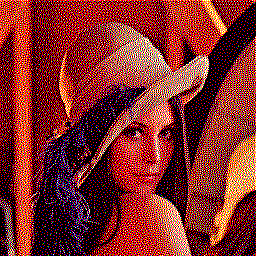
You can check this by trying to dither a full color image in a program like Photoshop. It doesn't work unless you use at least the 8 colors.
In fact, ink jet printers do something similar: They use subtractive color mixing to create red, green and blue dots (in addition to cyan, magenta, yellow and black ink and white paper), then all the remaining shades are dithered from those eight colors. It looks something like that: https://as2.ftcdn.net/v2/jpg/01/88/80/47/1000_F_188804787_u1... (though there black is also created with subtractive color mixing).
The color mixing type used by dithering is sometimes called "color blending". Apart from dithering it's also used when simulating partial transparency (alpha).