I have seen dozens of these things and have made a few myself.
Beyond some specific use cases, they don't seem to scale cognitively. The tangle of connections is a problem. The previous HN link from @andsoltis has a better critique than me.
Don't get me wrong. Besides being experientially cynical about these things, I'm also firmly in the camp of "one more UI breakthrough, bro and we might crack it!"
This one has some deep design that definitely attempts to extend the state of the art but still struggles with that aforementioned problem.
TBH though, the coolest feature is that widget that focuses on what you are doing. There is something there with it, I'm just not sure what the "there" or "it" is, but I do know I like it.
I spent a lot of time on this too, many years ago, including working on a language designed specifically for it, and my conclusion was that I couldn't find a way to make it work without making the visual representation "just a tool" for working with a textual representation, because we still need to be able to communicate about code in all kinds of context where a largely visual system would mean being forced to share screenshots, as well as being able to handle e.g. diffs and source control. And once you still need to know and understand and work with a textual representation it feels like a lot of the potential evaporates, and that made me gradually lose interest.
I'd love it if someone found a solution to that, but it feels like an intractable problem beyond some specific use cases as you say.
There needs to be some way of sharing diagrams, but hopefully not as screenshots? Maybe more like a higher-level SVG, where there is text and you can look at it, but it’s not the preferred way of viewing it. It would need to be easy to embed these diagrams in other documents, which suggests a standard format and viewers readily available, for browsers and editors at least.
Support for embedding such things in another language (Like we do with SQL and regular expressions) would be important, too.
That might be a place to start. Can we replace regular expressions with a visual language? What would it take to have “railroad diagrams” widely available in at least one programming language and many editors?
Yes, good example. On the other hand, emojis seem pretty popular, and many programming languages do support non-ascii symbols in identifiers. We just don’t use them much for actual code.
Along with markdown, there’s also increasing support for math equations in forums and blogging software.
Emojis have universal appeal. Coding symbols doesn't.
Math symbols are a better example, but also extremely well established, and it's still taken a very long time to get widespread support, and it's still far from universal.
But note that non-ASCII symbols etc. was an example of the difficulty of even getting support for something "that simple". Now try to take the step up to e.g a node-based editor.
That’s fine though? Ultimately everything you do on the computer is just a representation of bits being shuffled around. That doesn’t diminish its meaning or effective’s of a better user interface.
The problem becomes if the form you're used to working with the code in is very different from the form you need to communicate about it in.
In practice every attempt I've looked at either become hard to communicate about the code in, or the visual aspect tends to end up just becoming a secondary visualisation of code that you still treat as textual first.
In the latter case, turning it into a better UI is an unsolved problem, because round tripping reliably between something readable as text and a meaningful visual representation is really hard.
As I said, I hope someone solves this, but most attempts aren't even pushing the boundaries into uncharted territory - a lot of attempts have been made over the years.
The trick is that you don't round trip. You choose one immutable data structure that captures both the textual source of the program and the semantic information captured by the parser at the same time.
That doesn't solve anything. The problem isn't how to represent the AST, but defining both a visual and textual version that can unambiguously represent the same thing without either or both representational becoming unusable.
But then you want to write about it and explain it to someone else, and you're back to needing a way to represent it that fits on a page or can be explained verbally.
Better to round-trip to the AST, and have the textual representation be derivative of that (e.g. by a code formatted like Go).
This also makes it easier to verify that you have all the same capabilities in both representations, as the ways of manipulating the AST are enumerable.
I built a language and UI around that way back, and many others have. I ditched mine because there were way too many unsolved problems I felt made it useless.
The problem is that if your primary means of working with the code is visual, the textual representation of your code then tends to be foreign to you when you're trying to use it to communicate aspects of the code, and when you constrain yourself to something that can be represented in a readable manner in a textual form, it turns out to be really hard to get to a point where the visual form is easier to work with.
E.g. something as basic as how you comment code in ways that roundtrips nicely is an unsolved problem.
If I have code represented as a graph, I'd be inclined to want to label relationships and dataflows that would be hard to place textually in a way that is meaningful in a textual version and that would roundtrip back to labels in the right place in the visual version.
I've not seen any attempts at visual code that gets even that right.
I've not managed to get it right myself either. If you force users to use an editor built into this tool, and edit a textual representation where some information is hidden, you can do better, but then if people e.g. copy a textual representation of the code into another application and back in, you end up with a mess.
Again, I want to be proven wrong about this. Badly. I love the idea. I've just seen enough failed attempts (and made enough failed attempts) to be disillusioned about it.
I think diffs, snippets, and source control are crucial, but I think they only tie you to a textual representation if you are trying to use existing, text-oriented tools for them.
I grant that this makes the project significantly larger if you're going to remove that constraint.
I'm pretty sure I have a general solution to that problem. The key is that hierarchies can be embedded in text, as HTML and XML do. Check out https://github.com/bablr-lang/
I personally think CSTML is both compact and readable, though I understand why it would look the opposite the very first time you see it (and without any syntax highlighting at that).
Open up the source code for this web page: is it compact and readable? The answer seems to be that HTML is "good enough" in that regard, and I suspect CSTML will be the same especially as more developer tooling for it becomes available.
The problem is that I'm not talking about markup. Markup - unless it's so lightweight as to be near unnoticeable is not a solution. Unless every application you're transferring it via supports CSTML, the representation needs to be as compact and readable as a regular programming language.
To take your example, pretty much anything longer than [1, true, "3"] is a non-starter if someone is pasting it into Slack, or sending an e-mail. The CSTML representation isn't readable to them, and would take additional steps on both sides vs. just writing the source representation. I'm not going to tell people how to do something by writing it into some other tool and pasting some large blob into Slack or my e-mail client and expect the recipient to reverse the process.
That is the problem space. How you represent that as an AST isn't the problem - that's easy. How you represent it in a way that everyone can read and write and that "passes seamlessly" via existing tools is the problem.
(I must also admit that I think the choice of serialization format for CSTML is utterly baffling and feels like it adds a lot of NIH)
I use such tools when I can, and am fascinated with the concept, since it evokes Herman Hesse's _Glass Bead Game_ (from his novel _Magister Ludi) which was a book I remember fondly from my youth.
Advantages are:
- discoverability --- it seems pretty easy to arrange all elements in a hierarchy and make them accessible via clicking/revealing
- no syntax errors --- if things fit together/connect, then it should be a syntactically valid program
The problem is, it relies on a couple of concepts we don't seem to have a good solution for:
- What does an algorithm look like?
- How to deal with an algorithm which is larger than the current screen/window size? (it's all-too easy to have the same sort of problem of a not-wrapped program with lines longer than the current window size and more lines than will fit in a window, and there doesn't seem to be a 2D graphical equivalent of turning on word-wrapping)
- If programs are broken down into discrete modules, then connected together, one is back to the wall-of-text description which presumably one was trying to escape from, just wrapped up in boxes and connectors
Looking at those, I feel like we are approaching the problem entirely wrong.
Even in text, you don't try and look at everything at once, zooming out for a "structure overview" seems useful, but that is not what is happening here, its just imperative code being shoehorned into a DAG and left wherever a user left it instead of organizing itself, which is the whole benefit to graphical programming.
This demo of "unit" at least seems to organize nodes and views of nodes better.
I agree, some facility for automatic re-organization and adjusting what is shown/readable in terms of hierarchy based on how much or little of the program is being shown would help a lot.
> - no syntax errors --- if things fit together/connect, then it should be a syntactically valid program
for consideration, one need not change the encoding medium to achieve this: JetBrains MPS <https://www.jetbrains.com/mps/#:~:text=Why%20MPS> (Apache 2 licensed: https://github.com/JetBrains/MPS ) is like a middle ground between "flashing cursor in a textarea" and "drag-and-drop programming" and they alleged to have written their bugtracker (YouTrack) using MPS but they have since removed the citation in the footer so I don't know if it was true or is true
But Hesse never actually describes the glass bead game. I thought that was the whole point of the book. He alludes to aspects of the alleged game, and let's the reader imagine perfection. Often similar elisions and allusions with the latest UI framework de jour.
I used LabVIEW extensively in the past. It was possible to organize code for readability, but it was physically laborious and I got massive eyestrain headaches and wrist fatigue from all of the fine mouse work needed. To be fair, maybe that's a personal ergonomic issue. I also can't use CAD for the same reason.
I can sling text with my eyes closed, and have managed the ergonomics of typing well enough that it hasn't injured me in almost 50 years.
On the other hand for applications where dataflow was a good paradigm for the problem being solved, I appreciated its benefits.
> Beyond some specific use cases, they don't seem to scale cognitively. The tangle of connections is a problem.
This just isn't true. I've actually built things in visual languages. It just requires the same organization as text-based languages. One could write an entire text-based program in a single file in a single function, which would be a similar mess. In fact, the benefit or feature of visual languages is that they showcase poor code more readily than text-based code.
I have also actually built things in a visual programming language. They are simply not capable of the same level of organization as a text based language because pictures is a bad way to communicate. There is a reason humans advanced past cave painting and hieroglyphics.
I have used LabVIEW, among other visual languages, and built systems with 1,000+ VIs, which are the fundamental building blocks of code organization, and hundreds of classes. LabVIEW has VIs, clusters, classes, libraries, and projects, all of which are useful and required for a well-managed, decoupled code system.
With good software principles, there's nothing that says you can't organize and scale visual code well.
I one time interviewed at a place that had swore off LabVIEW and were moving to Python. The reasons of switching from LabVIEW were the same tired reasons of organizational issues. When I asked to see their Python code, they showed me a single Python file over 10,000 lines long, and there were function signatures that were over 20 lines long. That was just the function signatures. This example, along with many more, and my experience in both visual languages and text-based languages make me very skeptical about claims about not being able to organize and scale code in visual languages.
We see the tangle representing a complex system and say the tangle is ugly.
We hide the tangle in text and names and say it is better. There is something odd there.
That the tangle is perceived to be uglier than the word.... is it that our brains deal better with a sliding window of symbols rather than gazing upon the sprawled true tentacled glory of some large algorithmic expression?
The promise of VP is that the program is the architecture is the monitoring tools.
The first will be for tiny machine-generated programs linked together, which will be for a research project. The second is for an abstract physics game which will be for learning, fun, and hopefully some tiny profit on Steam. (Will appear here https://store.steampowered.com/search/?publisher=My64K when playable)
In, both I am adding severe constraints to the VP design but the game one will be the most interesting. I'm looking to add a kind of cellular automata mediated physics that also provides gradual automated optimization. Think programming in Minecraft with Redstone but with multiple dimensions and a regular polygon substrate. The key ideas I am exploring in both are:
1) Can we design a substrate that enforces some order that solves the tangle problem?
2) Within a substrate, can an algorithm be "crystalized" or "folded" into something recognisable by its shape?
I am starting next week. I have six months off work. It should be fun.
Visual programming languages are not prevented from using textual symbols, though. And many people use diagrams to communicate ideas more efficiently than they could with text alone.
Beyond some specific use cases, they don't seem to scale cognitively. The tangle of connections is a problem.
Tons of things like this were built in Smalltalk. (Including a UI->Domain model connection layer in the IBM VisualAge Smalltalk IDE.) They all had scaling problems, especially, "they don't seem to scale cognitively."
It's not as if the problem doesn't exist in most codebases. It's more that the problem is invisible without such tools. Tools making the tangle visible make themselves seem unusable.
The fundamental problem, is that we don't have ways of introspecting these horrendous relationship graphs for specific contexts. If IDEs and other programming tools generally could create custom browsers/IDE windows for things based in queries like:
"All of the methods that contain references to ClassA.Member1 and ClassB.Member2 which also call function Y."
...where this query can be modified or further specified at runtime. Then there could be specific built in queries that cover everything touched by canned refactorings. Then these further could be intersected or unioned.
EDIT: Forgot to complete my thought. If the graphical diagram could show contextually relevant slices of the system, it would greatly cut down the confusing web aspect of the diagrams.
I discovered Unit in the latter half of 2022 and found it very interesting. I always loved Fusion and Houdini for the flow based programming aspects. I think in Houdini's case it is notable that is has such a long history it dates back to earlier research in visual computing...
Anyway, I used Unit as an excuse to play with OBS and stream a bit... if you'd like to see a video of how I figured out some bits about how it worked since I couldn't find anything close to a tutorial I have a video on YouTube:
Thank you for posting this! It confirms my suspicion that Unit is probably not reinventing the meaning of computation to match the new visual medium? But still quite interesting how it is laid out.
This is quite comparable to the vision I had in 2012 for NuzzGraph, but there was no way I was going to realistically make any real progress given the complexity and my lack of experience at the time.
Also it was clearly a solution in search of a problem. I was a believer in the idea that graph databases would enable a new paradigm of application development in the way that relational databases did, and wanted to try to pioneer something. That was (so I thought) what college dropouts like myself in my early 20s needed to do to get ahead in tech, as I was only a mere data analyst at the time, with no connections to the tech industry, scraping by while living inside a garage.
It was a good exercise though and it somehow out of sheer luck caught the attention of Manning Publications as it likely came up in the search results for OrientDB. My project page included a sort of roadmap to integrate with OrientDB.
They signed me on as a co-author of the book OrientDB in Action as the other author(s) IIRC weren’t native English speakers and they needed one. The book was never released but a different author released a similar book without publisher backing which was good enough for OrientDB.
If a publisher ever approaches you to help write a book, no matter how ridiculous of a candidate you think you are, your initial response should always be yes. You don’t have any obligation to actually finish a book unless it’s in the contract. You won’t make a dime but you’ll get world-class training on writing technical documentation. They only required that I complete a draft of one chapter within a shorter timespan for the first phase.
I've probably mentioned this a few times on here, but Prograph was a GREAT example of a visual language, that solved a LOT of issues (spaghetti code) etc. It's worth a look if you're interested in visual programming
* object oriented
* scrunching of code - tha could be turned into functions (local-to-opers)
* you could edit code and values whilst it was running
* FAST!
Here's an ole video of some server software I made, that at the end shows me rustily doing some Prographing.
Love unit, long time admirer. If you're into this, you might also be into Substrate - a non-visual but also graph-based programming model, for multi-step ML programs https://www.substrate.run/
Second release since our public launch – we've been around in private beta for a bit and have had different versions of conditional support for a while!
I think the future is in mixed modal computing environments. Text is superior in some architectural paradigms and inferior in others.
Box and noodles can be more descriptive and interactive for some parts of a system but probably not for all parts of a system. Configurations for parts of applications can be better in a GUI than a yaml file. Embedding one language like SQL in another could have an integrated GUI subeditor complete with language server.
Visual/graphical like this I think should be layer of abstraction above traditional text code. With the express purpose of search/reuse (especially by less skilled computer users)
1) So a user creates a couple of nodes in a graph: a button, his specific hardware, a text node saying he wants to calcuate clicks per day.
2) This graph is then used to find published graphs by people who have used these nodes in a completed/deployed instance.
3) The user can easily browse and pick an exact complete graph to deploy himself. (layers here such as preventing private wifi passwords from getting to the published graphs)
4) If the graph is complete in terms of pointing to his exact hardware, exact code chunks as nodes, exact sdk versions then it transforms this graph into typical source code, and can be compiled and deployed, and after confirming it works, then shared again to the public graph collection to let others know it works.
5) if the graph isn't complete, you might have to write some code chunk nodes, connect things properly, or else use AI (har har) or even mark nodes as "todo: can someone please implement this code, or pledges/bounties for someone to help implement"
6) People need to be able to jump into any level they are comfortable with, the code, the graph shape, the public list of TODOs. Then there is translation/generation into the other levels. This makes a tool for higher level collaboration, that should be able to converge on finishing off desired solutions.
The whole point being a new level of abstraction that makes code reuse possible if someone has implemented the same thing in the past already. (but even if it was on different hardware/sdk there should be reusable stateless functional-style code that can be stitched together a bit easier)
The flow based visual programming has always being challenging field, and the problem remains: what are the values added comparing with the text based coding?
I really want to love it, please give me a strong reason.
Debugging is quite nice. Clicking on a wire and being able to visually see its value at runtime and even present it in a custom UI, like a graph or chart, is awesome.
It's easier to parallelize a flow graph than a sequential series of instructions. (This is why visual flow programming caught on in embedded hardware and IoT.)
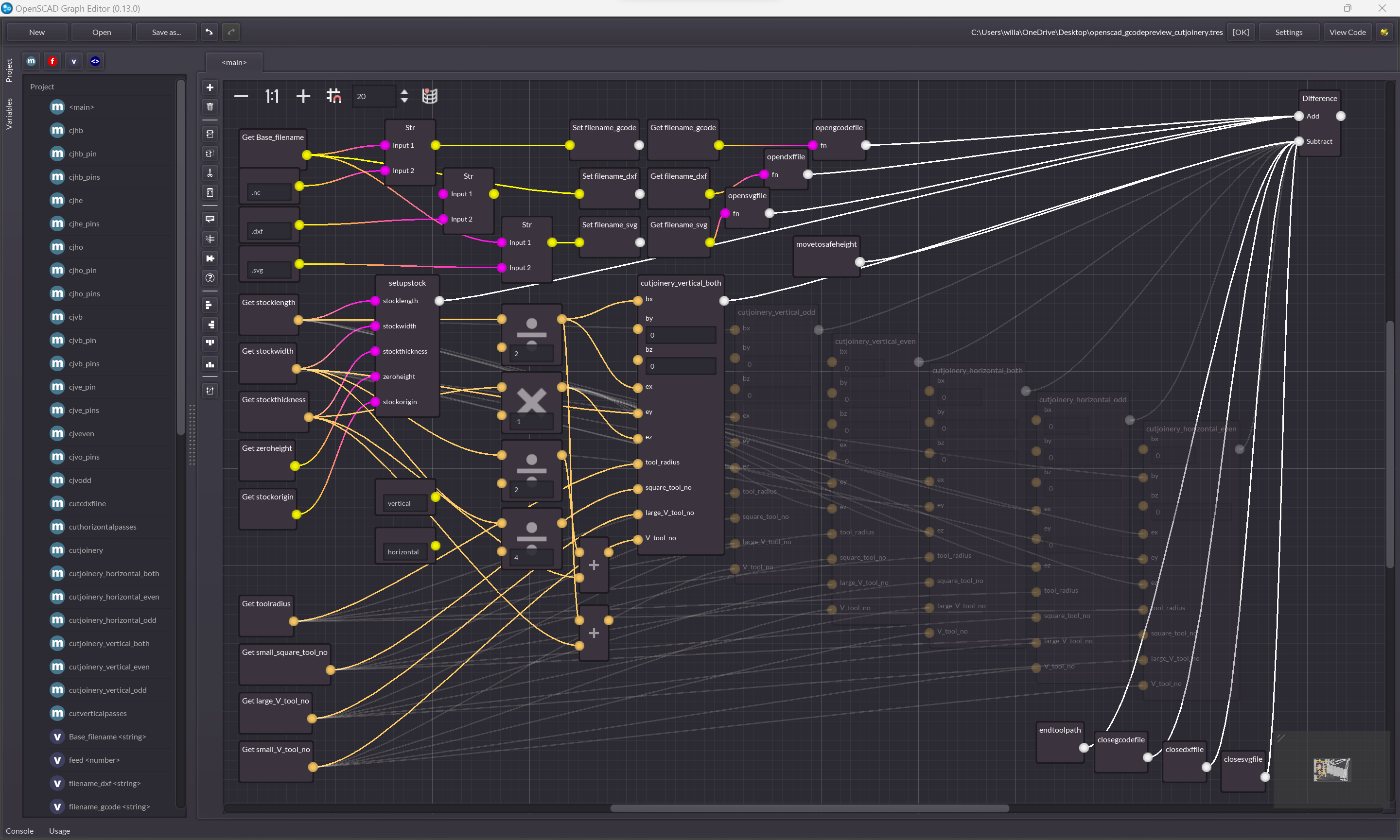
Beyond some specific use cases, they don't seem to scale cognitively. The tangle of connections is a problem. The previous HN link from @andsoltis has a better critique than me.
Don't get me wrong. Besides being experientially cynical about these things, I'm also firmly in the camp of "one more UI breakthrough, bro and we might crack it!"
This one has some deep design that definitely attempts to extend the state of the art but still struggles with that aforementioned problem.
TBH though, the coolest feature is that widget that focuses on what you are doing. There is something there with it, I'm just not sure what the "there" or "it" is, but I do know I like it.