Hacker News new | ask | show | jobs
by smeej 710 days ago
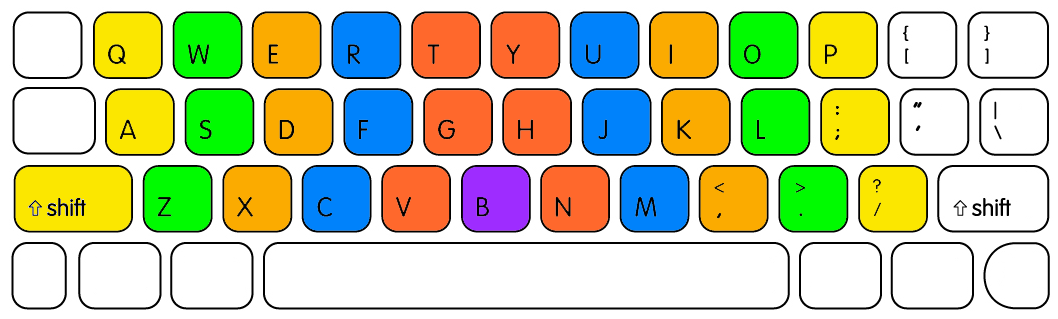
I've yet to wrap my mind around two things that are extremely common on "ergonomic" keyboards: ortholinear keys, and the positions of the C, X, and Z keys in the columns.

I type those with my index, middle, and ring fingers, respectively, because when I pull my fingers back toward my wrists with my hands sitting at a neutral angle, those are the keys they pass. Moving from A to Z on a regular keyboard would be a disaster of a hand position!

Who is it who's teaching people to type that way on standard keyboards? I'm an elder Millennial, so the first class in my school that ever practiced typing in kindergarten, in the very early '90s. When and why did anyone switch to a horrible hand position?

It's only from that horrible hand position that I can imagine "keys in a straight line" being an improvement. My index fingers cover more than one column of keys, so staggering them makes all of them easier to reach, rather than one set really easy and the other set much more awkward. My fingers do not move in straight lines from coiled to uncoiled, and I doubt other people's do either. They splay as they extend. They should be able to cover more keys with less movement extended than they do coiled, so putting keys in straight lines makes it worse, not better.

5 comments

> I type those with my index, middle, and ring fingers

I have never heard of anyone typing like this. I type those keys with my middle, ring, and pinky finger respectively.

A quick google search of “qwerty finger map” shows that middle-ring-pinky seems to be the standard. I don’t see any disagreement across any of the results. I suspect that your typing class was the exception, or you just picked up doing it differently than what was taught. I don’t think there was a large scale “switch” on how things are taught.

But yes, if you type differently than that then ortholinear keys would probably require you to make adjustments.

The second image in this article shows the typing position I'm talking about, and the article as a whole does a decent job explaining why it's better (though it's probably fairly obvious if you just look at the shape your hands make when you bring them together).

This was normal when I learned. Really wondering why anyone would change it.

https://www.onehandkeyboard.org/standard-qwerty-finger-place...

I’m not the one you replied to, but I generally type without using my pinky at all – including pressing Caps Lock (Ctrl) and Enter with my ring fingers. For me, I’ve had bad cases of RSI before, and find it more ergonomic to move my hands a bit more and avoid using the pinky most of the time.
Typing instruction never changed. Standard method has always been pinky on z, since typewriters. You were just taught an unusual method (or maybe picked it up on your own).

Ring finger on z is just as uncomfortable for me as pinky on z. The problem is the typewriter key layout, not finger placement.

> It's only from that horrible hand position that I can imagine "keys in a straight line" being an improvement.

As long as you type comfortably, you're doing fine. But if you want to wrap your mind around it, that starts with grokking that not only do most touch typists type Z with the pinky, and so on in, that is how it's taught as well.

So if it's what you do already, ortho just straightens that out. Most ortho keebs (I think? Not all of them, but most) are also splits, so the keyboard is lined up with the palm, something which isn't possible with a straight keyboard.

So given all that, columned keys are great. It's 32 keys which I can type without any elbow movements at all. Add in some thumb keys and we're really cooking ^_^.

It wasn't until I started seeing ortho keyboards that I realized anyone had ever been taught this, and I still can't figure out why.

This placement was normal when I learned to type, and it matches much more closely the shape my hands naturally make if I bring them together in front of me: http://www.onehandkeyboard.org/wp-content/uploads/2012/04/Z_...

So you got me thinking about what I actually do, and several rounds of typing "sphinx of black quartz, judge my vow" while trying to simultaneously notice what my fingers are doing, and do what I would do naturally†, I realized that on a standard keyboard, I type z and x with the ring finger, and c with the middle. I also type q with the ring finger, fairly consistently.

But on the ortho split, I do the obvious thing and type them in the "approved fashion". I used to have a bad habit of cross-typing y, which the split has mostly cured me of, since it's plain impossible. But for the word type, I absolutely do, since it's right next door.

The main point I was trying to make is that optimal tying on a staggered keyboard doesn't have much bearing on optimal typing on an ortho board to begin with. But you've given me some insight into a related puzzle, which is that I've noticed that some people take to ortho splits almost immediately, and other people find them very hard to use at first, the latter frequently just give up.

For me it was easy, except for the cross y thing: I was typing at close to my original speed in about four hours. But I type with a loose relationship between fingers and keys to begin with, my natural 'home row' on a standard keyboard is asdv nkl; for instance, and there are a small handful of keys which I'll hit with one of two fingers depending on what sequence I happen to be typing. I suspect that people who are rigorous about the layout in your link have an especially hard time with ortho keyboards.

I also simply don't see the point in ortho boards which aren't split. If you can't align your fingers with the columns, it seems like a strictly worse layout. But some people love it.

And for me, the point isn't really the ortho, it's the split. It's just vastly more comfortable to place my hands on either side of my torso, and the ortholinear part is just a natural consequence of that placement in a "may as well" sort of way. The tilt is what makes columns natural, without that it's at least a wash, and I would say worse.

[†] which is an absurd and unnatural thing to do, like trying to pay close attention to what your knees are doing while you walk down the street.

I was taught touch typing with pinky on the Z and index on the V for the bottom row. I think that's how it's designed to work, and that in this context stagger is a historical accident that ergonomic keyboards fix.
This certainly lines up better with my actual fingers...

http://www.onehandkeyboard.org/wp-content/uploads/2012/04/Z_...

I agree, but would suggest that the solution is splayed columns rather than staggered rows. Lots of keyboards do this, even more “normal” keyboards that are far from being Dactyl-like: https://github.com/GEIGEIGEIST/TOTEM

Also relevant, but for improving the ergonomics of “normal” keyboards with staggered rows: angle mod. https://colemakmods.github.io/ergonomic-mods/angle.html