At this point I would bet against commercial fusion power plants. It was always questionable if they would be cost competitive with fission power plants, but now even those are being replaced by renewables and grid storage.
The bigger problem is that fusion plants aren't useful for making weapons. Fission plants were basically a side project of the nuclear arms race, which is why they're a dying industry now. The world already has all of the nuclear bombs it will ever need and despite all of the promises they never managed to compete on cost. It's so much easier and cheaper to install wind turbines, solar panels, and grid scale batteries that there will probably never be a market for a commercial fusion power plant.
Strong Wind doesn't exist on asteroids and many planets, so I think there will be a long term need. Solar power decreases with the cube root of distance from the sun,so twice the distance is 1/8th the flux
Nitpick: Radiation decreases with the square of the distance (twice the distance, 1/4 the energy). This is because the surface of a sphere (which is where energy is collected) is 2D, not 3D.
I'm not concerned about commercially viable space colonies in my lifetime.
The real reason for fusion was that fission is not a renewable resource. In a few thousand years there will be a fuel problem with fission and we would be forced to switch to fusion if we had a fully nuclear power system.
I'm entirely content on relying on sci-fi energy production for a few thousand years from now.
This might sound like the same attitude that put us in our present climate crisis, but that was on the order of decades to centuries. Thousands of years include such unbelievable potential of technological development that there seems no point in trying to predict the actual challenges we'll face.
Interestingly enough, some of the advancements in fusion research and lasers may help with fission waste fuel recycling. [1] Though breeder reactors might end up being more economical.
So replacing old infrastructure is now an investment? There are just many reactors EoL and I'd say replacing those is not a sign that nuclear is booming right now.
I would bet against it. We haven't even built one of the key facilities to test the materials that we would hope to make a fusion reactor from. Once built, it will still take 20 years or so (as I recall) to come to some conclusions about suitable materials.
The sun is able to use gravity containment. Terrestrial fusion has to use magnetic and physical containment. The extremely high energy neutrons produced rapidly deteriorate common engineering materials. A replacement schedule is very difficult because of induced radioactivity, which means that the reactor cladding would need to be replaced by robots most likely.
Given how rapidly the price of batteries and solar are falling, it seems absurd to think it will make any economic sense to spend tens of billions of dollars on a monster fusion plant.
China are churning out regular old fission plants, and have 27 under construction right now. Even still, the average build time is 7 years.
So even if we get some breakthrough and figure out how to build a commercial fusion plant, it's a certainty it won't be up and running for something like 10-15 years. Solar and batteries will be so cheap there won't be any discussions.
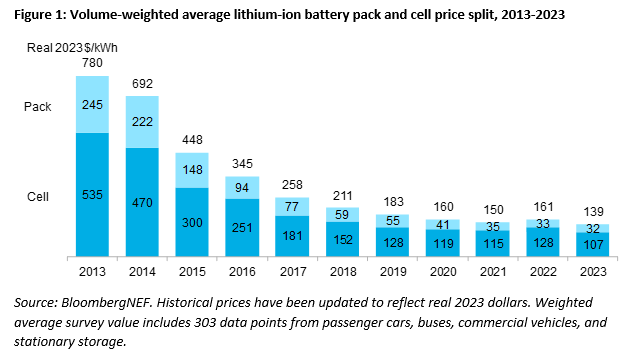
Prices are decreasing much slower now. At this pace, large scale energy storage for replacing stable energy sources like coal and fission power plants is far out of reach.
If you look at the beginning of the chart, the price decrease (from $780 to $258 in 2017) over the same four year period was 67%. And for 2023 it was only 24%. So progress has slowed a lot. In 2022 there was even a year-over-year price increase. That's bad news when you want to build massive energy storage systems that can replace power plants.
The bigger problem is that fusion plants aren't useful for making weapons. Fission plants were basically a side project of the nuclear arms race, which is why they're a dying industry now. The world already has all of the nuclear bombs it will ever need and despite all of the promises they never managed to compete on cost. It's so much easier and cheaper to install wind turbines, solar panels, and grid scale batteries that there will probably never be a market for a commercial fusion power plant.