Hacker News new | ask | show | jobs
by shagie 732 days ago
From https://www.lovecpokladu.cz/en/home/the-mystery-of-medieval-...

https://www.lovecpokladu.cz/img/2023/gm4pro/Sandomierzské%20...

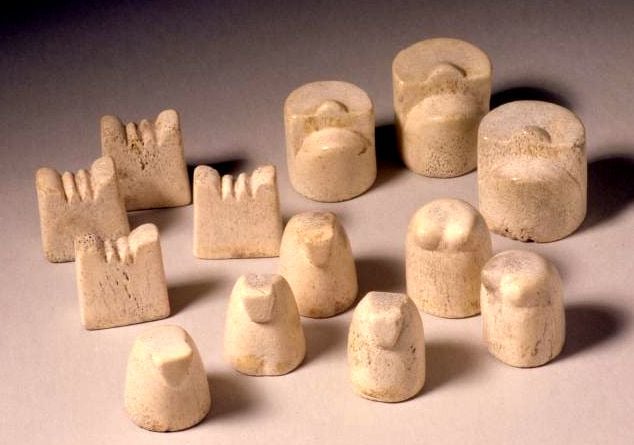
In that set you can see the rook being castle like on the end, the knight with a "triangular stick out head thing" and an elephant which has two bumps that at first glance made me think breasts rather than tusks. Then the inner two pieces with the king and queen.

The triangular head, however, is that of a horse's head rather than an upside-down miter or jewelry.

Another view of it from a different angle - https://pbs.twimg.com/media/FsPKPECX0AEwYP6?format=jpg&name=...

The bishop itself was a later introduction - https://en.wikipedia.org/wiki/Bishop_(chess)

> The bishop's predecessor in medieval chess, shatranj (originally chaturanga), was the alfil, meaning "elephant", which could leap two squares along any diagonal, and could jump over an intervening piece. As a consequence, each fil was restricted to eight squares, and no fil could attack another. The modern bishop first appeared shortly after 1200 in Courier chess.

1 comments

The 'boobs' could be just that, representing the queen.

That 'chess set' isn't even symmetrical! Two with triangular 'heads', one with 'boobs', one with a square projection!

Couldn't those two with grooves represent bishops? More typical of a mitre than a crown, but hey this was Germany, maybe that's correct there. And yeah, that last link to the early 'bishop' has a slot cut in it too.

Unless they found it with the board set up, then I'm gonna have doubts about any conclusions about correlations with modern chess pieces.

There are two "dual front bumped" pieces that are in the position of the bishop today.

There is one piece next to the king that has the same structure, except no bit on the top signifying the crown.

That set is hand carved out of deer bone - this isn't a super-high quality set (compare with https://en.wikipedia.org/wiki/Lewis_chessmen )

Another set with a similar abstract design - https://www.thehistoricgamesshop.co.uk/early-medieval-chess.... - https://sites.create-cdn.net/siteimages/33/6/5/336500/18/8/3...

> This example of 11th or 12th century chess pieces from Scandinavia, now in the Germanisches Nationalmuseum Nuremberg, shows two kings and a smaller, though similar, queen at the back right. On the left hand side are four rooks, and at the front four knights. There are two bishops between the knights and the two kings.

The pieces between the knights and the kings again have a design that makes me think of breasts again.

However, setting aside that those are bishops / elephants (with tusks), the knights at issue are without decoration have the triangular shaped heads sticking forward.

Here is an Iranian set: https://en.wikipedia.org/wiki/Shatranj#/media/File:Chess_Set...

You can see the horse like shape of the knight and two breast-suggestive elephant pieces.

https://thomasguild.blogspot.com/2013/10/byzantine-chess.htm... is a byzantine set. https://blogger.googleusercontent.com/img/b/R29vZ2xl/AVvXsEg...

> The separate chess pieces of the Sandomierz chess set. All have double/triple decorative lines at the bottom and belong to one playing set. First row: pawn (top view), bishop/elephant (side view), king (overview), counsellor (side view). Second row: king (side view), knight (front view), pawn (overview) and rook (side view). All images of this chess set are from the Sandomierz museum website.

The bishop/elephant again shows the tusks. The second row knight doesn't show the triangular shaped head as well though. You will see that the counsellor (Byzantine doesn't have the queen) is similar to that of the king, without the crown.