Hacker News new | ask | show | jobs
by robust-cactus 732 days ago
The form factor here is cool, but as someone whose been resin printing a bunch lately, the pitch to carry it around in your pocket sounds questionable.

1. Where are you going to store the resin? It isn't good to touch it. Are they also expecting people to carry around somewhat toxic resin in their other pocket and then make a little puddle on the ground to print? Resin printing is messy and cleaning is hard. Make sure to carry isopropyl alcohol in your other pocket.

2. It produces toxic fumes while printing that you need to exhaust. So you at least need a mask.

3. It takes hours to print on a large machine: you need a model file, to edit the model to print in resin well and then the actual print can be multiple hours long. Not to mention multiple print failures which is often the case.

Everything mentioned about the surgical application sounds possible today, but it's still not fast enough or reliable enough in that scenario. Also... Resin isn't that strong, you want to graft it to a bone, what?

2 comments

Raw materials aside, a tiny printer can go places a large printer cannot. Space? Deep sea? Inside other machines? Or on the tip of a robotic arm to do print little parts right onto their permanent place like a spider placing silk? Who knows!? 99% sure the "in your pocket" statement is more like "smaller than a breadbox", as in, it's plain-as-day comparisons of size, not use.
The size of the printing mechanism is an innovation for sure, but I think after you add up all the other components to make a functioning printer you end up at nearly the same size: a resin vat, space to print, various leveling mechanisms, filters, UV light shield etc - the form factor doesn't really change all that much.
If you think 3D printing is always going to be on a flat bed of the same size using the same amounts of material, then yeah, minimizing the printing mechanism sure seems like a non-necessary improvement. But that's not the intended use case anyway. It can only print small things. Maybe it can add tiny details or structures to large prints though
> Maybe it can add tiny details or structures to large prints though

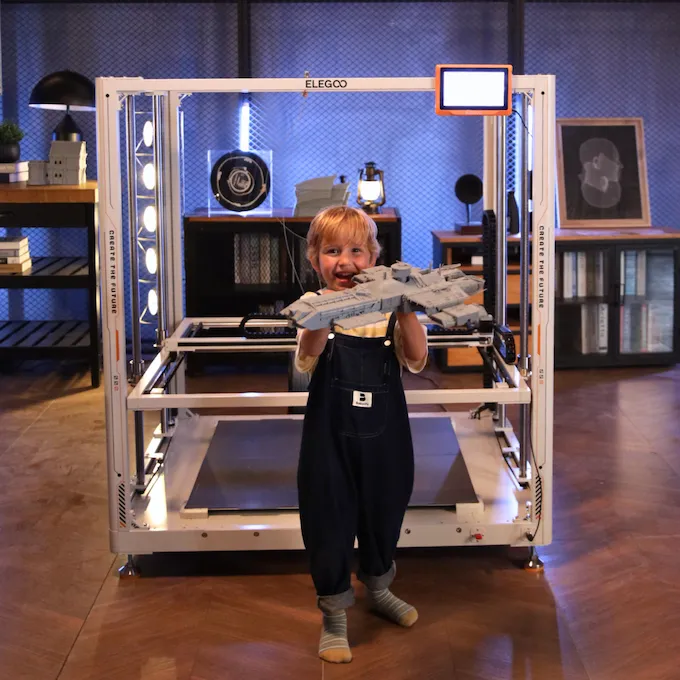
Combine it with their rather enthusiastic article on printing your own children

https://www.tomshardware.com/3d-printing/elegoo-making-3d-pr...

> Just imagine printing a piece of furniture, a near life-size statue, ...

"Such a lifelike figurine, with real plastic spaceship accessory"

https://cdn.mos.cms.futurecdn.net/zPi4gpbczzvoGR34Rds7D8-120...

If the Galaxy Quest aliens happen to glance this way lately...

Hmmmm interesting. I can see a use case for like a drone or small robot to have one of these attached to add details all over the place. Ok you've convinced me it's cool lol
Imagine the equivalent of endoscopy: being able to insert a small tube inside of an object and print structures larger than the tube inside of them.

Obviously, that requires a lot more than just this, but it's intriguing to think about being able to perform internal repairs of nearly-sealed objects.

Or print a kitten inside a bottle, for those old enough to catch the bonsai kitten reference. ;)

Resin isn't toxic. The problem is that resin can cure under your skin and the only way to get rid of the resin is for your immune system to do it. So people develop allergies against cured resin, which tends to cause more damage than the resin itself. Even after you have developed a resin allergy, there is generally no long term damage as long as you stay away from it and don't trigger your allergy.
That does sound pretty toxic to be fair.