It makes a lot of sense because obviously having a river there makes the transport of materials a lot easier, but i do wonder how nobody noticed this before.
> The biggest unknown with my model is whether there was a major western Nile channel at the time, as modern authorities are split on this question.
Seems like what we have now is the discovery of a natural branch, which doesn't mean they didn't dig out useful extensions too.
The Nature article calls this branch a "tributary of the nile", which is the opposite thing to a branch. The paper says distributary (a branch). The tributaries are way to the south in Sudan and Ethiopia and Kenya.
>They said also that the first man who became king of Egypt was Min; and that in his time all Egypt except the district of Thebes was a swamp, and none of the regions were then above water which now lie below the lake of Moiris, to which lake it is a voyage of seven days up the river from the sea: and I thought that they said well about the land;
Later on
>Such is this labyrinth: but a cause for marvel even greater than this is afforded by the lake, which is called the lake of Moiris, along the side of which this labyrinth is built. The measure of its circuit is three thousand six hundred furlongs (being sixty schoines), and this is the same number of furlongs as the extent of Egypt itself along the sea. The lake lies extended lengthwise from North to South, and in depth where it is deepest it is fifty fathoms. That this lake is artificial and formed by digging is self-evident, for about in the middle of the lake stand two pyramids, each rising above the water to a height of fifty fathoms, the part which is built below the water being of just the same height; and upon each is placed a colossal statue of stone sitting upon a chair. Thus the pyramids are a hundred fathoms high; and these hundred fathoms are equal to a furlong of six hundred feet, the fathom being measured as six feet or four cubits, the feet being four palms each, and the cubits six. The water in the lake does not come from the place where it is, for the country there is very deficient in water, but it has been brought thither from the Nile by a canal; and for six months the water flows into the lake, and for six months out into the Nile again; and whenever it flows out, then for the six months it brings into the royal treasury a talent of silver a day from the fish which are caught, and twenty pounds when the water comes in. The natives of the place moreover said that this lake had an outlet under ground to the Syrtis which is in Libya, turning towards the interior of the continent upon the Western side and running along by the mountain which is above Memphis.
That's higher than the Great Pyramid. Lake Moeris still exists and is not near Giza. The two pyramids are thought to be exaggerations of the Pedestals of Biahmu:
Today, King Min is more commonly known as Menes, an upper Egyptian King who ushered in 3000 years of dynastic Pharaonic history by conquering the Nile Delta and thus uniting for the first time all of Egypt. He was as ancient to Herodotus as Herodotus is to us today (2500 years each). It is humbling just how deep Egyptian history goes.
Fascinating, thanks for sharing! Makes me wonder if the great pyramid was partially submerged, and if so, by how much.
This account lends some credence to theories of the pyramids functioning as some sort of ram pump in my opinion. (Check out John Cadman’s work if you’re interested).
I looked that up, and boy was it an interesting read! For anybody who is interested in reading what John Chapman theorized about the pyramids, see here [0].
Makes a lot of sense. I did a small dive into watersheds and fluvial systems a long time ago and something that surprises layman is how quickly rivers can change in just a few decades, let alone thousands of years. Even (or perhaps especially
) large rivers love meandering and and carving new paths over time.
Humans think of rivers as static things and like to use rivers as natural "borders" and forget that these are actually organic and evolving systems.
I can't speak to "the literature" but people have been colloquially talking about the mysterious lack of a canal since at least the 90s. One of the reasons people floated was a no-longer-active branch of the nile.
IIRC it's been well-known for a while how they moved the vast majority of materials by land (similar to how the Stonehenge megaliths were moved, highly dissimilar to how the Rapa Nui moai were).
No,the best theory is they cut the stones in a slightly underwater quarry. The limestone if submerged hasn't gained co2. They used a complex system similar to a canal. They used ballast like logs or airbags to float the cut rocks while keeping them uderwater. Even the top working row was a water filled mini canal. They would drop the stones into place. Once the water was removed the limestone would absorb co2 and swell, tightening the blocks together. This would have been some serious engineering.
> For this, they said, the ten years were spent, and for the
underground chambers on the hill upon which the pyramids stand, which he caused to be made as sepulchral chambers for himself in an island,
having conducted thither a channel from the Nile.
Sounds like the same story for the Osireion, according to Strabo.
Ancient megalithic Geopolymer masonry made with electrodes and [Lingam,] electricity is apparently lost to modern day as well.
FWIU, in the Great Pyramid, there were/are copper rods in the shafts out from the King's Chamber, and the conductive gold at the top of the pyramid was added after construction over top of a perhaps more ancient well shaft (that is not as geomagnetically-aligned) that may have been a hydraulic/hydrologic water tunnel given the water erosion in the subterranean chamber.
Fairly,
Demonstrate moving and then placing an 80 ton granite stone with ancient materials and tools: copper, gold, limestone, granite, probably fulgurite (sand glass due to lightning) and/or volcanic glass, obsidian, grain dust, papyrus rope, papyrus boats, barges, [variable buoyancy] crane machines, masonry forms and jigs, chemistry in jars, large sceptre tuning forks, sand, porous cliffs by the sea
What are the dates on the outer structure, and on the oldest largest object within the structure?
Gears: Antikythera (200 BC), Watchmaking c. 1300 AD
But the boat, and things that float due to ballast or no; how old is that?
Aliens of similar height, from the tunnel and stair heights and sarcophagi.
Such as the [presumed] Sarcophagus of Senusret II - which has a pyramid built around it with perhaps newer and less precise masonry methods - which one might've hoped had contained instructions on how to produce spec granite at those tolerances back then; [1]
There is little evidence of advanced mechanical masonry tools at the time, except for the remaining megalithic stonework that later cultures built upon.
FWIU there are only a few examples of circular polishing, and the core drilling method leaves different signatures than known methods in modern day.
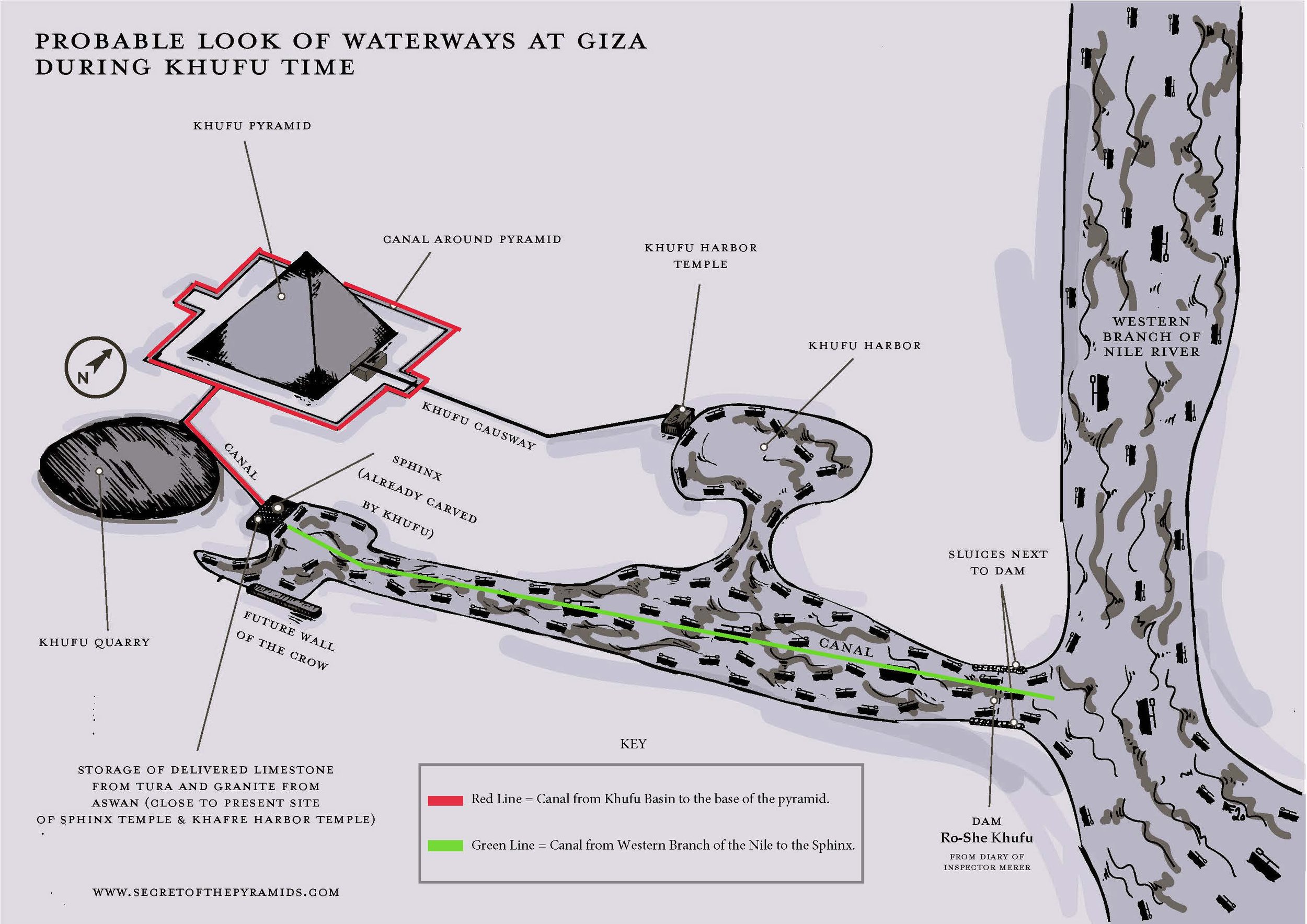
https://en.wikipedia.org/wiki/Diary_of_Merer
In fact it describes artificial basins, found in previous core samples.
Nice article about that, lots of pictures:
https://the-past.com/feature/records-of-the-pyramid-builders...
> The biggest unknown with my model is whether there was a major western Nile channel at the time, as modern authorities are split on this question.
Seems like what we have now is the discovery of a natural branch, which doesn't mean they didn't dig out useful extensions too.
The Nature article calls this branch a "tributary of the nile", which is the opposite thing to a branch. The paper says distributary (a branch). The tributaries are way to the south in Sudan and Ethiopia and Kenya.
Here's the paper:
https://www.nature.com/articles/s43247-024-01379-7