I wonder what that will mean for charging infrastructure that suddenly has to deliver 10x power to enable that. Not sure that sort of charging could be as ubiquitously placed as gas stations
Those would need to get cycled a lot(many times per day). You might want one for your house if you wanted to charge quickly at home, but for charging stations, I think more realistically they'd have 10x less charging spots if each person was only there 1/10th the time.
So the peak would be the same, but if there were too many customers then sort of like at a busy gas station people would be waiting for a spot rather than waiting for charging to complete.
> Those would need to get cycled a lot(many times per day).
Fortunately these batteries have "an estimated lifespan of 50,000 cycles". Also, since there aren't super-dangerous elements in them, they should be much easier and cleaner to recycle/renew - especially with the giant recharge-station-scale ones' we're talking about, which could be designed specifically for that.
Higher steady-state is mostly a good thing. You need to bulk up the power lines, but you're making good use of them and have lots of money to spend on them.
Okay, I mean I'm aware of that perfectly generic information but "sometimes management sucks" doesn't impact a feasibility analysis much. And this hypothetical station was already willing to spend on a lot on batteries.
Just because they want to spend on batteries doesn't necessarily mean they can spend on power lines. Most of the time you can't just pay the power company to bulk up your lines, just like you can't always pay an ISP to install a faster connection, even if they provide that service to another area.
I had an engineering colleague who previously worked at a company that reconditioned Prius batteries. It involved cycling powe in and out of the battery several times. Where did all that power come from? Another battery.
They easily do. Discharge rates are typically higher than charge rates. For stationary batteries it's all easier due to being able to have larger, more parallel batteries, and better cooling when weight is not a concern.
Battery-backed charging stations are already common, because it allows use of cheaper grid interconnection, and use of cheaper off-peak or renewable energy.
If the car batteries can handle some amount of power, batteries on the other side can handle the same amount.
Especially because the station would want to have multiple cars worth of energy stored, which means the load is divided among more cells and they don't have to work nearly as hard.
Not that much, grids can and do deal with highly variable loads all the time, as all the heavy machinery involved in traditional power generation (=generators, gearboxes, axles, turbines) has a lot of inertia that buffers sudden changes.
However, as more and more generation capacity shifts to renewable sources that by design have very small (wind) to zero (solar) inertia, there will be a requirement to build out frequency stabilizer units like the Tesla unit in Hornsdale, Australia [1].
Aren't batteries quite limited in their ability to provide synthetic inertia? Sure, they can respond on a second or tenth-of-second scale, but they don't provide the kind of instantaneous inertia you get from spinning rust. Inverters aren't exactly designed to just eat power surges, they'll instantly disconnect instead.
That's why the UK grid has been building some "high-inertia synchronous compensators", and a 2019 outage showed that it's urgently needed.
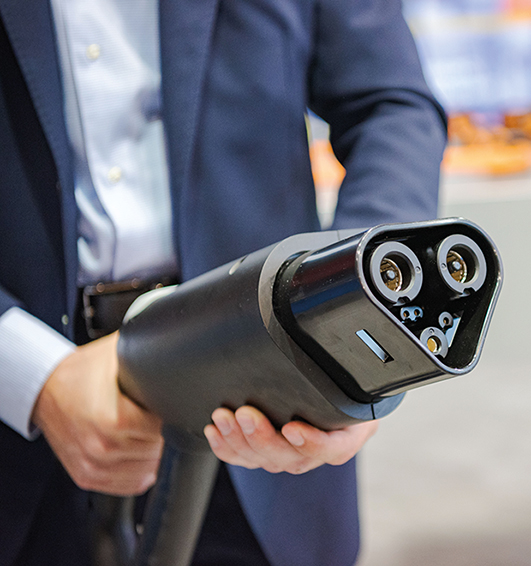
Megawatt charging system is big but doesn't seem unreasonable, and that gives you 5x the amps. In two minutes it can add 80kWh to an 800 volt battery, and the max voltage is 1250.