Discrete is the opposite of integrated, as in integrated circuit.
In practice, it means using multiple components. In a strict sense it means no integrated circuits at all, I suppose. But it's also a relative thing. So while a 7400 series chip is not a "discrete" component as most would think of it, using a hundred 7400 series chips to implement a processor is relatively more discrete than a microprocessor. (It's certainly not as integrated.)
Since the early 1980s, Ethernet interfaces have used used custom chips, because the amount of logic required would need dozens of gate-level chips otherwise (as seen here!)
In the early 1980s, an Ethernet adaptor required a lot of board space. They were often of similar complexity to the main CPU board. For example, this is DEC's first Unibus Ethernet: https://gunkies.org/w/images/1/16/DEUNA.jpg, which occupied two boards.
The software required to run a TCP/IP stack was also large, limiting the system to a handful of active sockets, and consuming large parts of the available CPU power to run something like Telnet or FTP.
It took a few years for CPUs to get more powerful, more RAM to become affordable, and for network hardware to become integrated onto the smaller boards like ISA or NuBus.
No, network cards use chipsets, meaning, most of the logic is inside one or two large ICs (Integrated Circuits). What the poster is doing is creating a card using the simplest existing ICs which contain simple logic circuits such as NANDs, multiplexers, etc.
No, most use much more complicated ICs. This isn't fully discrete (individual transistors, diodes, etc.) but only uses 7400-series logic ICs, not ASICs.
Although they're not common nowadays, the 7400 series includes some more highly integrated parts, including a complete ALU. There's no exact criteria for what "discrete logic" means, but I don't think anybody would accept a complete integrated ALU. To me, it means things like gates, multiplexers, or flip-flops: things that can be made with a few tens of transistors at most.
"Discrete logic" computers usually use integrated RAM chips, but seeing as RAM is usually drawn separately from logic on block diagrams, I think this is still acceptable. However, the popular trick of using an EEPROM as a giant lookup table for your ALU is in my opinion not "discrete logic".
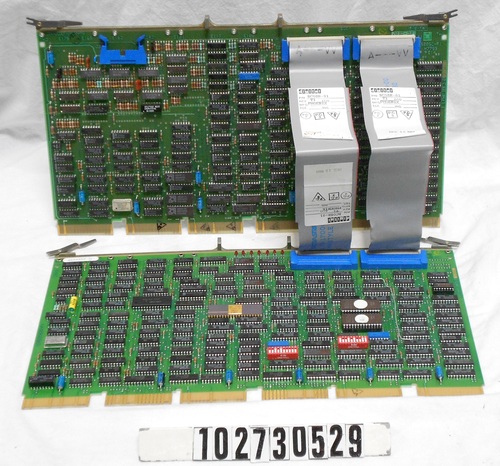
In practice, it means using multiple components. In a strict sense it means no integrated circuits at all, I suppose. But it's also a relative thing. So while a 7400 series chip is not a "discrete" component as most would think of it, using a hundred 7400 series chips to implement a processor is relatively more discrete than a microprocessor. (It's certainly not as integrated.)
Since the early 1980s, Ethernet interfaces have used used custom chips, because the amount of logic required would need dozens of gate-level chips otherwise (as seen here!)