Hacker News new | ask | show | jobs
by bell-cot 803 days ago
> Since the war in Ukraine started, the French government has urged companies to produce more weapons, faster and cheaper.

> However, the reality is complicated.

> "It's an ongoing process. Up until now, we were producing around 10 radars a year, now the target is over 20 a year,” Descourvieres said.

If there was an actual war on, and a nation was taking both combat and operational losses - then 10 or 20 per year hardly amounts to squat.

It seems hard to imagine that this is the country which constructed the Maginot Line - in a decade, mostly during a grim economic depression, when their entire nation's population was only a bit over 40M.

10 comments

Few reasons, one of them is that the Maginot line was built during a time where France was an industrial powerhouse. This has not been the case in a long time.

The other point, is that you are comparing a public infrastructure project with a private company.

Said private company behaves like one and does not want to take unnecessary risks by recruiting and training too much staff and later not having enough orders to keep them on the payroll.

Minor pedantic FYI - although your comment was clear (I think, or maybe I did misunderstand it), there's a linguistic difference between "Few reasons" (meaning "there aren't many reasons) and "A few reasons" (meaning "more than one", but implying that you're introducing the reasons, not that you're quantifying them as not many).
If France were to be at war with a nation knocking on our borders, our policy nowadays is to fire a nuclear-tipped ASMPA missile as a warning shot. We do not rely on our conventional forces or anyone else to safeguard our sovereignty should it escalate to that.

Our army and arms industry have suffered heavy cuts for thirty years after the end of the Cold War, prioritizing quality over quantity, but we've kept what we call a modèle d'armée complet, or an army with a complete set of capabilities, alongside the arms industry to sustain it. Said arms industry after spending decades surviving on frugal orders is now in the process of scaling up production substantially. It takes time, but we've already tripled production of Caesar self-propelled artillery with another doubling in sight for example.

If push comes to shove, we might take some time to wake up from our slumber, but we're French. Picking a fight with the Gallic rooster is usually a bad decision.

I suspect the doctrine of nuke as a warning shot is less effective today when a small group can launch, either for own purposes or as a proxy for another state, a large group of drones to strike with speed and precision the targets 1000+ km away. With that threat type nuking is not an option and we are back to traditional defense. My 2c.
Our nuclear deterrence policy is for safeguarding our country's sovereignty and vital interests. Unless that swarm of drones threatens our continuity of the government or our ability to conduct a nuclear strike, I doubt it is worthy of a Tête nucléaire aéroportée.

Unlike any other country with nukes, we do have a last-chance warning shot option in our policy. An ASMPA missile from us means thus far and no further. It's fired from a Rafale fighter rather than a ballistic missile submarine, which means the order can be reversed at the last minute if needed and it hopefully carries the message across before the adversary's early warning systems light up like a Christmas tree with French ballistic missiles.

We do have a problem of scale with our conventional forces, which have been cut down to the bone and are stretched thin operating at capacity. Unlike the Germans, we're using our army to conduct expeditionary forces around the world and have little on hand to spare because we refuse to compromise too deeply on our long list of capabilities to fight wars and have a bad habit of not storing up enough.

It will take a long time to bulk back up, but Ukraine has been a wake-up call that is taken seriously by our policy makers.

No small group has the resources to launch large groups of drones with a 1000km range. Those tend to cost >$100K per unit, and require significant support infrastructure.
That was true 10 years ago, but is no longer true today. All components, including body, motor and electronics are a few thousand dollars and a garage-sized machine shop is very capable.

The limiting factor is the skill to put it together, but recent action in Africa and Ukraine means the number of people who can integrate those components is rapidly growing.

French military doctrine: We will Nuke you as a warning. If that doesn't get the message across, we will empty our nuclear arsenal until all of your miserable cities are rubble and your farmlands are glass.
There's a famous quote by De Gaulle from the early 1960s which basically states that France isn't worth the price of killing 80 million people over, even if you have the means of killing over 800 million French people.

Also, we don't need American ballistic missiles to do so, unlike our friends on the other side of the English Channel.

The Vietnamese plucked your bird rather well if memory serves.
> If there was an actual war on, and a nation was taking both combat and operational losses - then 10 or 20 per year hardly amounts to squat.

That is correct. But you want to ramp up production without too much over-investment. It is not certain, at the moment, that this conflict will devolve to a full-blown world war. So if you invest in a factory to produce 1000 radars a year, what good is it if the conflict putters out?

There is zero solidarity on a European level for common investments in armament, with most countries lining up for US-made equipment instead of investing in ramping-up their own production. So that also means that the financial burden of ramping-up arms production is also not shared.

Unsurprisingly enough, complicated technology requires complicated manufacturing capabilities and finite time to create, QA etc.

These radar systems are many orders of magnitude more complicated than anything manufactured during WW2. It's not something easily scaled up.

Care to explain the components that take longer to manufacturate? Are there similar products manufactured in the US or Asia at higher scale
A depression cuts both ways -- lower tax revenue, but lower labor costs too.
It's getting hard to believe anything in this world anymore. A million shells fired by the Germans in Verdun in a mere 8 hours and now the entirety of Europe can't make that number in a year.
Those aren't the same shells though
They would work and be better than the nothing we have. Well some minor adustment for 155mm shells.
Well actually against modern armor they wouldn't work much better than nothing
Artillery shells are (99%) for use against infantry and other soft targets. Anti-armor is at most a micro-niche.
Did you ever read on the early parts of the war, during the race to the sea? Both sides were extremely low on ammunition, as they realized that their ideas of how much ordinance would be used in a real war were completely wrong. It took a really long time to ramp up production capacity to get anywhere near Verdun, and for the biggest horrors of WWI's trench warfare to appear.

Everyone kind of learned their lesson for WWII, as the real signal that war was coming wasn't actual invasion, but the ramping up of industry to actually supply combat. The US intervention in Europe couldn't have happened much earlier, because setting up the logistics to do any intervention whatsoever took years... and this was at a time where, while the US still claimed neutrality, the country was already changing their industrial production to be able to begin intervention.

So even in the good old days, nobody could change their industrial capacity to supply a war on a dime. And if there is no war, the costs of dedicating so much production to unused equipment is prohibitive

I'll take 10 000 modern shells over 1m of whatever the fuck they were using back in ww1. The accuracy was "it's going to fall somewhere between us and were the canon is pointed" and up to 50% didn't detonate.

We're talking about:

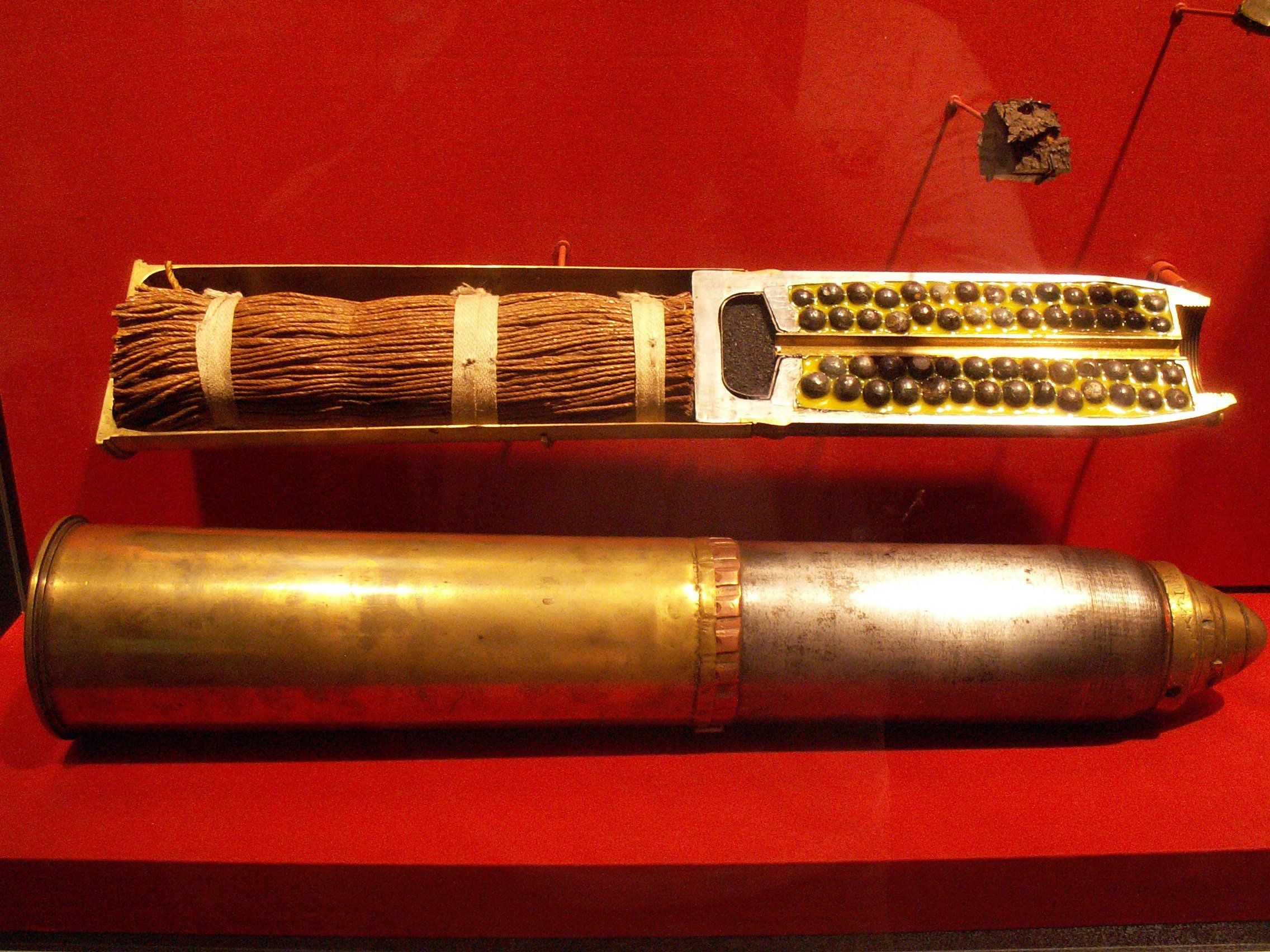
https://nfknowledge.org/wp-content/uploads/2017/09/2573.jpg

vs

https://en.m.wikipedia.org/wiki/Bofors/Nexter_Bonus

Just wait until we see what China can produce for a war
I'm very curious actually, especially after seeing how the 2nd largest army in the world is performing in Ukraine
China has been supplying the entire world with basically all of modern industrial goods. They have over 10x Russia's industry.

Anyone who draws China into a prolonged conflict is too dumb to live.

> Anyone who draws China into a prolonged conflict is too dumb to live

On land. Attacking Taiwan necessitates combined-arms warfare.

Add about two zeros to what the West collectively can build.
Pouring cement will always be easier/cheaper than maintaining an ever increasingly expensive army...

Imagine the amount of wasted resources and man hours it would have required to keep France world war ready since 1945

If there is an actual threat the response will be nuclear, that's the whole point of having nuclear submarines deployed 24/7. For regular military operations we have quite good intel services and projection forces

> 10 or 20 per year hardly amounts to squat.

Yes, before this war I never realised that our (western) military production is a joke. I am very disturbed that we cannot outproduce Russia despite having 20x their military budget.

People who say that the West could produce more if it was really pressed - well so could Russia, people are still driving BMWs and having parties, they have not mobilised the way the British have during WW2. I think it's dangerous to believe that we could magic capabilities out of thin air when it really counts.

The way we do contracts is a clownshow - UK has ordered more NLAWS and they will take two years to deliver.

Meanwhile in the Vietnam war, USA lost 10,000 combat aircraft, more than currently exist in all of western world combined. I cannot explain this in any way other than the system being rife with waste and abuse.

Not unlike with vaccines, massive production ramp ups are possible once the suppliers know that they aren't carrying any significant risk of losing a lot of money for overbuilding capacity.

As some of us learned in the pandemic, increases in production capacity that are not going to be long term will get your company hobbled, if not downright bankrupted if you overproduce. See what happened to anyone that assumed the demand for exercise equipment for the home was going to be long lived.

When looking at this kind of problems, it's always either regulation or incentives.. and here it isn't regulation, so it's all incentives.

The Maginot line in France has become synonymous with a useless measure of defence providing a false sense of security though.

It's a combination of several things.

First military hardware is a lot more expensive. A ww2 tank was a big piece of iron with a diesel engine in it, a modern tank has a ton more tech, all produced in small series (imagine the cost of the iphone if only 1000 were manufactured a year). That's even worst for planes. You can't line up an army on the scale of ww2 armies. And since the EU can't agree on single plane or tank design anyway, the volumes for each device are tiny and design/fixed costs hugely expensive to amortise.

Then you have socialist or quasi-socialist governments all over Europe, in France in particular, but even in the UK, slashing military budgets to launch big redistribution programs, along with building up big bureaucracies since the 80s. Government spending managed to go up as the share of military spending and other basic services (police, justice) went down. The problem with benefits is that people come to rely on them and then it becomes politically impossible to cut them back (same thing in the US), unless you have a Thatcher, but there is none on the horizon. So basically now these countries are stuck and have zero wriggle room even to face imminent danger.

That's the cost of free riding on US military spending for half a century. If an elected Trump walks away from both Ukraine and NATO, Putin will have free reign to bully the other missing pieces of his russian empire (moldavia, baltic states, even poland). And there will be little a country like France will be able to do with its small military samples. Its army was seized to bomb terrorist camps in Africa and nuke an invader. They have nothing in between.

>The Maginot line in France has become synonymous with a useless measure of defence providing a false sense of security though.

... which has absolutely nothing to do with bell-cot's point in invoking it as a counterexample to France's current production ability.

Even re production. It's only a massive piece of concrete. France is still good at pouring massive amonts of concrete, that's what all of its suburbs are made of. The line was not exactly a marvel of engineering even for the time (and neither forward looking).