Hacker News new | ask | show | jobs
by kdklol 886 days ago
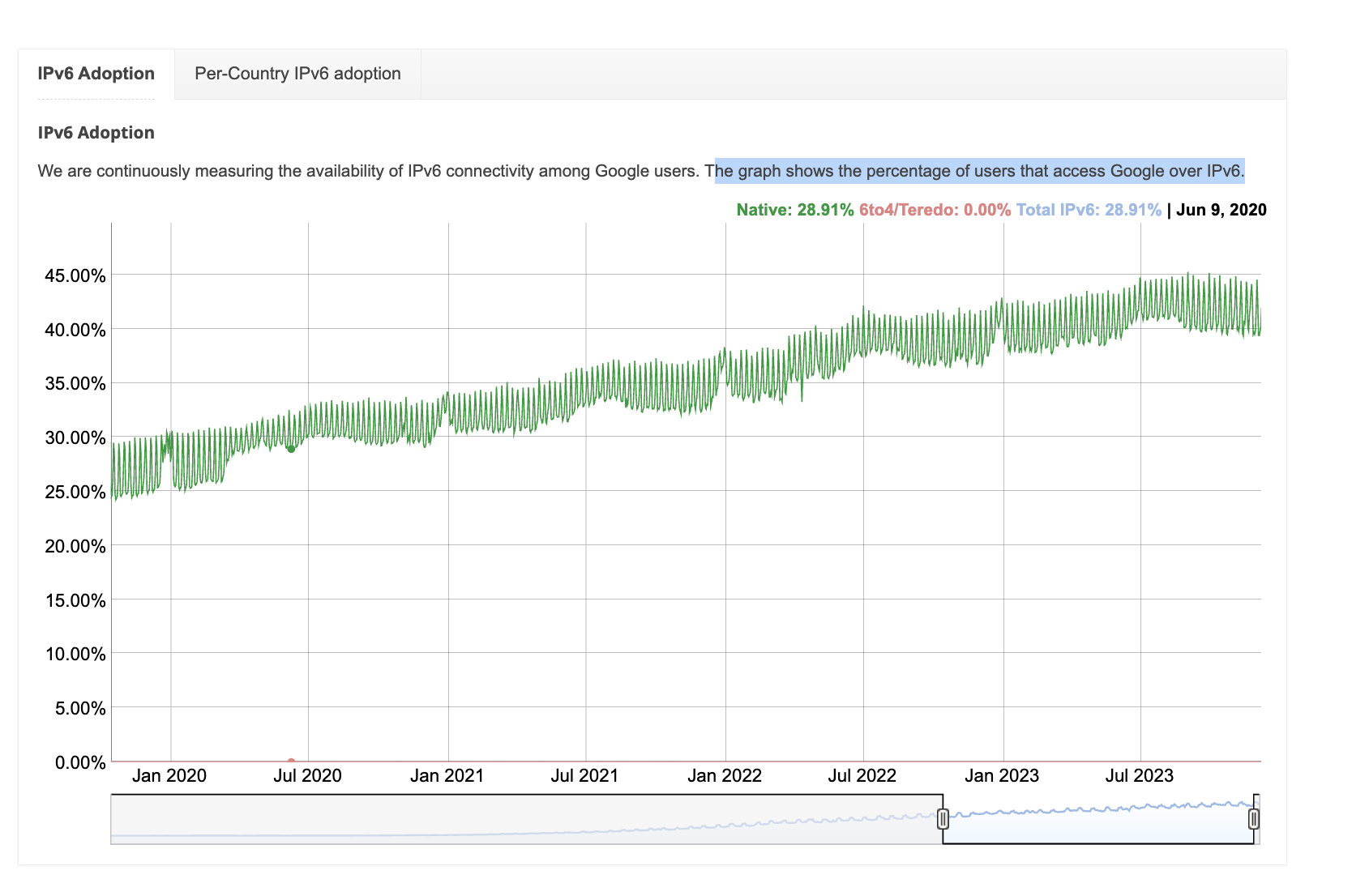
Realistically, you should sell it while it's valuable. Take a look at IPv6 adoption. I know, I know, "IPv6 will never be here blah blah blah", so the naysayers say, but look at what Google is getting now, for instance:

https://www.google.com/intl/en/ipv6/statistics.html

We're counting down the years before IPv6 will become the major protocol, after which, IPv4 addresses will slowly start to loose value.

"But it's only FAANG, noone else has IPv6!" Just not the case anymore. But even if, most people don't care about anything else anyway. I have a friend who helps to operate a university dorm network. Allegedly, he once removed an IPv4 address by mistake from one student's computer. He only heard about it half a year later, when the student casually mentioned that only Google, Facebook and other big sites seem to work. Apparently, if Google, Facebook, and the School's website works, it's acceptable to most (which is sad for different reasons, but that's not my point).

Anyway, that's still at least a few years away though, you can have some fun with it for now :)

3 comments

> Allegedly, he once removed an IPv4 address by mistake from one student's computer. He only heard about it half a year later, when the student casually mentioned that only Google, Facebook and other big sites seem to work. Apparently, if Google, Facebook, and the School's website works, it's acceptable to most (which is sad for different reasons, but that's not my point).

The fact that the "sad part" is that the student only uses big tech websites and not that this netop was able to do something like this with no alerting or guardrails says a lot about HN's culture these days.

In general I wonder what kind of alerting these dorm ISPs run. Do they ever do reachability tests for devices on their network?

Some university networks are run tightly, others are rather loose when it comes to security, monitoring and debugging network cables that are syncing up at lower speeds. Really depends on who is staffing the IT team...

Many older universities give you a public IPv4 address with no NAT when you plug into a network port.

OP, one neat thing you should try is broadcasting a /25 through /29 and seeing which ISPs this is routable from (eg: Lumen (aka Centurylink/Quantum), Verizon, T-Mobile, AT&T, Comcast, etc). There are a number of blocks smaller than /24's being broadcast, and it would be quite interesting to see which ISPs are willing to route traffic to smaller blocks.

There's a management system that assigns IPs automatically, written in-house in the late 2000s, but yes, anything there can be manually overridden. He was probably diagnosing something earlier and forgot to clean up. Meanwhile, new students moved in I guess.

Missing IPv4 addresses are not reported as some systems are left IPv6-only intentionally. It's a dorm network, but it's sort-of a research project at the same time. It is also run by students themselves (there's a "student's union") and the school does not pay or maintain the dorm's infrastructure.

I know alerting is done for some things, but not for the individual student's machine. This is different for every dorm, but in this case, a wired symmetrical gigabit connection is provided to every member student, public IPv4 and IPv6 included. The only restriction is to not download torrents, besides that, pretty much anything can be arranged, including opening port 25, routing additional IPv6 prefixes, hosting...

It's a very free environment is what I'm getting at.

Why is this data so spikey[1]?

Are the spikes in IP6 usage driven by work, home or mobile?

[1] https://files.littlebird.com.au/Shared-Image-2024-01-13-12-0...

Good question! It's spiking up on weekends, the reason for that is that corporate networks are not as incentivized as large public ISPs to adopt IPv6. They have a lot more customers and are more directly affected by IPv4 exhaustion, especially the mobile providers.
Interestingly enough if you zoom in you'll notice that all the tips of the spikes are Saturdays.
I'd guess work VPNs don't implement IPv6 (why would they, if they only need to share 1 IPv4), which results to home internet usage being higher on the weekends.
> the student casually mentioned that only Google, Facebook and other big sites seem to work

tragic :sob: