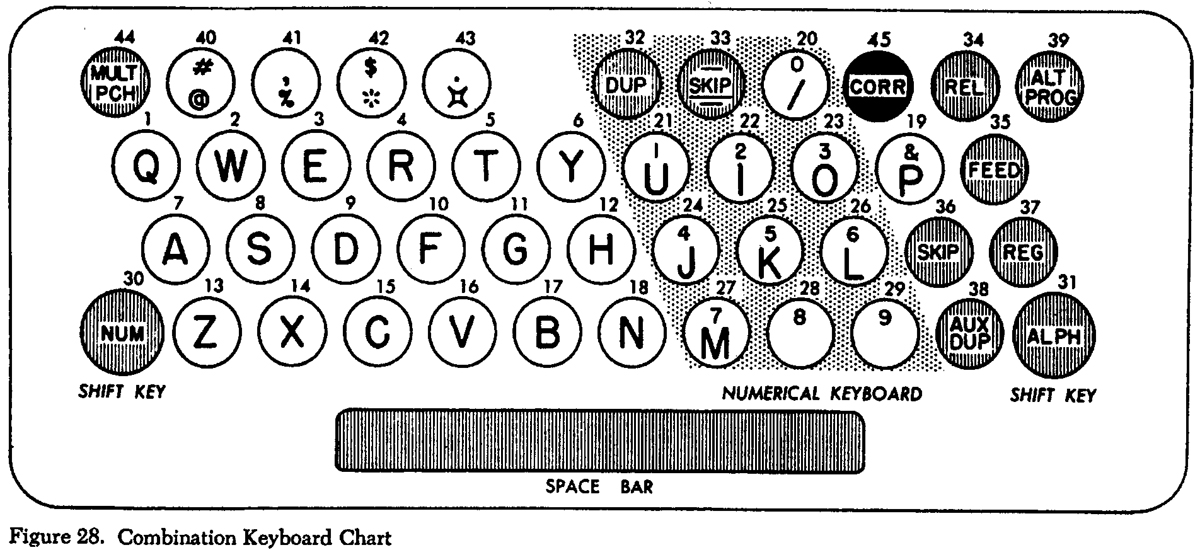
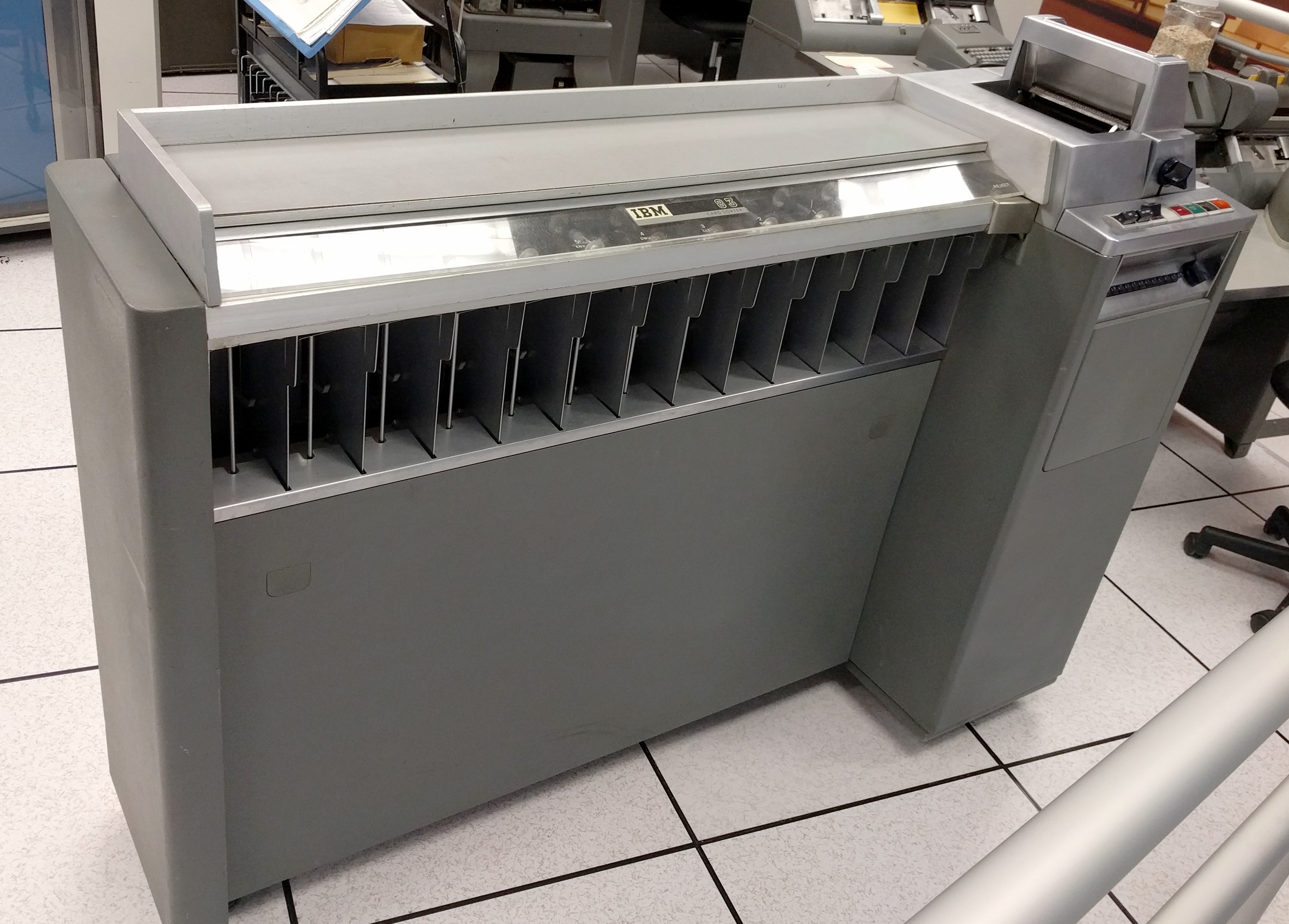
| I started programming around 1967-1968. In my high school, there was an old keypunch machine used for school administration purposes. I had a friend that was able to submit any program I keypunched to the school district's IBM computer; I never saw the computer but it's likely that it was something like an IBM 1130. My my friend would bring the output back a couple of days later; so fixing even one typo required a few days. This old keypunch machine was a model 026, not the much nicer model 029 that was ubiquitous while I was in college. The 026 had a very basic keyboard, see [1], one could punch the columnar code for the upper case letters and numerals along with a handful of symbols: #@,%$./ and space. This isn't enough to even program in early FORTRAN, the language I was trying to use. To type say an equals sign one had to use the multi-punch key that allowed punching a combination of the basic symbols that would properly encode the equals sign. It was slow going. One mistake and the card (corresponding to a line of code) was ruined and had to be redone. I had just finished reading a book on solving linear programming problems, which come up often in operations research, using the simplex algorithm (I still have this book too). Naturally, I decided that that would be the first program I ever wrote. That definitely wasn't the best "hello world" program to try first. I wish I still had a listing of that program; it would be good for a few laughs. The first working program I wrote printed out a table of sine and cosine values for angles from 0 to 90 degrees. The rest of my programs in high school were not much more sophisticated. I was just trying to learn it on my own as a hobby. I still own my book on Fortran that I bought with my newspaper route income back then, McCracken's book on Fortran IV [2]. A couple of years later I got to write more serious programs and used the IBM 029 keypunch machines that were a lot better. Programs got long enough (hundreds of lines!!) that card management became important. Sturdy cardboard boxes or even long metal drawers designed for holding the stacks of cards were the main tool for source code management. In college, I was able to use IBM's data processing equipment for punching line numbers in columns 73-80 on each card (these columns are ignored by FORTRAN IV); this allowed dropped cards to be sorted back into order through a series of passes (one for each digit of line number) on IBM card sorting machines. This was my introduction to radix sorting, [3]. One complication when numbering cards was inserted new code between existing cards. Because of this, my initial punching of line numbers in columns 73-80 had to be done with gaps, usually I'd leave one or two zeros at the end of each card number. However, to get the auto numbering machine to do this required pulling out a large (1 foot square) plug board from the equipment and physically connecting jacks with switchboard like cables to make the equipment count by hundreds and punch in columns 73 through 80. It was all quite primitive. But one did learn to review code carefully before submitting it for being run. Grad school was better, I still frequently used FORTRAN punched on cards, but I was also able to use the mainframe in a timesharing environment where I used TECO as my text editor at a terminal, there must have been around twenty of these terminals connected to the CDC 6400, [4]. [1] http://www.columbia.edu/cu/computinghistory/026-keyboard.jpg [2] https://archive.org/details/guidetofortraniv00mccr [3] https://ibm-1401.info/KensSorter/type83-a.jpg [4] http://www.bitsavers.org/pdf/cdc/cyber/cyber_70/kronos/60407... |