Hacker News new | ask | show | jobs
by wannacboatmovie 967 days ago
EFI config screens should be text mode only, full-stop. So they can easily be used over serial console redirection.

Ran into one recently that was high-rez graphical. It needed a USB mouse to change critical settings because the tab order for the onscreen widgets didn't work.

Anyone responsible for creating graphical EFI config screens should stop writing software for the good of humanity.

7 comments

Text-only BIOS setup was the norm for a long time before the stupidly bloated EFI graphical stuff became common. Even then, there were the better full-featured TUIs:

https://upload.wikimedia.org/wikipedia/commons/0/05/Award_BI...

https://liveusb.files.wordpress.com/2010/05/awardbios-firstb...

And the simplified crap with tabs that often came with prebuilt PCs but later seems to have spread to others too:

https://cdn.staticneo.com/a/Intel_Sandy_Bridge_Z68_P67/S%20B...

To my horror, I recently had to visit the UEFI firmware setup of a Lenovo tablet.... That was touch enabled.
And it is to be expected to be able to configure a touchscreen device using the touchscreen.
Most gaming laptops' UEFI screens are so "gamer" it's cringe. Dell XPS series have UEFI GUIs that are quite neat and absolutely an improvement over the text screens.
I'm also partial to the Surface devices'. MS put a surprising amount of effort into making them look Windows-y.
I did enjoy my Dell touchscreen-supported firmware setup when there was a menu 15 items long and an incredibly slow mouse speed.
> Text-only BIOS setup was the norm for a long time

Long-time Thinkpad users scoff at that ... while the figure of a duck suddenly enters their minds..

(Yes: I clearly remember my pre-USB thinkpad having a graphical BIOS with windows, icons, and a duck-shaped mouse cursor).

For those who haven't seen it: https://www.youtube.com/watch?v=XTaNi6uL41s

BIOSes of the time were all written in highly-optimised Asm, and I suspect those little "easter eggs" they added were because the programmers knew they had enough space left over to put some more fun stuff in.

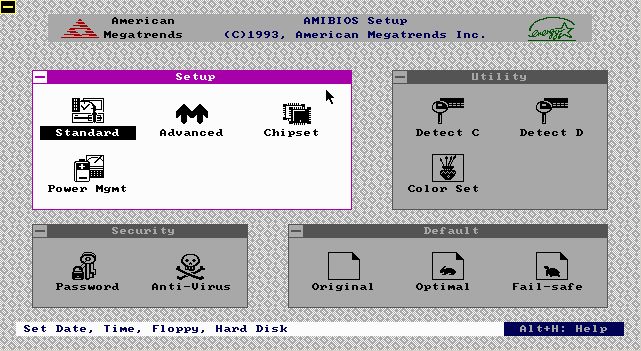
There was also AMI WinBIOS that provided a GUI, but I remember it being much less featureful than other BIOSes of the time with a TUI and didn't like mobos that used it, so in that case they may have sacrificed functionality for appearance.

I miss Openboot firmware that was on SunOS servers and workstations. It was IIRC mostly written in FORTH and we could write forth snippets at the serial console to make mods / query the pre boot environment. I also found the SGI boot firmware similarly functional. Both allowed changing boot settings and allowed to boot from network without any trouble at all. Graphical BIOS that came with the x86 systems was such a downgrade for us especially since you could not interact over serial/remotely with a simple terminal connection. IMHO
Is there also a term for when you present mangagers or clients with an array of options and intentionally degrade the ones that in your opinion would come out worse? Asking as a graphic who would never ask someone to pick the best of three pitches while alreading harboring a strong preference.
A 90's TUI that will forever be more productive than Windows 11.
As someone with experience in Turbo Vision and Clipper, I don't miss them, beyond some nostalgia from simpler times.
> Text-only BIOS setup was the norm for a long time

I've had a GUI BIOS setup on almost every PC I've owned since the first 486 I built back in 1993.

The GUI was rendered in text mode. It's called a TUI (Text-based User Interface)
Plenty of 486 era machines had the AMI ”WinBIOS” whose setup utility kinda-sorta emulated a Win 3.x look and ran in (EGA 640x350 4bpp?) graphics mode, with mouse support:

https://media.moddb.com/images/groups/1/4/3107/winbios.gif

TIL, I thought TUI meant Terminal UI
You know what's funny?

UEFI actually lets you provide both touchscreen-capable bells&whistles gui, and a text UI for the frankenstein VT-UTF8 standard (essentially, VT-220 compatible with UTF-8, kinda like linux console) - all in mostly one codebase.

There's a standard UI description language which is used to specify menus, options and values (and how they are written into nvram), which is then interpreted by text mode interface driver (enabled when you connect over serial port) and graphic mode interface driver (where you can drop all sorts of graphical bells & whistles).

It's also how you can integrate menus from add-on cards into firmware setup.

Text UIs don’t actually require different resolution and refresh rates. Even Macs can boot into a text mode, but there’s no jarring mode-change flicker when it switches in and out of it!

Besides, there’s nothing to prevent you having a nice graphical boot configuration while still having a text version as a fallback (which is exactly what Intel Macs do)

Even for text-only I’d prefer native rez if possible to reduce scrolling, label truncation, etc.

That said yes, there’s no reason why there shouldn’t be a low rez textual fallback.

Then you'd need scaling and all that. Seems a bit overkill for something people rarely use.
scaling? nah, I'd say to just choose at runtime a sane text size (only to avoid using the same pixel size on a 1024x768 as a 5k screen) and set the number of rows and columns to fit the screen. Even if there isn't enough to fill the screen that's fine.

> Seems a bit overkill for something people rarely use.

Okay, but a lot less so than a full GUI with mouse and thousands of colors, like many motherboards have gone to.

The "sane text size" is naturally going to be the 80x25 text mode (720x400) which is what those config screens were originally defined for. Monitors will usually upscale lower resolutions anyway.
I think the rest of the PC industry could use some of the "paint the back of the fence" mentality that apple has; as of right now, many aspects of PCs off of the happy path are ugly as shit
It’s not even that Apple paints the back of the fence. Apple does not have a BIOS or a UEFI or now iBoot screen at all! They made sure not to have a fence at all.

You’re either in macOS or booted in its recovery partition.

Real boot loaders have embedded Forth interpreters!
Do Macs still have this?
No, it stopped for the Intel switch, I believe.
Yeah, the Open Firmware preboot Forth console was a PowerPC only thing.

Now Apple’s bootloader is actually a tiny macOS. As much as I don’t like the complexity this brings, I do strongly approve of a boot environment that supports proper input devices and video. My iMac Pro’s (intel, non-macOS-based bootloader) bootloader drops keyboard inputs when typing my long passphrase because I type too fast for it. The Mx macs no longer have this problem.

And the nearly indestructible protection that DFU brings.
Upside though? I was helping a more software-oriented buddy get a PC build up and running that'd been half-finished by some kid he paid to put it together. The GUI on the EFI config was so intense, it was slowing down and completely locking up.

Got into the temps, realized that the CPU fan had been plugged into an AUX fan header instead of the CPU header.

Fan was spinning, wouldn't have thought to check if the EFI wasn't crashing.

I'm completely joking of course. I completely agree with you, I miss text-only mode. The modern Dell one stinks, the Asus one stinks...I have no data, but I'd be shocked if Gigabyte or ASRock were any good... :(

Text mode on my 8K monitor at any time, even in boot, is dumb and annoying and anachronistic. It’s 2023.