Hacker News new | ask | show | jobs
by zlsa 978 days ago
4. Yes, all USB-C to USB-C cables can charge at a minimum of 60W which should be sufficient to charge almost anything

5. It depends, but the output capacity is printed on the power supply[0]. (Compare to USB-A, where the most you could do is 12W.)

6. The minimum of the cable (60W for any cable, 100W for some cables, 240W for a very few[1]) and the charger

[0] Annoyingly, this problem is compounded when using a power supply that can output (say) 100W on one USB-C port, but when both are used, the limit on the two ports is 60W / 40W.

[1] There are vanishingly few products (power supplies, cables, and devices) that support USB EPR. If you have one of these, just use the power supply and cable the device came with; this is no worse a situation than with devices that used proprietary power cables.

2 comments

That’s incorrect on all three counts.

Some “low wattage” specification USB-C devices are compliant with USB-C but are only compatible with USB-A power bricks because thet require 5V:

https://www.reddit.com/r/UsbCHardware/comments/c3q4s6/why_do...

Some USB-C cables are only 31 watts, and some devices can’t charge with less than 60W:

https://www.macworld.com/article/234030/how-to-tell-whether-...

Example brands from the above two links include JBL, Schooshe, and Apple.

I’ve hit similar problems with all my USB-C devices.

> Some “low wattage” specification USB-C devices are compliant with USB-C but are only compatible with USB-A power bricks because thet require 5V:

This is because they are not USB-C compliant, despite physically featuring a USB-C port. The USB-C spec calls for any USB-C sink (i.e. device that consumes power) to include a pull-down resistor (Rd in the diagram on page 4: https://www.ti.com/lit/wp/slyy109b/slyy109b.pdf?ts=169690039...)

Devices that do not include this resistor, and are therefore unable to be powered with a USB-C to USB-C cable, are noncompliant and should not exist.

> Some USB-C cables are only 31 watts, and some devices can’t charge with less than 60W

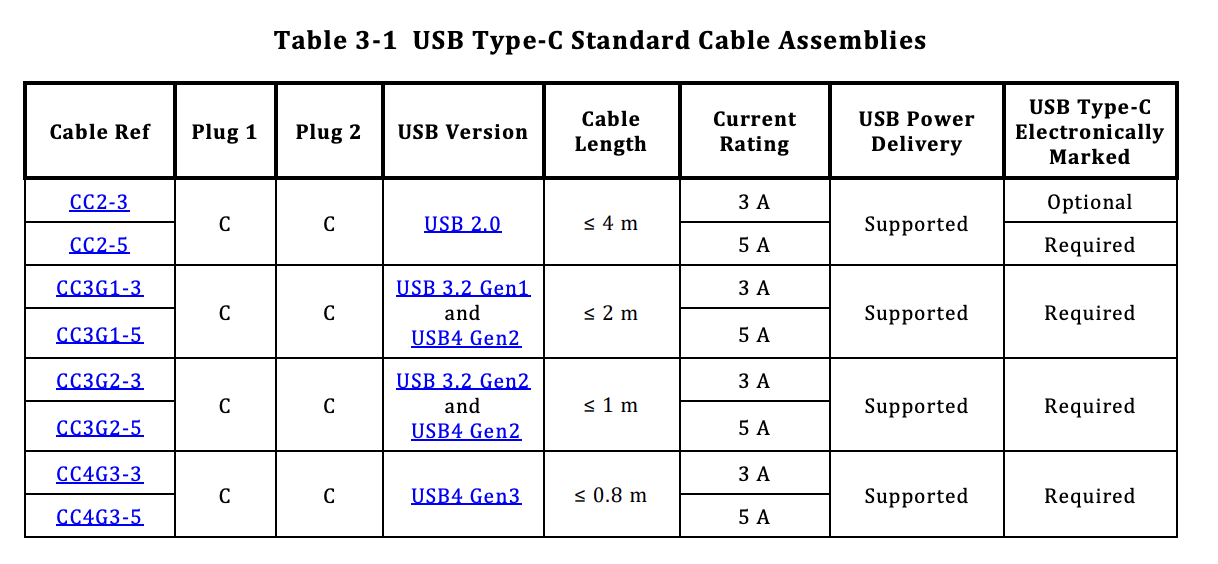
As seen in [0], page 37, even USB 2.0 C-to-C cables will support USB-PD at 3A: https://host.zlsadesign.com/HJU_Drfba.png

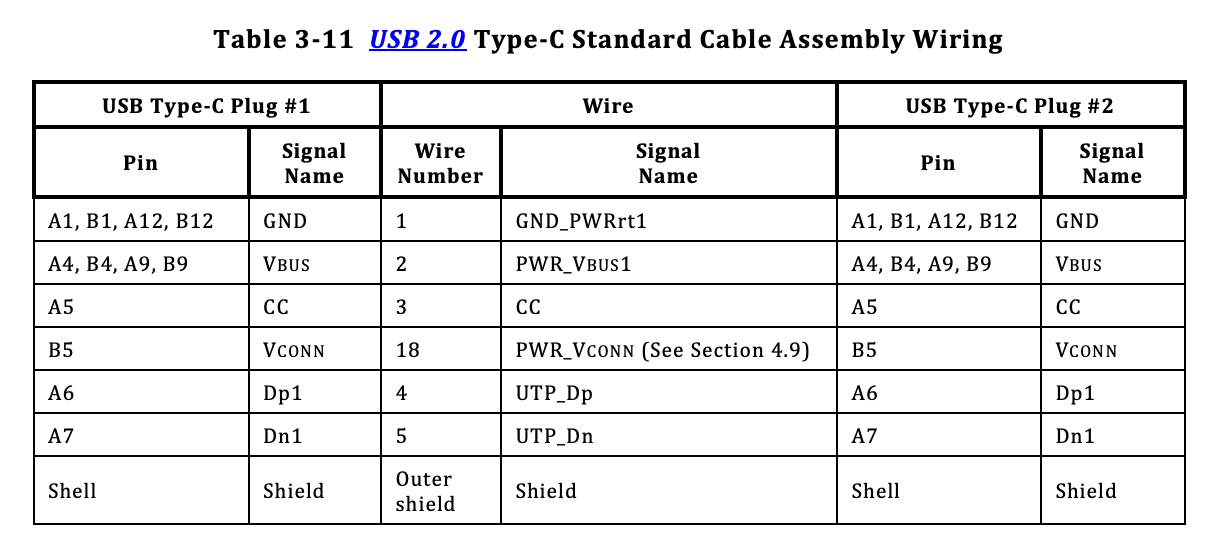
The USB-PD handshake is performed independently of the cable, and uses the CC wire that is mandatory even in USB 2.0 C-to-C cables (page 76 of [0]): https://host.zlsadesign.com/Bk62vSMZp.png

You're right about the 60W point. Anecdotally, every device I've ever tried to charge has had no problems at 60W (although of course they'll charge more slowly than if they had 100W), but this is definitely not guaranteed.

0: https://www.usb.org/sites/default/files/USB%20Type-C%20Spec%...

And your Reddit link also has a comment suggesting using a USB A to USB C adapter. Those are also non compliant

https://hackaday.com/2022/12/27/all-about-usb-c-illegal-adap...

There is a certain combination of cable+adapter+device that can ruin your device. I don’t remember the details. I heard about it on the Accidental Tech Podcast

4) A USB 2 cable with USB-C in both ends can't 60W.
According to the USB-C spec page 37[0], even USB 2.0 C-to-C cables will support USB-PD at 3A (negotiated with the CC wire which is mandatory even on 2.0 C-to-C cables.)

0: https://www.usb.org/sites/default/files/USB%20Type-C%20Spec%...

And this is kind of the point, if HN commenters can’t figure this stuff out, what are the chances that normal people can?

Speaking of which, every time I ask the question about “tell me just from looking at a USB C cord…”, I learn something new.

> if HN commenters can’t figure this stuff out, what are the chances that normal people can?

Plugging it in would probably be a good start. I can't name a single time where I've ever mistakenly identified a USB-C cable. Sometimes I've plugged it in when it wasn't connected to the wall, but I think worrying about non-compliant USB-C cables is no more relevant than caring about non-MFI certified Lightning cables.

Until you take a USB C cable with you in your laptop bag to connect with your portable USB C external monitor that gets power and video from one USB C cable and find out you have the wrong USB C cable with you.
Hate to say it, but it's entirely PEBCAK to not select a Thunderbolt cable when they want DisplayPort alt-mode. It's why the damn cable and marketing even exists in the first place.

99% of people only care about power (and optionally data), so that's what the spec focuses on.

And you’re also proving my point. You don’t need a thunderbolt cable to supper video out….