The author keeps asserting the "inherent weakness" of steel-on-steel railways; however, there are very good reasons it has been settled on as a good choice. Friction and sound losses are generally minimized, thanks to a very small contact surface and smooth, hard materials with little give; wheels can be re-machined back into spec a couple times rather than being replaced; rails can be re-used for lower-speed applications when worn; unlike pneumatic tires, steel can be machine into conical, self-centering, turn-adapting geometries with fixed axles and no need for differentials; the list continues and is quite long. Apparently, a recent change to wheel geometry reduced wear and extended lifetime by as much as 40%.
Imagine what airplanes would look like if we wanted to build them to survive a crash...
I'm also a little unclear how humans could survive a 100mph crash even if their container makes it through. If they were wearing a 4-point harness, I guess? Do they build crumple zones into train cars? Or... just rely on utterly demolishing anything they hit so the deceleration is kept under control? (https://www.reddit.com/r/BitchImATrain/)
You really don't want to see what a 90mph crash in a bus looks like. It ain't pretty. Those speeds are unreasonable for a bus, but common on commuter rail in many civilized places.
There was also a design with a layer of rubber between an inner steel wheel and a thin outer steel tire.
That was used by high speed trains in Germany - until one of the steel tires broke at 300 kilometers per hour and got stuck in a switch, causing the train to detail and hit the support column of an overpass, which collapsed on top of the train. 101 people dead: https://en.wikipedia.org/wiki/Eschede_train_disaster
I heard that in this story the managers took a ride on train at high speed and wanted it to be smoother/quieter and that these wheels with rubber would do that, but the engineers said it was a bad idea but were overruled - at least until the tragedy.
There was a documentary about it but I can't find the link.
> a comparable carriage fitted with pneumatic tyres could need as many as 20 wheels.
How does a bus get by with far fewer wheels?
I think the answer is that they are still building with the same weight as a train, rather than a bus.
That points out an unexplored engineering envelope for modern trains, made possible by newer technologies:
* Very light trains. Think lighter than road cars, since they don't need crumple zones or crash worthiness.
* Virtual coupling. Basically platooning on rails. Now the cars need to at most push/tow one other disabled car, so they don't need a beefy chassis to support towing long trains, coupling forces, etc.
* Homogenous cars. They all have traction motors, small batteries and sensors and compute. Think a low-range Tesla on rails.
* Autonomous control. Self-driving on rails. No operator cab. Since the train is now quite light, with a reasonable stopping distance, obstructions on the track can be potentially avoided so long as the sensors are adequate.
* Much faster acceleration and deceleration. With leaning, they could also corner faster.
* Probably intrinsically quieter, but now pneumatic tires would probably have reasonable life.
> Very light trains. Think lighter than road cars, since they don't need crumple zones or crash worthiness.
Crashes involving light rail are common in urban areas, because the trains share streets with cars. I don't see that going away as long as human-driven cars are allowed. And because passengers are often standing, the trains must be heavy to improve passenger safety in crash situations.
> Virtual coupling. Basically platooning on rails.
Modern designs typically have very long cars, with only 1, 2, or rarely 3 cars in a train. Longer cars increase passenger capacity and improve space utilization, because passengers can move around freely. They also allow busy passengers save some time by exiting from the right end of the train.
> Much faster acceleration and deceleration. With leaning, they could also corner faster.
Urban trains already limit acceleration and deceleration to improve passenger safety and comfort. Long-distance trains with sitting passengers and grade separation are another matter.
> Crashes involving light rail are common in urban areas,
That's a good point. That doesn't mean that trains need to be as heavy as they are, though. Having a crumple zone and weighing 3x of non-commercial road vehicles would still be quite a bit lighter, and would provide safety.
> Modern designs typically have very long cars
I live in Switzerland, and it's common to have train combinations that are very long here, even with long cars.
> limit acceleration and deceleration
There are limits, of course, but they can be relatively high if you strictly control "jerk". That's where computer control comes into play, as it requires high driver skill to stop the train at the right position while limiting jerk.
> I think the answer is that they are still building with the same weight as a train, rather than a bus.
  A non-trivial part of this difference is that train cars are generally bigger
  than a bus. Light rail is generally more bus sized and they are generally
  closer in weight (though still heavier).
> * Homogenous cars. They all have traction motors
Electric passenger rail systems generally already use EMUs which have a power unit per-car or per pair of cars.
> small batteries
I'm not sure how you're going to have a small battery in a bus-sized vehicle that needs to operate fairly continuously for a good portion of the day unless this is on a partially electrified ROW. EMUs with smaller batteries to serve such routes already exist FWIW.
I think there's a reasonable case to be made to adjust US passenger rail regulations to allow lighter cars (especially in the context of high-speed rail), but allowing pneumatic tires seems like a poor motivation for it.
A non-trivial part of this difference is that train cars are generally bigger
than a bus. Light rail is generally more bus sized and they are generally
closer in weight (though still heavier).
Muni's articulated streetcars weigh about 100,000 lbs each while typically the max weight for a laden tractor trailer is around 80,000 lbs. Light rail is a marketing term, not indicative of the actual weight.
Not sure where you're getting the 100k lbs figure from. The Siemens S200 LRVs are supposedly 76k lbs as deployed in SF. Traditional "heavy" rail EMUs often exceed 100k pounds per car (Kawasaki M8s used by Metro North range from 97k to 144k lbs). The unarticulated New Flyer XT40 trolley buses that Muni also uses are only about 32k lbs by comparison, but they're only 40 feet long whereas the S200 LRV is 75 feet long. The articulated XT60s (60 feet long) would be a better point of comparison, but I can't find a weight for those.
SFMTA is saying 80,000lbs for the LRV2/3 and 78,000lbs for the LRV4 – I rounded it up to 100,000 because the last time I thought about their weight was when they were new (and their weight as a point of ire). Breda over promised and underdelivered and the LRV2s were quite a bit heavier than expected prompting a lot of teeth gnashing (and eventually a lawsuit if memory serves) from residents. Wikipedia pegs the New Flyers at about 45,000 lbs. BART's cars were in the 50,000 lb range due to their extensive use of aluminum.
Trains are heavy and often operate at faster speeds than buses, that's why they can get away with relatively few axles.
Train crash worthiness is quite an interesting topic. Important to remember is that trains carry hundreds of people. So a crash involving a single train carriage can easily become a catastrophe.
Excellent ideas. In the US, metropolitan rail transit systems need a dramatic reimagining. They are expensive, slow, and often crime ridden. Would love to see their right of way put to better use.
We should rip out the train tracks, put down asphalt, and convert them to car tunnels, but to be used only by people driving one specific brand of car.
You joke, but a dedicated lane for self driving vehicles (either privately or publicly owned) could be lower cost and better utilization of the resources.
AFAIK, basically all French subway systems opened after the 1960s use this system.
This is one of the things I strongly associate with Paris: the slight smell of burned rubber when you enter a Métro station of a line with rubber tires.
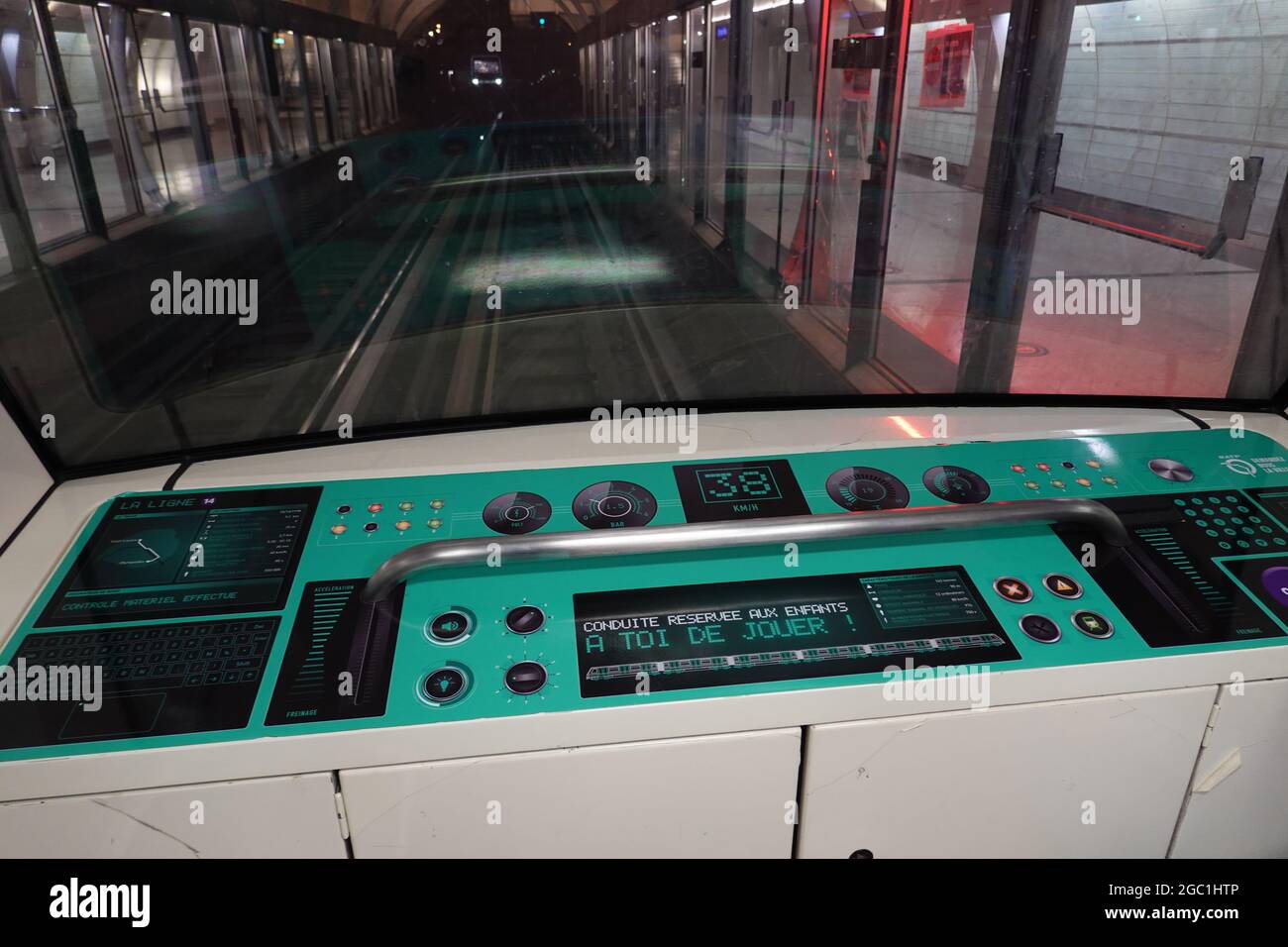
Pro tip for Paris visitors with children: ride with one of the automated lines 1, 4 or 14, and enter through the very first door. There is a fake (printed) control panel for children below the front window [0].
The reason why metros on tires is a thing is that they used to have much better acceleration/breaking characteristics than rails, which is good for metros since you can cram more trains in the same lines this way.
I said “used to” because, from what I understood, the development of ABS made breaking characteristics of traditional trains much better than before, which reduces the improvement you get with tires.
(Don't quote me on that though, I got this from a coffee machine discussion with a former metro driver when I was working for RATP 10 years ago so my memory may not be 100% accurate at this point)
Half right. The limit at this point is much more do with what (likely standing, possibly not even holding on) people can tolerate, not what the device is physically capable of generating.
Both BART and Muni had problems with the service brakes on their new trains flat spotting the wheels – apparently it's still not quite as much a solved problem as it should be. BART especially tends to run their trains with out of round wheels – almost certainly not helped by running aluminum wheels.
Exactly. After initial testing of the rubber tires in the 70ies, RATP quickly decided to not use the full acceleration/breaking potential of the rubber tires, because it was very uncomfortable for passengers.
True, though emergency braking isn't entirely subject to these limitations.
At least for tramways I know for sure[1] that the tram will happily have you break your arm inside the tram because it braked too strong in case of emergency rather than crushing a pedestrian that crossed in front without paying attention.
Maybe the rules are different for metros though, given that there aren't as many pedestrian on the way…
[1] because I got the information from the system design team of a big tramway manufacturer I worked with no later than last year so my memory is much fresher, and the source is more reliable.
Muni reduced the emergency braking force back in 2008–2009 or so, because, yes people were getting injured (and given how frequent EB applications were back then…). You can definitely achieve sufficient braking without having to violently throw people to the ground.
So does Taipei's Wenhu line (https://en.wikipedia.org/wiki/Wenhu_line) which was built by a French consortium in the 90s (Matra IIRC). Construction disputes were epic but it seems to operate very smoothly now. The other lines in the system are rail-based.
Ten of the lines are rubber-tired. Instead of traditional steel wheels, they use pneumatic traction, which is quieter and rides smoother in Mexico City's unstable soils. The system survived the 1985 Mexico City earthquake.
Can somebody explain to me the difference between this „short lived experience“ and the actual ongoing decades long operations of tire based metro/subway systems?
See Practical Engineering's latest video: https://www.youtube.com/watch?v=Nteyw40i9So